
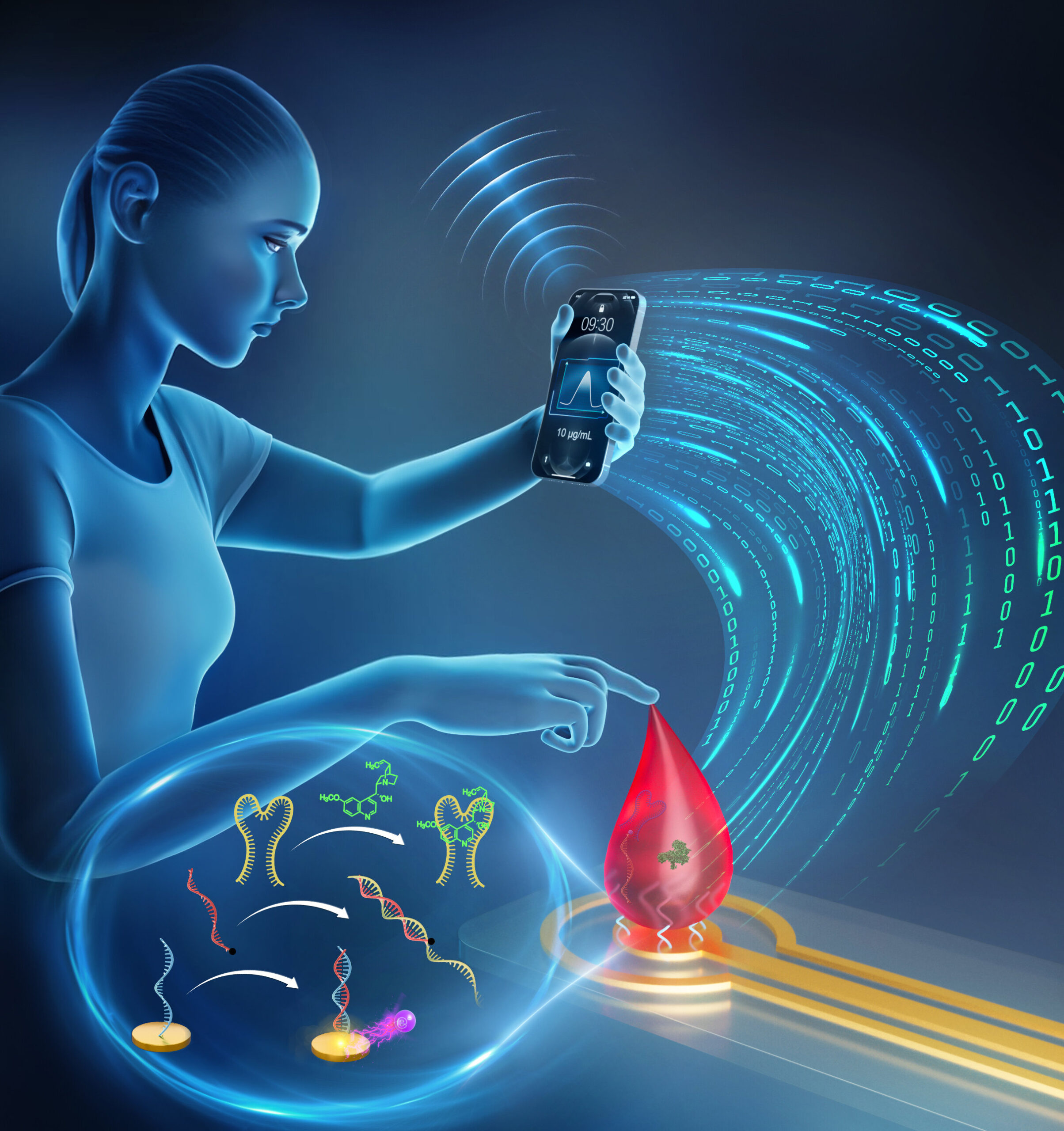
Chemists at Université de Montréal have developed “signaling cascades” made with DNA molecules to report and quantify the concentration of various molecules in a drop of blood, all within five minutes.
Their findings, validated by experiments on mice, are published in the Journal of the American Chemical Society, and may aid efforts to build point-of-care devices for monitoring and optimizing the treatment of various diseases.
This result was achieved by a research group led by UdeM chemistry professor Alexis Vallée-Bélisle.
“One of the key factors in successfully treating various diseases is to provide and maintain a therapeutic drug dosage throughout treatment,” he said. “Sub-optimal therapeutic exposure reduces efficiency and typically leads to drug resistance, while overexposure increases side effects.”
Maintaining the right concentration of drugs in the blood remains, however, a major challenge in modern medicine. Since each patient has a distinct pharmacokinetic profile, the concentration of medications in their blood varies significantly. In chemotherapy, for example, many cancer patients do not get the optimal dosage of drugs, and few or no tests are currently rapid enough to flag this issue.
“Easy-to-perform tests could make therapeutic drug monitoring more widely available and enable more personalized treatments,” said Vincent De Guire, a clinical biochemist at the UdeM-affiliated Maisonneuve-Rosemont Hospital and chair of the Working Group on Laboratory Errors and Patient Safety of the International Federation of Clinical Chemistry and Laboratory Medicine.
“A connected solution, similar to a glucometer in terms of portability, affordability, and accuracy, that would measure drug concentrations at the right time and transmit the results directly to the health care team, would ensure that patients receive the optimal dose that maximizes their chances of recovery,” De Guire said in an independent assessment of the study.
Holder of a Canada Research Chair in Bioengineering and Bio-nanotechnology, Vallée-Bélisle has spent many years exploring how biological systems monitor the concentration of molecules in their surroundings in real time.
The breakthrough with this new technology came by observing how cells detect and quantify the concentration of molecules in their surroundings.
“Cells have developed nanoscale ‘signaling cascades’ made of biomolecules that are programmed to interact together to activate specific cellular activities in the presence of specific amounts of external stimuli or molecules,” said the study’s first author Guichi Zhu, a postdoctoral fellow at UdeM.
“Inspired by the modularity of nature’s signaling systems and by the ease with which they can evolve to detect novel molecular targets, we have developed similar DNA-based signaling cascades that can detect and quantify specific molecules via the generation of an easy measurable electrochemical signal,” she said.
The sensing principle of these sensors is straightforward: the molecular target or drug to be monitored can interact with a specific DNA molecule, called an aptamer. Upon binding to the molecular target, this aptamer DNA can no longer inhibit another electro-active DNA, which can then reach the surface of an electrode and generate an electrochemical current easily detectable with an inexpensive reader.
“A great advantage of these DNA-based electrochemical tests is that their sensing principle can also be generalized to many different targets, allowing us to build inexpensive devices that could detect many different molecules in five minutes in the doctor’s office or even at home,” said Vallée-Bélisle, whose team validated their novel mechanism by detecting four distinct molecules in that time.
Tested on mice
To illustrate how this novel signaling mechanism can be adapted into an easy-to-use home test to help patients monitor and optimize their chemical therapy, the authors also demonstrated the real-time monitoring of an anti-malaria drug in living mice. The current gold-standard tests employed to do so typically require hours of procedures and an expensive instrumental setting.
This novel signaling mechanism produces sufficient change in electrical current to be measured using inexpensive electronics similar to those in the home glucose meters used by diabetics to check their blood sugar.
“Using this DNA-based assay, we have been able to develop sensors for multiple blood molecules even if their concentration was sometimes less than 100,000 times less concentrated than glucose,” said Bal-Ram Adhikari, another UdeM postdoctoral fellow who participated in the study.
More information:
Kinetically programmed signaling cascades for molecular detection, Journal of the American Chemical Society (2025). DOI: 10.1021/jacs
Citation:
DNA signaling cascades offer a better way to monitor drug therapy at home (2025, October 16)
retrieved 16 October 2025
from https://phys.org/news/2025-10-dna-cascades-drug-therapy-home.html
This document is subject to copyright. Apart from any fair dealing for the purpose of private study or research, no
part may be reproduced without the written permission. The content is provided for information purposes only.