
Close Menu
  • News
    • Medical
    • Nanomaterials
    • AI & Robotics
    • 2D Materials
    • Metamaterials
    • Nanoelectronics
    • ETF’s
    • Medicine
  • Environment
    • Earth.com
    • TreeHugger
    • Nanomuscle
  • Beauty
    • Makeupanalysis
What's Hot

Nanotechnology Plus Medicine Equal NanoMedicine

February 3, 2026

Improving PPE’s Antimicrobial Efficacy with ZnO Nanoparticles

December 5, 2025

PI Introduces Next-Generation 6-Axis Nanopositioning Alignment System

December 4, 2025
Facebook X (Twitter) Instagram
  • Contact Us
  • Privacy Policy
  • Terms & Conditions
Facebook X (Twitter) Instagram
Elnano – Global Innovative Nanotechnology SolutionsElnano – Global Innovative Nanotechnology Solutions
  • News
    • Medical
    • Nanomaterials
    • AI & Robotics
    • 2D Materials
    • Metamaterials
    • Nanoelectronics
    • ETF’s
    • Medicine
  • Environment
    • Earth.com
    • TreeHugger
    • Nanomuscle
  • Beauty
    • Makeupanalysis
Elnano – Global Innovative Nanotechnology SolutionsElnano – Global Innovative Nanotechnology Solutions
Home » Developing Albumin-Recruiting Nanoparticle for mRNA Vaccines
Medical

Developing Albumin-Recruiting Nanoparticle for mRNA Vaccines

October 16, 2025No Comments4 Mins Read
Share
Facebook Twitter LinkedIn Pinterest Email

A research team from the Yong Loo Lin School of Medicine, National University of Singapore (NUS Medicine), and Tsinghua University has developed a new mRNA vaccine delivery method that could improve safety, enhance effectiveness, and reduce patient burden.
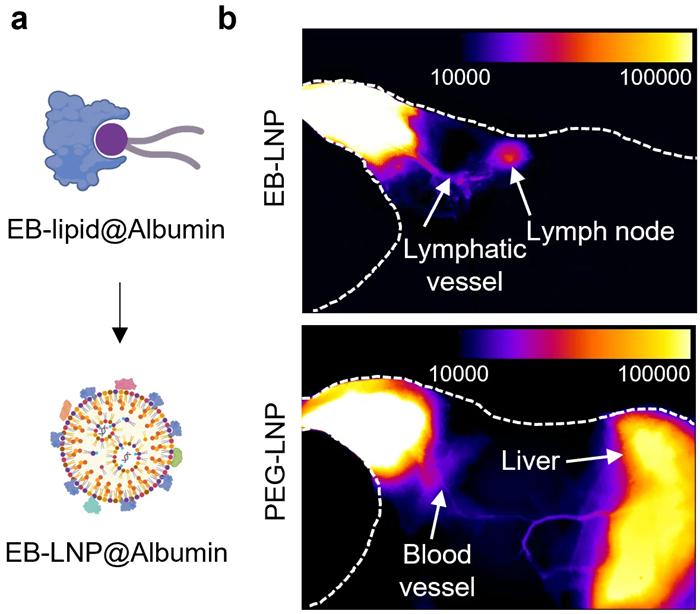
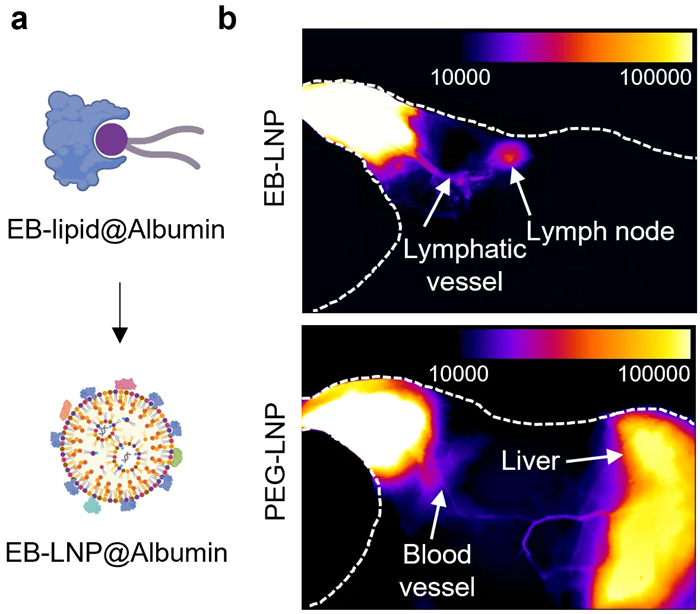
An albumin-recruiting lipid nanoparticle (EB-LNP) formulation promotes lymphatic drainage while avoiding liver accumulation compared to traditional LNP system (PEG-LNP). a, The molecular complex formed between EB-lipid and albumin. EB-lipid was employed to prepare EB-LNP using microfluidic device. b, In vivo fluorescence imaging of mice following intramuscular injection of EB-LNP or PEG-LNP labelled with a near-infrared probe, demonstrating the different biodistribution and tissue accumulation.
An albumin-recruiting lipid nanoparticle (EB-LNP) formulation promotes lymphatic drainage while avoiding liver accumulation compared to traditional LNP system (PEG-LNP). a, The molecular complex formed between EB-lipid and albumin. EB-lipid was employed to prepare EB-LNP using microfluidic device. b, In vivo fluorescence imaging of mice following intramuscular injection of EB-LNP or PEG-LNP labelled with a near-infrared probe, demonstrating the different biodistribution and tissue accumulation. Image Credit: National University of Singapore

Published in Nature Materials, the study introduces a technique that uses albumin-recruiting lipid nanoparticles—known as Evans Blue-modified lipid nanoparticles (EB-LNPs)—to deliver mRNA directly to the lymph nodes, the immune system’s key hubs. Unlike current delivery systems, which often accumulate in the liver and may trigger toxicity, this new approach largely bypasses the liver.

In lab tests, the EB-LNP delivery system outperformed traditional methods across several applications, including cancer immunotherapy and protection against viral infections such as melanoma, HPV-related cancers, H1N1 influenza, and Omicron variants of SARS-CoV-2.

Traditional lipid nanoparticle-based vaccines can accumulate in the liver after intramuscular injection, raising the risk of liver damage and dampening immune responses. We aimed to design a smarter delivery system that avoids this problem and directs the vaccine exactly where it’s needed.

Shawn Chen Xiaoyuan, Study Co-Senior Author and Professorm, Department of Diagnostic Radiology, and Nanomedicine Translational Research Programme, National University of Singapore

While current polyethylene glycol-lipid nanoparticles (PEG-LNPs) are widely used for mRNA delivery, they often get trapped in the liver, which is especially problematic when high or repeated doses are required, as in cancer treatment. This can lead to inflammation, allergic reactions, or liver toxicity.

See also  Customizable nanomedicine platform shows promise for advancing personalized mRNA cancer therapeutics

To address this, the team opted to use albumin, a naturally occurring transport protein, to guide the vaccine payload through the lymphatic system directly to the lymph nodes.

The researchers developed a delivery system that uses albumin—a naturally occurring transport protein—to guide the vaccine through the lymphatic system directly to the lymph nodes. By “hitchhiking” on albumin, the vaccine reaches its target efficiently, where it’s absorbed and prompts a focused, robust immune response.

To achieve this, the team synthesized a specialized EB-lipid that binds tightly to albumin. Once injected into muscle tissue, the resulting EB-LNPs attract albumin to their surface, which naturally steers them toward lymph nodes rather than the liver. This design avoids broad systemic circulation, significantly reducing liver exposure and the risk of toxicity.

Even at lower doses, the EB-LNP vaccines triggered strong antitumor T-cell activity and high levels of neutralizing antibodies. Importantly, no liver inflammation or toxic effects were observed, even with repeated injections. And unlike conventional PEG-LNPs, EB-LNPs did not provoke strong anti-drug antibody responses.

This albumin-hitchhiking strategy represents a paradigm shift in mRNA vaccine delivery. It has broad implications for cancer, infectious diseases, and potentially autoimmune disorders. For patients, that means fewer injections, reduced side effects, and longer-lasting protection.

Guocan Yu, Assistant Professor, Key Laboratory of Bioorganic Phosphorus Chemistry & Chemical Biology, Department of Chemistry, Tsinghua University

Looking ahead, the research team is preparing to move into clinical trials to assess safety and efficacy in humans. They also plan to explore broader applications, including treatments for autoimmune diseases and lymphatic cancers. In parallel, they’re working with industry partners to scale up manufacturing and speed up the development of this next-generation mRNA vaccine platform.

Our hope is to transform how mRNA vaccines are designed—making them safer, more effective, and easier to administer.

Pei Huang, Study Co-Lead Author, and Research Fellow, Department of Diagnostic Radiology, and Nanomedicine TRP, National University of Singapore

Journal Reference:

Feng, Y., et al. (2025) Albumin-recruiting lipid nanoparticle potentiates the safety and efficacy of mRNA vaccines by avoiding liver accumulation. Nature Materials. doi.org/10.1038/s41563-025-02284-w

See also  Bacterial enzyme and nanoparticle discoveries hold promise for treating gut pain

Source:

National University of Singapore

Source link

Albuminrecruiting Developing mRNA Nanoparticle vaccines
Share. Facebook Twitter Pinterest LinkedIn Tumblr Email

Related Posts

Green-synthesized zinc oxide nanoparticles from desert plants show broad antimicrobial activity

November 17, 2025

Genetically engineered virus acts as ‘smart sponge’ to extract rare earth elements from water

November 14, 2025

Magnetic nanoparticles that successfully navigate complex blood vessels may be ready for clinical trials

November 14, 2025

Decoding new DNA ‘letters’ to advance medicine and biotechnology

November 13, 2025
Add A Comment

Comments are closed.

Top Posts

Hybrid nanoantennas enable light capture from diamond defects

September 21, 2025

Customizable nanomedicine platform shows promise for advancing personalized mRNA cancer therapeutics

October 30, 2025

Peptide nanotubes show promise for overcoming chemotherapy resistance

October 10, 2025

Subscribe to Updates

Get the latest sports news from SportsSite about soccer, football and tennis.

Explore the future with our Nanotech blog—covering innovations, research, applications, and breakthroughs shaping science, medicine, and modern technology.

We're social. Connect with us:

Facebook X (Twitter) Instagram YouTube
Top Insights

Nanotechnology Plus Medicine Equal NanoMedicine

February 3, 2026

Improving PPE’s Antimicrobial Efficacy with ZnO Nanoparticles

December 5, 2025

PI Introduces Next-Generation 6-Axis Nanopositioning Alignment System

December 4, 2025

Subscribe to Updates

Get the latest creative news from FooBar about art, design and business.

  • Contact Us
  • Privacy Policy
  • Terms & Conditions

© 2026 elnano.com - All rights reserved.

Type above and press Enter to search. Press Esc to cancel.