
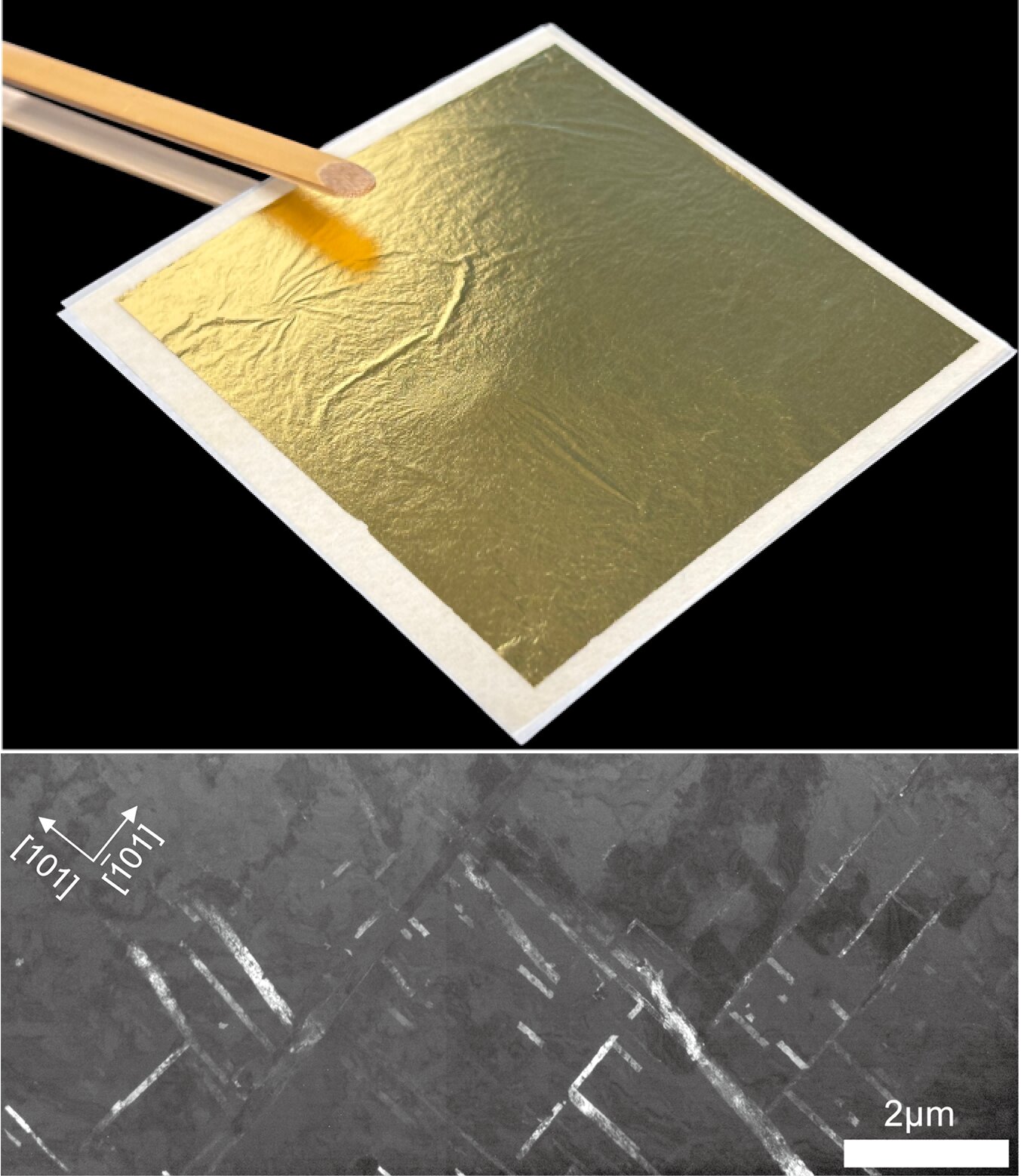
Kanazawa gold leaf is a traditional Japanese material known for its remarkable thinness, just 100 nanometers—about 1/1,000 the diameter of a human hair—and its brilliant shine.
Made using the entsuke technique, a manual process of packing and hammering at room temperature, this ultra-thin foil is commonly used to decorate temples, shrines, crafts, and historical objects.
While the skill of Kanazawa artisans has gained global recognition, including UNESCO’s designation as an Intangible Cultural Heritage in 2020, the scientific reason behind its unique thinness has remained unclear.
Now, researchers from the Japan Advanced Institute of Science and Technology (JAIST), led by Professor Yoshifumi Oshima, in collaboration with Doctoral Course Student Yuanzhe Xu; Senior Lecturer Kohei Aso; Prof. Hideyuki Murata at JAIST, and Specially Appointed Professor Satoshi Ichikawa at the University of Osaka, have uncovered the deformation processes that give Kanazawa gold leaf its special qualities.
Using electron backscatter diffraction (EBSD) and transmission electron microscopy (TEM), the study, published in npj Heritage Science, found that during the intense hammering process, the gold crystals go through an unusual change. Instead of recrystallizing, the material uses non-octahedral slip systems, specifically the {110}– <110> slip system, which are usually inactive in gold.
This crystal behavior shifts hammering stress into the [001] direction, creating the characteristic cube texture that provides the leaf with its brilliance and durability.
“Understanding how ultrathin films such as Kanazawa gold leaf can be fabricated via the pack and hammer method at room temperature while maintaining a {001} texture is of both scientific and practical significance,” explained Prof. Oshima.
The study compared two types of Kanazawa gold leaf. Zumi foil has a thickness of about 1 micrometer, while the more refined No. 4 Kanazawa gold leaf is only 0.1 micrometers thick. These samples represent different stages of the traditional entsuke hammering process. To reveal the structural changes that occur during fabrication, researchers used imaging techniques, including EBSD and TEM.
The results showed clear differences between the two materials. In the Zumi foil, the crystal texture was mixed, featuring many orientations and a high density of dislocations, which are tiny structural irregularities in the crystal lattice. In contrast, the No. 4 gold leaf had a well-ordered structure with a dominant {001} cube texture over large areas.
This texture developed even though the hammering took place at room temperature and lacked the usual recrystallization process that typically helps with crystal alignment. The TEM images provided more insights, offering direct evidence of slip bands, which are narrow areas where many dislocations align together.
The study confirmed the activation of the {110}– <110> slip system, a deformation mechanism rarely seen in gold. This was surprising because such mechanisms usually activate only under high temperatures or during processes like rolling, which apply stresses differently. The fact that traditional artisans achieve this effect through hand hammering at room temperature underscores the precision of the entsuke technique.
These findings matter beyond the cultural significance of Kanazawa gold leaf. By explaining how the leaf’s unique brilliance and durability develop, the research offers a scientific basis for the sustainable preservation of traditional crafts.
Artisans who carry on the centuries-old tradition of gold leaf making can now work with a better grasp of the physical principles behind their craft. This knowledge helps ensure that cultural treasures, including temples, shrines, and historical artworks adorned with Kanazawa gold leaf, can be preserved and restored with confidence in the material’s performance.
The study also links traditional craftsmanship with modern science and technology. The deformation mechanisms discovered may inspire the design of ultrathin metallic films with specific properties. These films could find applications in electronics, sensors, decorative coatings, and nanotechnology, where precise control of crystal orientation is crucial for performance and stability.
Looking ahead, these insights could guide the development of high-performance nanomaterials that combine extreme thinness with special optical, mechanical, and electronic properties. This might lead to innovations in flexible devices, sustainable decorative materials, and consumer electronics.
As Prof. Oshima states, “Our study enables the development of high-performance nanomaterials with unique optical, mechanical, and electronic properties, driving innovations in consumer electronics, flexible devices, and sustainable decorative materials, and fostering cross-disciplinary breakthroughs inspired by traditional craftsmanship.”
This work shows how traditional Kanazawa gold leaf techniques can inspire modern materials science, ensuring their brilliance continues to influence future generations.
More information:
Yuanzhe Xu et al, Deformation mechanism behind the unique texture of Kanazawa gold leaf, npj Heritage Science (2025). DOI: 10.1038/s40494-025-02055-5
Citation:
Cracking the secret of Kanazawa gold leaf’s brilliant texture (2025, October 7)
retrieved 7 October 2025
from https://phys.org/news/2025-10-secret-kanazawa-gold-leaf-brilliant.html
This document is subject to copyright. Apart from any fair dealing for the purpose of private study or research, no
part may be reproduced without the written permission. The content is provided for information purposes only.