
PFAS are fluorinated compounds found in many everyday products, such as outdoor clothing and cookware like Teflon pans. This is because PFAS are durable, heat-resistant and dirt-repellent. Their stability is precisely what leads to problems: although potentially harmful to our health, these substances are scarcely broken down at all in the environment and are regarded as “forever chemicals.” PFAS are also found in wastewater. Although they can be removed by filtration, this is a laborious process.
A team led by the German Federal Institute for Materials Research and Testing (BAM) has now developed a new filter material based on an unusual production technique. Crucial experiments were carried out at DESY’s X-ray source PETRA III to optimize the process. The working group is presenting its results in the journal Small.
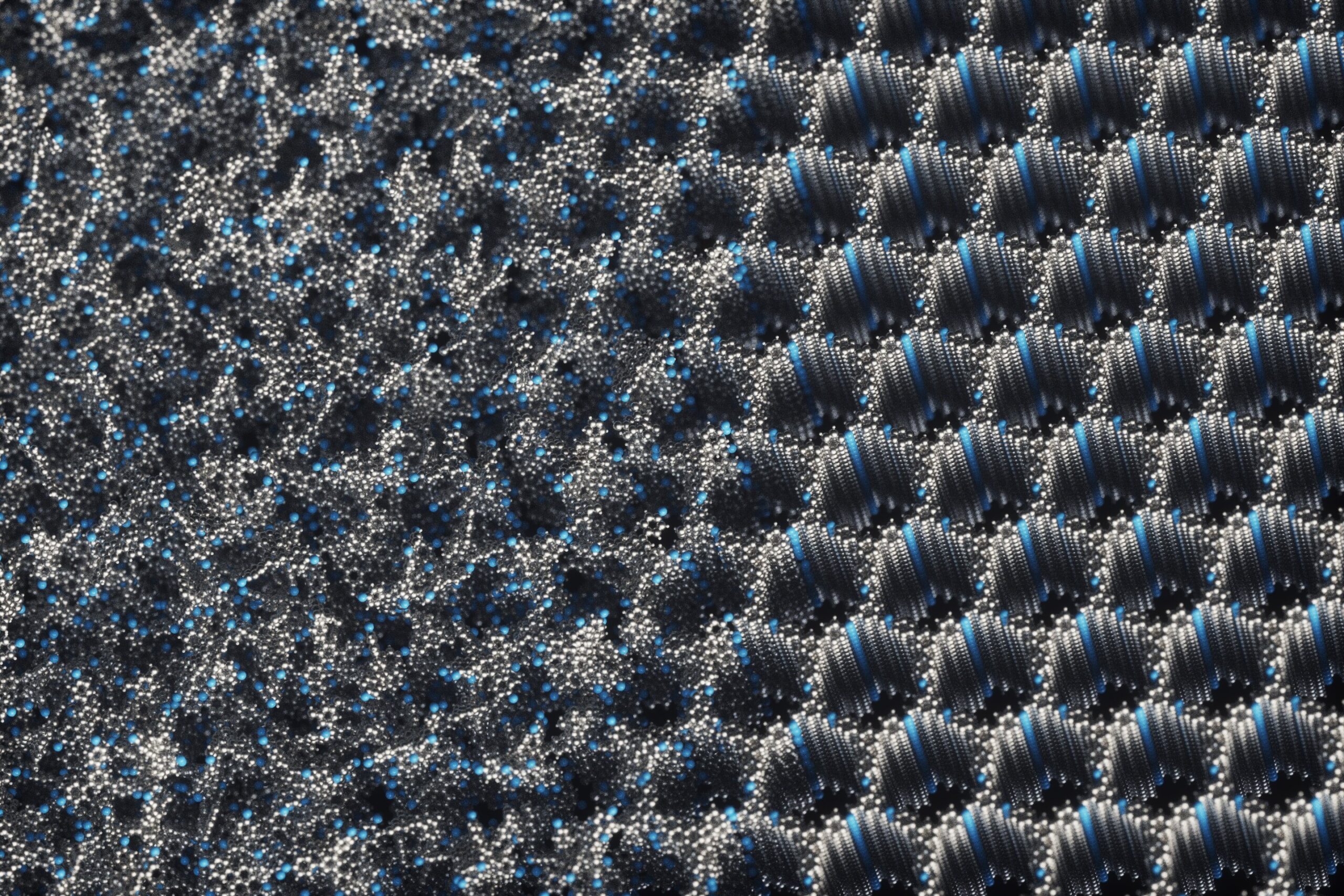
The candidates for this new filter material are known as “covalent organic frameworks.” The pores of these COFs are just a few nanometers across, so that PFAS molecules literally get stuck inside them. The nanoscale scaffolds can be manufactured using an original technique—by grinding them in a special type of mill.
“In the laboratory, we use a small plastic cylinder about the size of a film canister,” explains BAM researcher Franziska Emmerling. “Into this, we place some powder, a droplet of solvent and two steel balls, each about the size of a peppercorn.”
A special device then shakes this ball mill to and fro more than 30 times per second, as a result of which its contents are ground up. Initially, the powder granules become smaller, which increases their surface area. After a few minutes, the frictional heat, increased pressure and kinetic energy initiate a chemical reaction. The finely ground particles combine to form larger structures, scaffolds that can act as a filter. This little-known branch of chemical manufacturing is known as mechanochemistry.
“It is actually quite an old story. Mechanochemistry probably already played a role in ancient times,” says DESY physicist Martin Etter. “The first pharmaceutical substances for medicines were presumably released or even formed in chemical reactions when plant matter was ground up in a mortar.”
Today, mechanochemical processes are used in industry to synthesize drugs, catalysts and functional materials. Since they do not normally need large amounts of toxic solvents and require comparatively little energy, such methods are considered sustainable and environmentally friendly.
But what is the most effective way to produce the filter frameworks using a ball mill? To find out, the research group in Hamburg studied the process using the high-intensity, focused X-ray beam produced by PETRA III. While the mill was in action, the beam scanned its contents every ten seconds and was able to determine the structure of the crystals.
“The pattern produced by the two starting materials at our detector is different from that of the chemical formed by the chemical reaction,” explains Etter. “We were able to watch, in real time, as the patterns of the two starting chemicals became weaker and weaker, while at the same time the pattern of the new chemical began to appear—that of the framework structures.”
To identify the optimal parameters for the process, the team varied a number of factors, including the frequency with which the ball mill was agitated and the amount of solvent added. The results showed that the best scaffolds were obtained at a frequency of 36 hertz, using 266 milligrams of powder and adding 250 microliters of solvent—just a few drops. Unlike other framework structures already used as filters, the new material does not contain any heavy metals and would therefore be more environmentally friendly.
While it is not yet clear how the potential PFAS filters could be manufactured on an industrial scale, Etter already has some ideas as to where they might eventually be used. “In the wastewater treatment plants of companies that produce PFAS chemicals, for example,” says the physicist. “And maybe one day they could even be integrated into ordinary taps to filter our drinking water.”
Research into mechanochemistry will continue at DESY. The experts have high hopes for PETRA IV, the planned successor to the current X-ray source. PETRA IV will deliver a significantly finer, more narrowly collimated X-ray beam, which should speed up the measurements considerably.
“That means we won’t just be able to take one picture every ten seconds, but perhaps ten pictures per second,” says Etter. “And that would allow us, for example, to observe chemical processes that take place very quickly and in which short-lived intermediate structures are formed.”
More information:
Maroof Arshadul Hoque et al, Mechanochemically Synthesized Covalent Organic Framework Effectively Captures PFAS Contaminants, Small (2025). DOI: 10.1002/smll.202509275
Citation:
Ball mill technique produces nanoscale scaffolds that filter PFAS (2025, September 23)
retrieved 24 September 2025
from https://phys.org/news/2025-09-ball-mill-technique-nanoscale-scaffolds.html
This document is subject to copyright. Apart from any fair dealing for the purpose of private study or research, no
part may be reproduced without the written permission. The content is provided for information purposes only.