
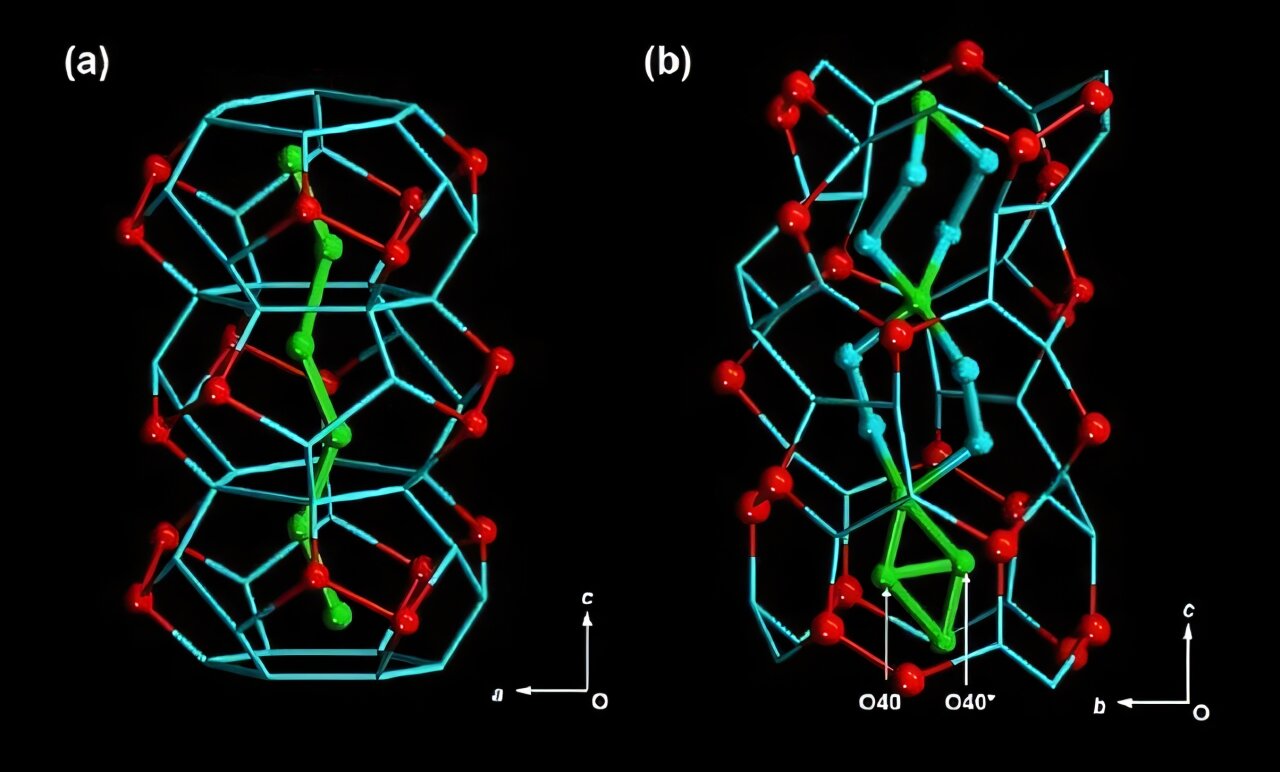
Despite being one of the most familiar substances on Earth, water holds many secrets that scientists are still working to understand. When confined to extremely small spaces—such as within certain proteins, minerals, or artificial nanomaterials—water behaves in ways that are drastically different from its bulk liquid form.
These confinement effects are critical for many natural and technological processes, including regulating the flow of ions through cell membranes and the properties of nanofluidic systems.
One intriguing yet poorly understood state of confined water is called the “premelting state.” In this unique phase, water behaves as if it were on the cusp of freezing and melting at the same time, thus defying simple liquid or solid classifications. However, it has proven difficult to study the premelting state and other confined water dynamics in detail.
While techniques such as diffraction methods (example, X-ray analysis) are useful for pinpointing the positions of atoms other than hydrogen, they are not sensitive enough to capture the picosecond-scale rotational motion of hydrogen and the motion of individual water molecules.
In a recent study, a research team led by Professor Makoto Tadokoro alongside Lecturer Fumiya Kobayashi and first-year Ph.D. student Mr. Tomoya Namiki, from the Department of Chemistry, Tokyo University of Science, Japan, shed new light on the mysteries of confined water.
Their paper, published online in the Journal of the American Chemical Society, reports how they used static solid-state deuterium nuclear magnetic resonance (NMR) spectroscopy to observe the hierarchical dynamics of water confined within the hydrophilic nanopores of a molecular crystal and characterized the premelting state, which is a new phase observed in water.
To perform their experiments, the team produced hexagonal rod-like crystals with quasi-one-dimensional channels containing a nanopore approximately 1.6 nm in diameter and filled them with heavy water (D2O).
By measuring the NMR spectra of a single crystal of {[Co(D2bim)3](TMA).20D2O}n at room temperature, the researchers were able to confirm the existence of a hierarchical, three-layered structure in the contained water molecules.
The unique peaks observed in the spectra corresponded to every layered structure with distinct movements and hydrogen-bonding interactions with one another of the confined water, providing clear evidence of multi-layered organization.
Furthermore, water confined in the nanopores freezes in a different structure from bulk ice and first melts through a distorted hydrogen-bonded structure, leading to the formation of a premelting state.

To gain insights into the premelting state, the researchers heated the crystal gradually from low temperature to get the water from a frozen state to a liquid state. They observed distinct changes in the NMR spectra that confirmed a phase transition into the premelting state, and their measurements revealed the presence of two seemingly contradictory states.
“The premelting state involves the melting of incompletely hydrogen-bonded H2O before the completely frozen ice structure starts melting during the heating process. It essentially constitutes a novel phase of water in which frozen H2O layers and slowly moving H2O coexist,” explains Prof. Tadokoro.
The researchers measured the spin–lattice relaxation time to quantify the rotational mobility of the heavy water molecules in this new phase. While the activation energy for the premelting state was far from that of bulk ice, the correlation time was remarkably close to that of bulk liquid water.
Simply put, this means that while the water molecules’ positions were relatively fixed as one would expect of a solid, their rotational motions were extremely fast and liquid-like.
Taken together, these findings build toward a more comprehensive understanding of how water behaves in extreme confinement. They clarify crucial structural and dynamic aspects, which are important for understanding how water and ions permeate through biological proteins and membranes. Looking ahead, these insights could also lead to practical innovations.
“By creating new ice network structures, it may be possible to store energetic gases such as hydrogen and methane and develop water-based materials such as artificial gas hydrates,” says Prof. Tadokoro.
Controlling the freezing properties of water based on the structure of ice could lead to the creation of new, inexpensive, and safe hydrosphere materials.
Overall, this study ultimately demonstrates that even a substance as common as water still holds fundamental secrets waiting to be unlocked.
More information:
Tomoya Namiki et al, Solid-State 2H NMR Analysis for Hierarchical Water Clusters Confined to Quasi-One-Dimensional Molecular Nanoporous Crystals, Journal of the American Chemical Society (2025). DOI: 10.1021/jacs.5c04573
Citation:
A deep look into the unique structure and behavior of confined water (2025, September 22)
retrieved 23 September 2025
from https://phys.org/news/2025-09-deep-unique-behavior-confined.html
This document is subject to copyright. Apart from any fair dealing for the purpose of private study or research, no
part may be reproduced without the written permission. The content is provided for information purposes only.