
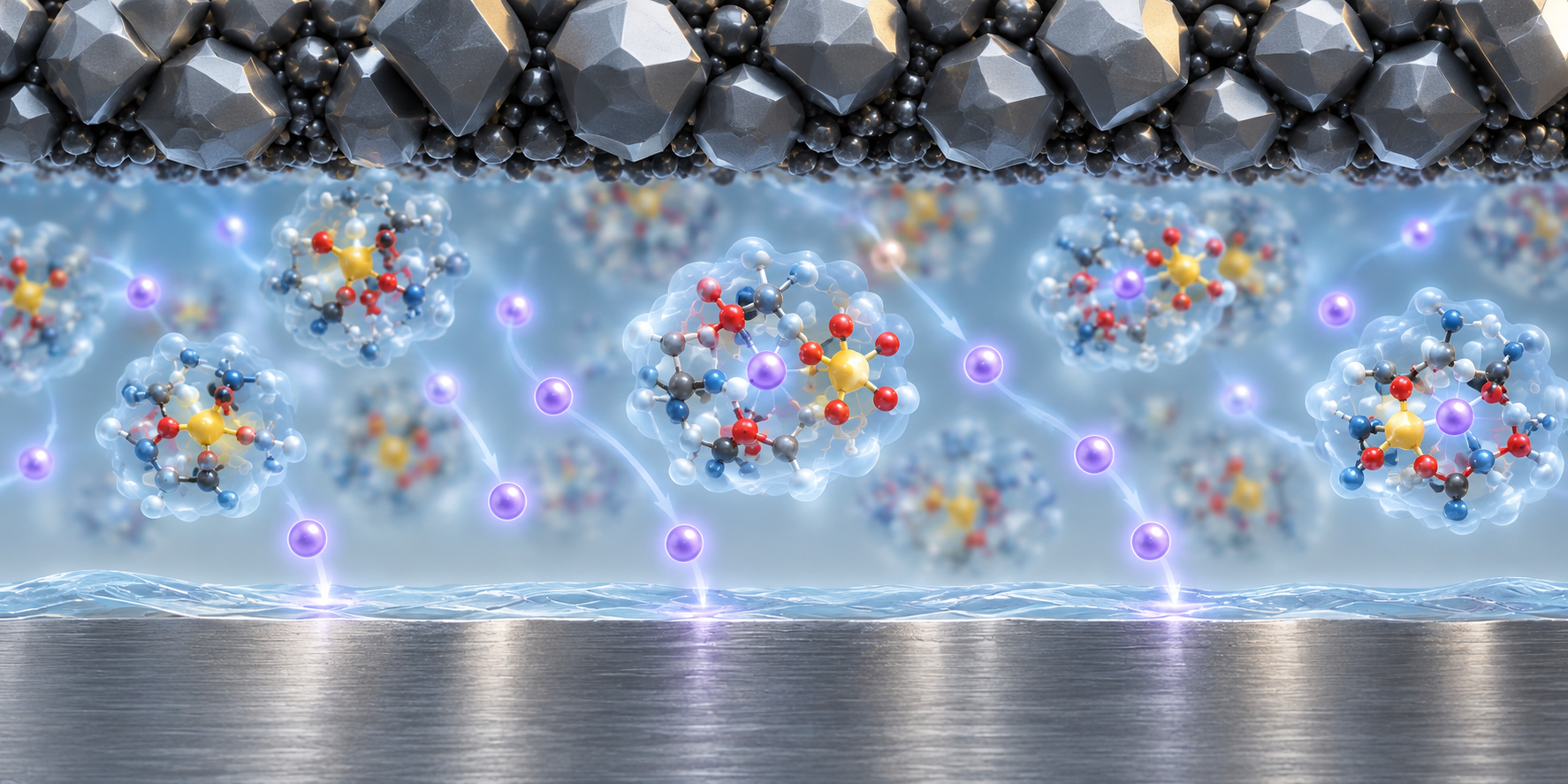
By weakening interactions that normally tie electrolyte components into extended aggregates, researchers created an unusual nanoscale structure that could change how lithium metal batteries balance energy density, durability, and safety.
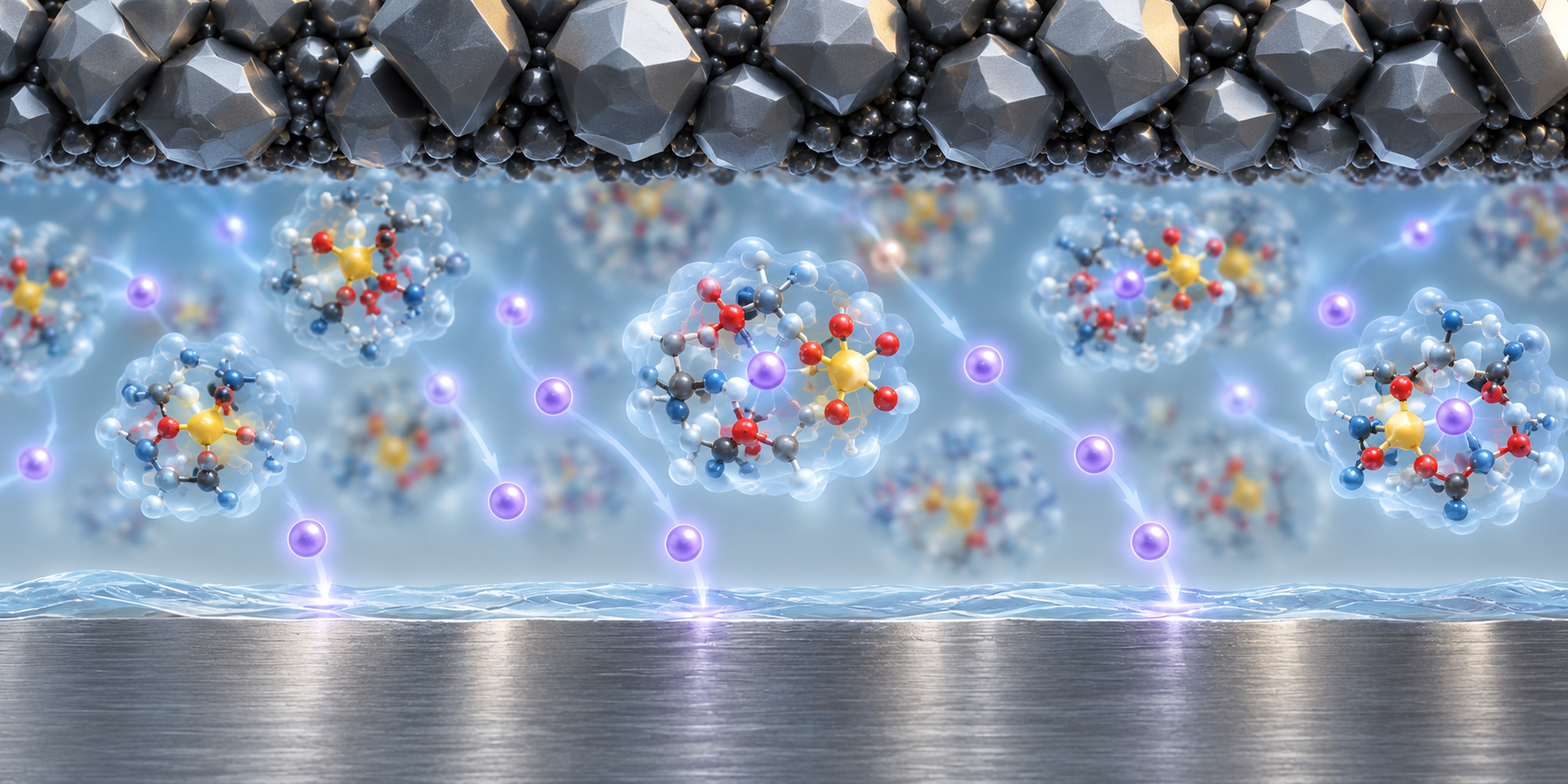
Paper: Safe electrolyte design with isolated solvation nanoclusters for high-energy lithium metal batteries. AI-generated abstract conceptual image created using ChatGPT/OpenAI
A recent study in the journal Nature Communications presents a sterically regulated electrolyte for high-energy lithium (Li) metal batteries. The researchers introduced a non-flammable cyclic fluorinated diluent that organizes electrolyte components into isolated solvation nanoclusters. These findings show that precise control of electrolyte interactions can help produce safer and more durable lithium metal batteries.
The Need for Safer High-Energy Lithium Batteries
Lithium metal batteries could achieve specific energies above 500 Wh kg–¹, which makes them promising for electric vehicles and large-scale grid energy storage. These batteries typically combine a lithium-metal negative electrode with a high-capacity, nickel-rich layered-oxide positive electrode.
Both electrodes in lithium metal batteries are highly reactive, leading to side reactions that consume the electrolyte, form inactive lithium, and damage the positive electrode. These reactions can increase impedance and shorten battery life. Lithium dendrites pose another major safety risk because they can penetrate the separator and cause internal short circuits.
Researchers have developed localized high-concentration electrolytes (LHCEs) to address these challenges. These electrolytes use non-coordinating diluents to lower viscosity and flammability while preserving anion-rich solvation structures. However, common diluents can still interact with anions and solvent molecules. Such interactions may disturb lithium-ion coordination and stabilize extended ionic aggregates rather than efficiently fragmenting them into smaller clusters.
This study examines how diluent structure controls electrolyte organization. The researchers designed 1,1,2,2,3,3,4-heptafluorocyclopentane (HFC), a sterically hindered cyclic fluorinated alkane. The resulting sterically regulated concentrated electrolyte (SRCE) forms isolated solvation nanoclusters.
Designing an Electrolyte with Isolated Solvation Nanoclusters
The researchers compared three electrolyte systems: HCE, LHCE containing the conventional diluent TTE, and an SRCE containing HFC. All systems used lithium bis(fluorosulfonyl)imide (LiFSI) and dimethoxyethane (DME), while the diluted electrolytes had a LiFSI:DME:diluent molar ratio of 1:1:1.5. All electrolytes were prepared in an argon-filled glovebox.
The study combined computational modeling with structural, chemical, and electrochemical characterization. Density functional theory (DFT) calculations evaluated molecular electrostatic potentials, binding energies, and hydrogen-bond interactions, while molecular dynamics (MD) simulations examined molecular distributions and ion coordination. The authors note that these calculations were intended to provide qualitative and comparative insights rather than exact descriptions of the electrolyte under operating conditions. Nuclear magnetic resonance (NMR) spectroscopy was used to further assess interactions among lithium ions, anions, solvents, and diluents. Synchrotron-based wide-angle X-ray scattering (WAXS) was used to examine ionic cluster organization.
The study then evaluated lithium plating and stripping in lithium–copper and lithium–lithium cells. Scanning electron microscopy (SEM) was used to examine lithium deposition, while X-ray photoelectron spectroscopy (XPS) and time-of-flight secondary ion mass spectrometry were used to characterize the solid electrolyte interphase (SEI).
Full-cell tests evaluated lithium metal/NCM cells across multiple coin- and pouch-cell configurations, including 50 μm lithium, practical electrode loadings, high-voltage operation, elevated temperatures, calendar aging, higher-nickel cathodes, and pouch-cell configurations. Additional characterization methods were used to assess cathode interphases, structural degradation, transition-metal dissolution, and electrolyte consumption. Nail-penetration, overcharge, and differential scanning calorimetry tests were used to evaluate safety.
Nanoclusters Improve Lithium Deposition and Electrode Protection
HFC reorganized the electrolyte at the nanoscale without causing visible phase separation. DFT, NMR, and MD results showed that HFC exhibited weaker interactions with Li+, FSI–, and DME than TTE. HFC preserved strong Li+–FSI– coordination and maintained anion-rich solvation environments. WAXS measurements showed that the HFC-containing SRCE promoted smaller, isolated solvation nanoclusters rather than extended ionic aggregates. This structure improved lithium-ion transport while limiting large-scale aggregation.
The SRCE electrolyte also improved lithium deposition. It achieved a lithium plating and stripping coulombic efficiency of 99.61% and supported stable operation at current densities up to 10 mA cm–². Microscopy revealed dense, uniform lithium deposits, while lithium–lithium symmetric cells sustained plating and stripping for more than 1600 hours without short circuits or increases in overpotential. The resulting SEI was thinner and more uniform, with abundant LiF and Li2O.
SRCE protected the NCM811 cathode by forming a thin cathode electrolyte interphase below 4 nm. This interphase had a higher mechanical modulus than those formed by HCE and LHCE. After cycling, SRCE cells showed less cation mixing, fewer particle cracks, and lower transition-metal dissolution.
These improvements translated into longer cycle life and higher energy density. 50 μm lithium–NCM811 coin cells with a 2.5 mAh cm–² areal cathode capacity retained 80% capacity after more than 800 cycles, while a separate 6 Ah pouch cell using an NCM95 cathode and a leaner electrolyte loading of 0.93 g Ah–¹ exceeded 500 Wh kg–¹ based on the total pouch-cell mass. Safety tests on a fully charged 1 Ah pouch cell showed no sparks or explosions during nail penetration, while 200% overcharge in an Ah-level pouch cell caused less than a 10 °C temperature rise without swelling or leakage.
Towards Safer and Higher-Energy Battery Systems
This study demonstrates that electrolyte microstructure plays an important role in battery performance, durability, and safety. The HFC diluent reduces unwanted interactions with lithium ions, anions, solvents, and ionic aggregates while preserving the cation-anion coordination needed for stable solvation. This balance promotes the formation of isolated solvation nanoclusters rather than extended ionic networks.
The resulting SRCE electrolyte improves lithium-ion transport and suppresses dendrite formation. It also promotes thin, inorganic-rich SEI and CEI layers that protect both the lithium metal and nickel-rich cathode. These interfacial improvements help reduce chemical degradation, structural damage, and electrolyte consumption during cycling.
The SRCE system achieved 99.61% lithium plating and stripping efficiency and enabled more than 800 cycles with 80% capacity retention in lithium metal/NCM811 coin cells. It also performed well under high-voltage and elevated-temperature conditions, retained 96% capacity during an 8-month calendar-aging protocol involving repeated 24-hour rest intervals, and enabled a 6 Ah NCM95 pouch cell to exceed 500 Wh kg–¹. Safety tests further showed no ignition or explosion during nail penetration and stable behavior during severe overcharge.
These findings indicate that controlling electrolyte interactions at the molecular and nanoscale levels can support both high energy density and improved safety. The authors also argue that extending cell life while reducing electrolyte consumption could lower material use per unit of energy delivered, providing a potential sustainability benefit alongside the performance and safety gains. Overall, the isolated nanocluster strategy provides a promising design principle for developing safer, longer-lasting lithium metal batteries for electric vehicles and large-scale grid energy storage.