
Close Menu
  • News
    • Medical
    • Nanomaterials
    • AI & Robotics
    • 2D Materials
    • Metamaterials
    • Nanoelectronics
    • ETF’s
    • Medicine
  • Environment
    • Earth.com
    • TreeHugger
    • Nanomuscle
  • Beauty
    • Makeupanalysis
What's Hot

Nanotechnology Plus Medicine Equal NanoMedicine

February 3, 2026

Improving PPE’s Antimicrobial Efficacy with ZnO Nanoparticles

December 5, 2025

PI Introduces Next-Generation 6-Axis Nanopositioning Alignment System

December 4, 2025
Facebook X (Twitter) Instagram
  • Contact Us
  • Privacy Policy
  • Terms & Conditions
Facebook X (Twitter) Instagram
Elnano – Global Innovative Nanotechnology SolutionsElnano – Global Innovative Nanotechnology Solutions
  • News
    • Medical
    • Nanomaterials
    • AI & Robotics
    • 2D Materials
    • Metamaterials
    • Nanoelectronics
    • ETF’s
    • Medicine
  • Environment
    • Earth.com
    • TreeHugger
    • Nanomuscle
  • Beauty
    • Makeupanalysis
Elnano – Global Innovative Nanotechnology SolutionsElnano – Global Innovative Nanotechnology Solutions
Home » Light-responsive molecule enables reversible cell death control using visible and UV light
Medical

Light-responsive molecule enables reversible cell death control using visible and UV light

November 11, 2025No Comments3 Mins Read
Share
Facebook Twitter LinkedIn Pinterest Email
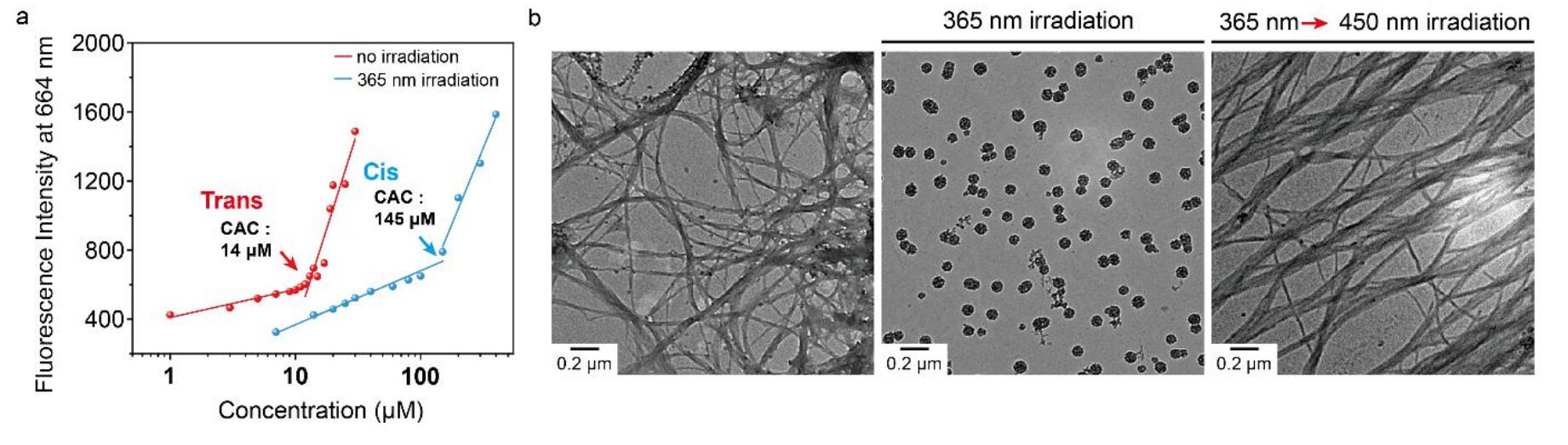
(a) The critical aggregation concentration (CAC) of Mito-AZB in PBS buffer (pH 7.4) was determined under both non-irradiated conditions and upon exposure to 365 nm light. Steady-state fluorescence spectra were recorded using Nile Red at an emission wavelength of 645 nm, and the CAC was quantified based on the calibration plot derived from the emission spectra. (b) TEM image of Mito-AZB after stirring PBS buffer for 24 h and morphological change of Mito-AZB assembly upon alternating irradiation at 365 nm and 450 nm for 10 min respectively. Credit: Nano Letters (2025). DOI: 10.1021/acs.nanolett.5c04030

A novel technology that utilizes light of different wavelengths to control cellular functions by inducing reversible assembly and disassembly of molecules has been developed. This breakthrough could pave the way for new approaches in treating superficial cancers, such as skin cancer, as well as serving as a powerful molecular tool for fundamental life science investigations.

A research team, led by Professor Ryu Ja-Hyoung in the Department of Chemistry at UNIST, has developed a photoswitchable molecule named Mito-AZB, capable of repeatedly assembling and disassembling in response to specific light wavelengths.

The findings were published in Nano Letters.

This molecule specifically targets mitochondria within cells and exerts controlled mechanical stress on mitochondrial membranes through repeated cycles of assembly and disassembly.

When exposed to visible light at 450 nm, the molecules assemble into a robust fibrous structure, applying physical stress to the mitochondrial membrane. Conversely, upon irradiation with ultraviolet light at 350 nm, the fibers disassemble.

This cyclical process damages the mitochondrial membrane, causing the release of pro-apoptotic factors into the cytoplasm and ultimately inducing apoptosis, a form of programmed cell death.

Experimental results demonstrated that, following treatment with the molecule and alternating exposure to UV and visible light, mitochondrial membrane potential collapsed, and levels of reactive oxygen species and apoptosis-related proteins surged within cells. Fluorescence microscopy confirmed the accumulation of the molecules around mitochondria, validating their targeted action.

The development of Mito-AZB involved combining three key components: a targeting moiety that guides the molecule to mitochondria, an azobenzene unit that undergoes reversible structural changes upon light irradiation, and a fluorescent dye for real-time visualization under microscopy.

See also  PI's Precision Motion Control: Essentials with Fast Delivery

By replacing the mitochondrial targeting component with other organelle-specific molecules, the team successfully adapted the system to target lysosomes and the endoplasmic reticulum, demonstrating its versatility in selectively disrupting various cellular organelles.

Professor Ryu explained, “This research demonstrates that external light stimuli can precisely manipulate molecular assembly states within cells and modulate cellular responses accordingly.”

“Such technology holds promise for treating superficial cancers like skin cancer through targeted, non-invasive light therapy. Furthermore, it provides a powerful molecular tool for basic research to transiently inhibit or activate organelle functions, advancing our understanding of cellular mechanisms.”

More information:
Sangpil Kim et al, Photoregulated Assembly–Disassembly Dynamics of Interfering with Organelle Membrane Integrity, Nano Letters (2025). DOI: 10.1021/acs.nanolett.5c04030

Provided by
Ulsan National Institute of Science and Technology


Citation:
Light-responsive molecule enables reversible cell death control using visible and UV light (2025, November 11)
retrieved 11 November 2025
from https://phys.org/news/2025-11-responsive-molecule-enables-reversible-cell.html

This document is subject to copyright. Apart from any fair dealing for the purpose of private study or research, no
part may be reproduced without the written permission. The content is provided for information purposes only.


Source link

cell Control death enables light Lightresponsive molecule reversible visible
Share. Facebook Twitter Pinterest LinkedIn Tumblr Email

Related Posts

Green-synthesized zinc oxide nanoparticles from desert plants show broad antimicrobial activity

November 17, 2025

Light intensity steers molecular assemblies into 1D, 2D or 3D structures

November 17, 2025

Genetically engineered virus acts as ‘smart sponge’ to extract rare earth elements from water

November 14, 2025

Magnetic nanoparticles that successfully navigate complex blood vessels may be ready for clinical trials

November 14, 2025
Add A Comment

Comments are closed.

Top Posts

Giving waste plastics a second life as high-performance carbon nanomaterials

October 25, 2025

Micro-robot can target, capture, and move individual cells

September 18, 2025

Tiny Metamaterial Lens Snaps Outsize Images

September 18, 2025

Subscribe to Updates

Get the latest sports news from SportsSite about soccer, football and tennis.

Explore the future with our Nanotech blog—covering innovations, research, applications, and breakthroughs shaping science, medicine, and modern technology.

We're social. Connect with us:

Facebook X (Twitter) Instagram YouTube
Top Insights

Nanotechnology Plus Medicine Equal NanoMedicine

February 3, 2026

Improving PPE’s Antimicrobial Efficacy with ZnO Nanoparticles

December 5, 2025

PI Introduces Next-Generation 6-Axis Nanopositioning Alignment System

December 4, 2025

Subscribe to Updates

Get the latest creative news from FooBar about art, design and business.

  • Contact Us
  • Privacy Policy
  • Terms & Conditions

© 2026 elnano.com - All rights reserved.

Type above and press Enter to search. Press Esc to cancel.