
Researchers at UNIST have unveiled a simple, yet effective method to replace the insulating coating—known as polyvinylpyrrolidone (PVP)—that covers silver nanowires (AgNWs), enabling significantly better electrical conductivity and enhanced durability. This innovation paves the way for the development of flexible, foldable, and rollable electronic devices using AgNW transparent electrodes.
Led by Professor Tae-Hyuk Kwon from the Department of Chemistry at UNIST, in collaboration with Dr. Ji Hoon Seo of Korea Electric Power Research Institute (KEPRI), Professor EunAe Cho of KAIST, and Professor Sang-Won Park of Suwon University, the research team successfully developed the facile solution-based spin-coating process to replace the traditional insulating PVP coating on AgNWs. This approach simultaneously improves both performance and durability.
AgNWs are metallic filaments thousands of times thinner than human hair, arranged in a network that conducts electricity while allowing light to pass through, making them ideal for transparent electrodes in flexible electronic devices. However, during fabrication, PVP is used to promote nanowire growth by encapsulating their surfaces. Unfortunately, PVP also acts as an insulator, preventing efficient electrical conduction and increasing the overall resistance of the electrode.
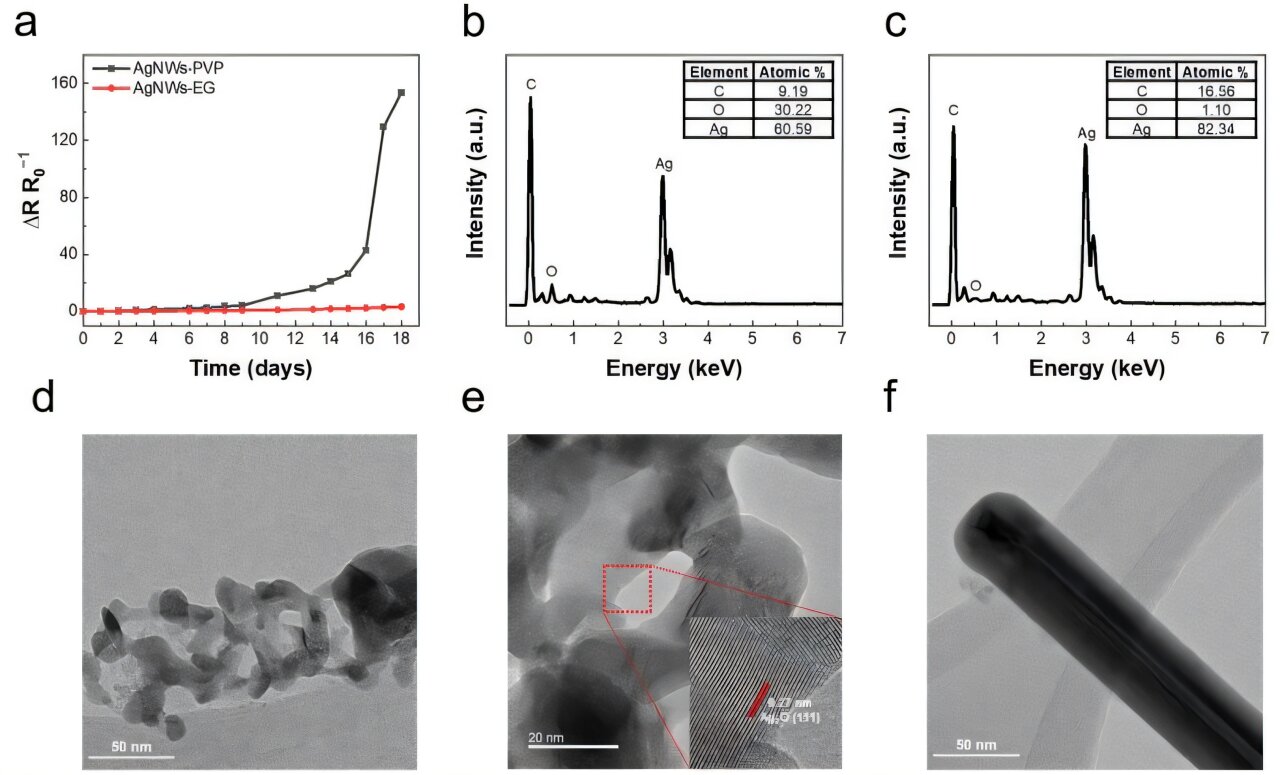
The research team devised a method to easily exchange PVP with ethylene glycol (EG) using a simple solution process. By immersing the AgNWs in an EG solution and rapidly spinning them, the PVP coating is effectively removed, enabling a new, conductive layer to form. This layer not only enhances electrical pathways but also protects the nanowires from moisture and improves transparency.
The paper is published in the journal Angewandte Chemie International Edition.
Professor Kwon explained, “We considered various physicochemical properties such as viscosity, volatility, and hydrogen-bonding ability of potential replacement ligands. This comprehensive approach allowed us to develop an effective ligand exchange technique.”
The PVP replacement resulted in a 43% reduction in electrical resistance, nearly doubling the conductivity. Moreover, the modified electrodes maintained high performance even under harsh conditions—at 85°C and 85% humidity—and showed a slight increase in light transmittance, enabling the production of brighter, more transparent electrodes.
Using these improved electrodes, the team fabricated transparent heaters that demonstrated more than 35% higher heating performance compared to conventional AgNW heaters. Thanks to lower resistance, these heaters reached temperatures of 140°C–145°C within just six minutes of powering on, surpassing the previous maximum of 102°C.
Dr. Seo from KEPRI stated, “While traditional power cables are protected by external insulations to ensure electrical stability, the insulating PVP coating on AgNWs posed a challenge by increasing resistance. The new ligand exchange method provides a simple, scalable solution without complex processing or high-temperature treatments. This technology has great potential for applications in flexible displays, wearable sensors, electronic paper, and transparent heating devices in next-generation electronics.”
More information:
Junhyeok Kwon et al, Improving the Conductivity and Stability of Silver Nanowires Through Spontaneous Ligand Exchange for Joule Heating, Angewandte Chemie International Edition (2025). DOI: 10.1002/anie.202518337
Citation:
Silver nanowire electrodes get a conductivity surge with new coating technique (2025, November 10)
retrieved 10 November 2025
from https://phys.org/news/2025-11-silver-nanowire-electrodes-surge-coating.html
This document is subject to copyright. Apart from any fair dealing for the purpose of private study or research, no
part may be reproduced without the written permission. The content is provided for information purposes only.