
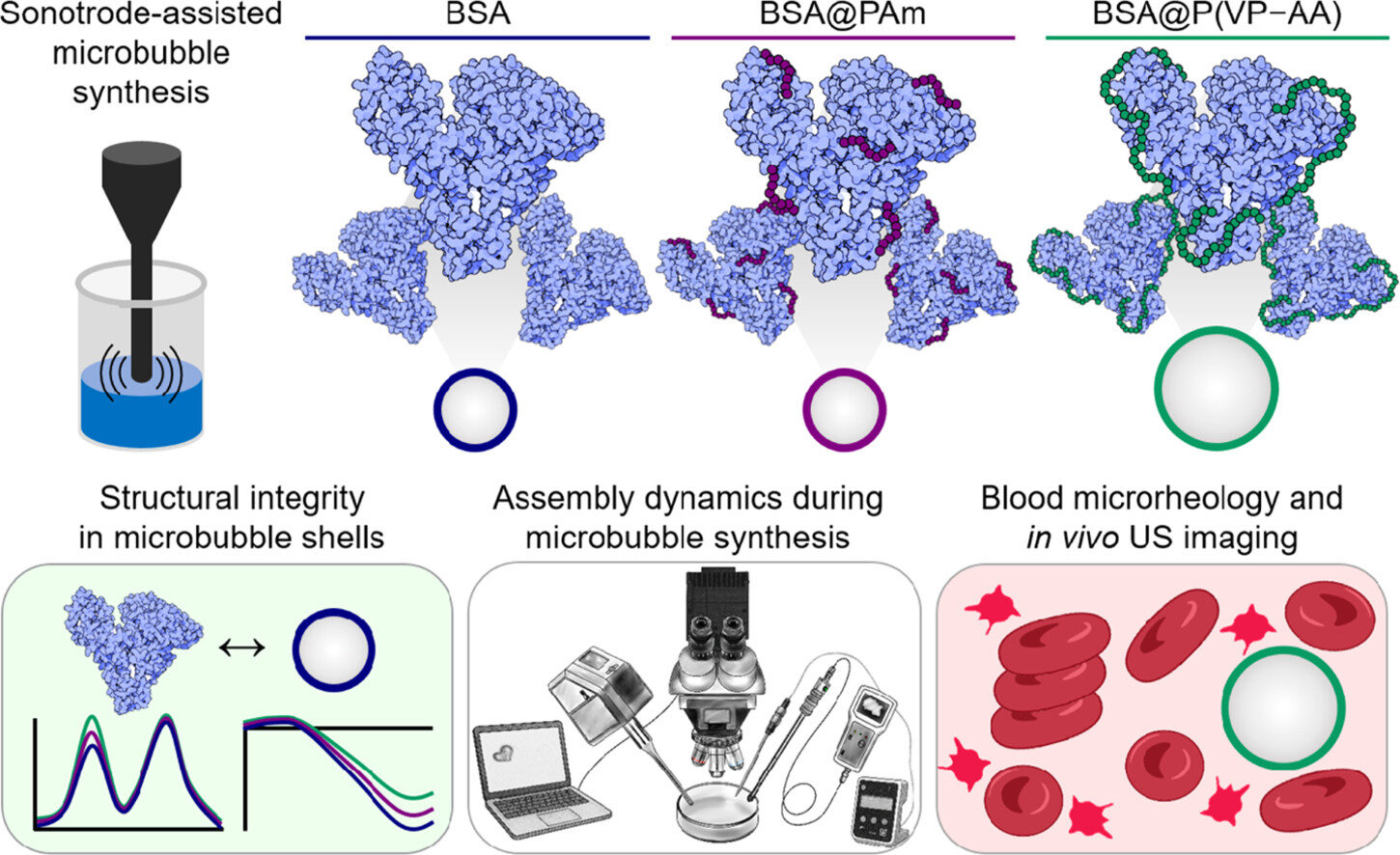
Researchers from Skoltech, ITMO University, and their colleagues have reported new findings about the behavior of microbubbles exposed to ultrasound. The data obtained by the team will enable the creation of more stable and safe microbubbles that could have therapeutic applications as vehicles for drug delivery to the brain and targeted activation of anti-cancer agents, and would make it possible to limit intense ultrasound exposure, avoiding its side effects. The study is published in Acta Biomaterialia.
Microbubbles are used in ultrasound diagnostics to increase the contrast of the image and make even the smallest vessels visible. However, the complex physics and chemistry underlying the behavior of microbubbles under ultrasound exposure has not been studied in detail. To make ultrasound a controlled therapeutic tool, scientists need to understand precisely how bubbles form, pulsate, and burst, and what determines the energy of the “pop.”
This effect is crucial for any attempts to use microbubbles for targeted activation of cancer drugs in the tumor (sonodynamic therapy) and delivery of pharmaceutical agents to the brain past the blood–brain barrier, a layer of densely packed cells that prevents medications circulating in the bloodstream from entering the brain.
“Rather than work with living tissue, we aimed to figure out the physics of the bubbles,” said the lead author of the paper, Junior Research Scientist Tatiana Estifeeva from Skoltech Photonics. “When we know precisely how the bubbles behave at every stage, we can purposely design stable and safe chemical compositions to keep a handle on everything from the state of the protein molecules in the bubble shell to the effects on blood.
“In the future, such thoroughly researched bubbles could be used not just for visualization but for therapies that employ ultrasound as a very targeted and mild intervention.”
The team investigated microbubbles with a protein shell with two types of additives that enhance stability. Both proved successful in stabilizing and “pacifying” the bubbles, making sure that the protein retains its natural structure and does not deteriorate when exposed to ultrasound. This is important, because a stable shell means there is less risk of undesirable reactions in the body.
“To retrace the entire life cycle of the bubbles, from birth to burst, we recorded them on video and used a cavitometer. It’s an instrument that registers soundwaves in a solution and makes it possible to monitor cavitation—the bubbles’ pulsation as their size oscillates under ultrasound exposure.
“Our measurements indicate that the stabilizing additives nearly halved cavitation intensity, transforming the process from chaotic bubbling to mild pulsation. The behavior of such bubbles can be made predictable and therefore safe,” said study co-author Galina Kalinichenko, a master’s student in the “Photonics and Quantum Materials” program at Skoltech.
The scientists also examined the interaction between the microbubbles and human blood. The shape and mobility of red blood cells were unaffected by the bubbles, which shows they do not disrupt the normal flow of blood and are potentially safe for administration in the body.
Control over the behavior of the bubbles at all stages from formation to breakup creates the foundation for future applications in medicine. The transition to focused low-intensity ultrasound will become possible once researchers can fine-tune bubble composition and know cavitation intensity.
The study demonstrates that understanding the physics and chemistry of microbubbles will eventually unlock their potential for noninvasive treatment options. Previously confined to the domain of diagnostics, ultrasound may become a tool for high-precision interventions.
More information:
Tatiana M. Estifeeva et al, Direct insights into synthesis, protein integrity, and blood microrheology of albumin microbubbles, Acta Biomaterialia (2025). DOI: 10.1016/j.actbio.2025.09.026
Citation:
Microbubble physics study confirms utility of ultrasound for noninvasive therapy (2025, October 30)
retrieved 31 October 2025
from https://phys.org/news/2025-10-microbubble-physics-ultrasound-noninvasive-therapy.html
This document is subject to copyright. Apart from any fair dealing for the purpose of private study or research, no
part may be reproduced without the written permission. The content is provided for information purposes only.