
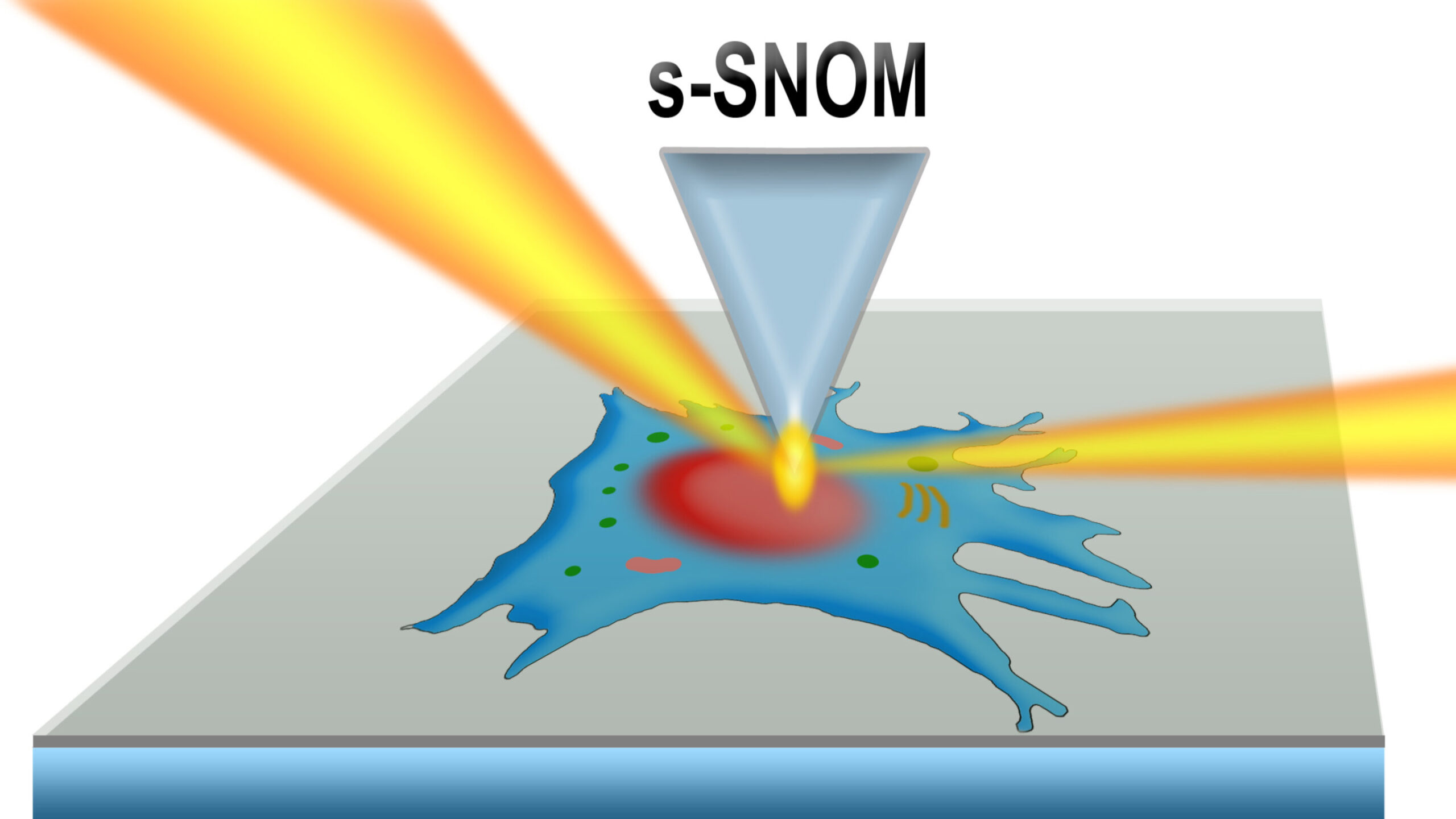
Infrared vibrational spectroscopy at BESSY II can be used to create high-resolution maps of molecules inside live cells and cell organelles in their native aqueous environment, according to a new study by a team from HZB and Humboldt University in Berlin.
Nano-IR spectroscopy with s-SNOM at the IRIS beamline is now suitable for examining tiny biological samples in liquid medium in the nanometer range and generating infrared images of molecular vibrations with nanometer resolution. It is even possible to obtain 3D information. To test the method, the team grew fibroblasts on a highly transparent SiC membrane and examined them in vivo. This method will provide new insights into cell biology.
Infrared spectroscopy is a damage-free method for characterizing biological tissues or cells. With the use of an infrared scattering-type near-field optical microscope (s-SNOM), even the smallest sample volumes are sufficient to gain rich information about the molecular composition, structure and interactions, with a spatial resolution of down to 10 nm.
The study is published in the journal Small.
Testing the method on fibroblast cells
The IRIS beamline at BESSY II synchrotron source provides highly brilliant and the extremely broadband infrared light required by this method. In a recent study conducted at BESSY II, under the joint leadership of Dr. Alexander Veber, HZB and Prof. Dr. Janina Kneipp from HUB, the team demonstrated the effectiveness of this method to record vibrational spectra of living cells in liquids. They used fibroblasts, which are responsible for building connective tissue and producing collagen, as test samples.
For the first time, the team used an ultra-thin silicon carbide membrane that serves as a protective biocompatible interface between the cells and their liquid medium and the probing tip of the s-SNOM based infrared nanoscope, which detects the vibrations.

“Not only were we able to visualize the nucleus and cell organelles, but we succeeded too in reading the individual contributions of proteins, nucleic acids, carbohydrates and membrane lipids based on the detected vibrational spectra,” says Veber.
This was possible because the silicon carbide membrane is highly transparent to infrared light. The observed cell structure at the nanoscale is consistent with the known heterogeneity of cells, thus validating the new method.
“We could also vary the measurement parameters in order to control how deep into the sample we detect signals—allowing us to explore its different layers. This paves the way towards infrared nano-tomography of the cells, i.e. a detailed 3D visualization of cell structure and composition,” says Veber. Standardized 2D and 3D vibrational imaging and spectroscopy could enable faster progress in biophysics and nanomaterials.
“This method offers the possibility of analyzing biological samples and liquid-solid interfaces much more accurately than was previously possible,” says Veber. “In principle, we could use it to examine any type of cell, including cancer cells.” The new development is available for national and international user groups of the IRIS beamline.
More information:
Alexander Veber et al, Nano‐Infrared Imaging and Spectroscopy of Animal Cells in Liquid Environment, Small (2025). DOI: 10.1002/smll.202507097
Citation:
What vibrating molecules might reveal about cell biology (2025, October 16)
retrieved 17 October 2025
from https://phys.org/news/2025-10-vibrating-molecules-reveal-cell-biology.html
This document is subject to copyright. Apart from any fair dealing for the purpose of private study or research, no
part may be reproduced without the written permission. The content is provided for information purposes only.