
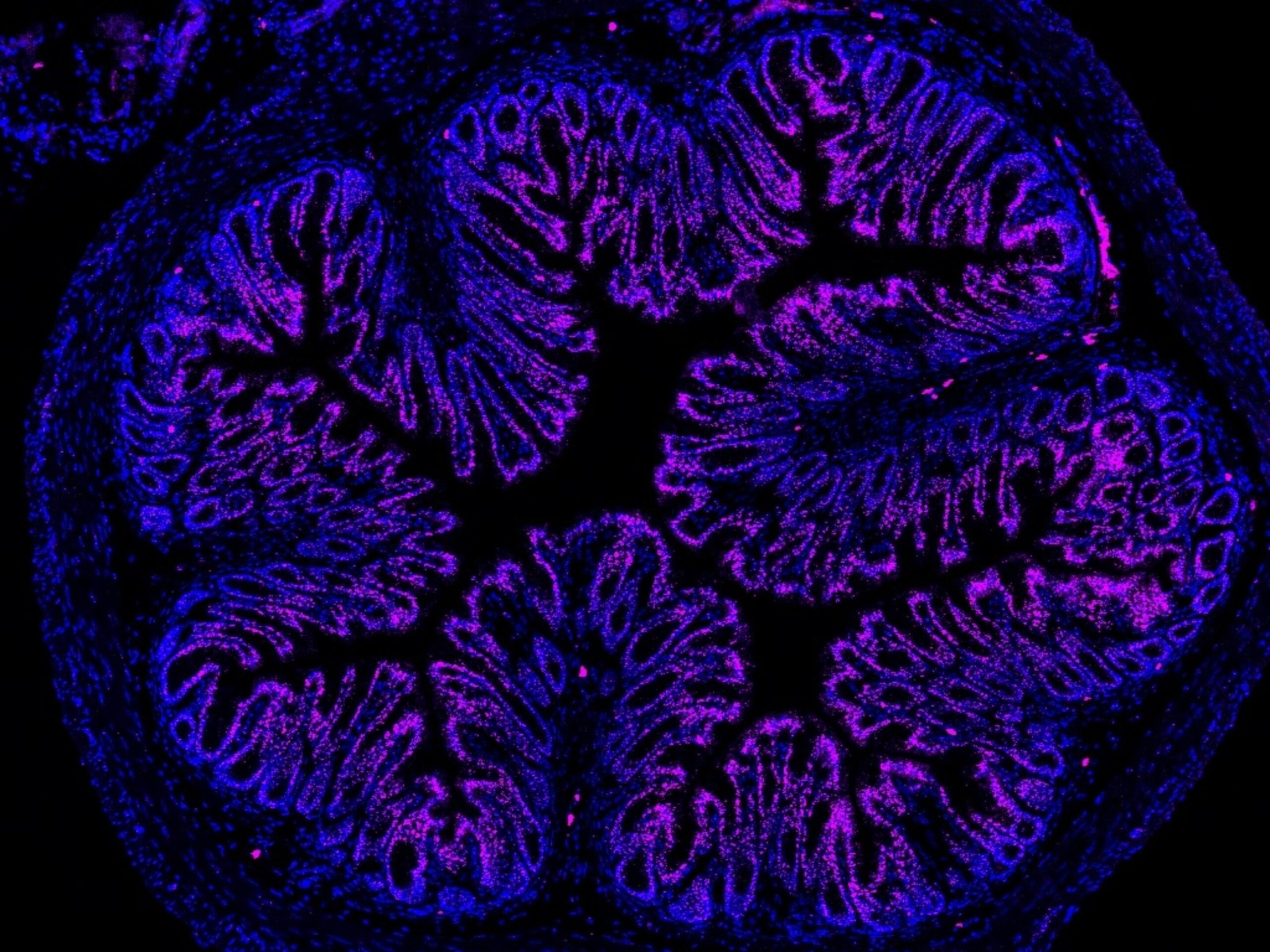
Abdominal pain is a hallmark of many digestive disorders, including inflammatory bowel disease and irritable bowel syndrome. In an effort to develop targeted treatments for gut pain, scientists have discovered a new enzyme in gut bacteria and are using nanoparticles to deliver drugs inside cells.
Currently, there are no treatments specifically for gut pain, and existing painkillers are often insufficient at managing symptoms. These drugs—including opioids, NSAIDs, and steroids—also come with side effects, some of which directly harm the digestive system.
In two new studies published in Cell Host & Microbe and Proceedings of the National Academy of Sciences, researchers focused on PAR2, a receptor involved in pain signaling that has been shown to play a role in gastrointestinal diseases marked by inflammation and pain. Found on the lining of the gut and on pain-sensing nerves in the gut, PAR2 is activated by certain enzymes called proteases and is a promising target for treating gut pain—in numerous ways.
“In focusing on this receptor, we’ve mapped out a pathway between a bacterial enzyme and pain and determined how to block PAR2 using nanoparticles—both of which may help us to treat pain related to digestive disorders in the future,” said Nigel Bunnett, professor and chair of the Department of Molecular Pathobiology at NYU College of Dentistry and a faculty member in the NYU Pain Research Center.
A brand-new bacterial enzyme as a regulator for pain
Dysbiosis, or an imbalance in the composition of microbes in the gut, is an underlying factor in many digestive diseases. Scientists are increasingly interested in how microbiome-targeted therapies, including probiotics, can be used to restore this balance between good and bad bacteria.
Bacteria in the gut produce a range of amino acids and other small metabolites to communicate with the rest of the body. Matthew Bogyo, a professor of pathology, microbiology, and immunology at Stanford University School of Medicine, wanted to understand if bacteria also communicate by producing proteases and whether these enzymes regulate PAR2 activity and may be a factor driving pain.
Using a large library of human strains of bacteria found in the gut, Bogyo and his colleagues tested each strain to see if they produced enzymes that would cleave and activate PAR2. Surprisingly, more than 50 bacteria secreted enzymes that cleaved PAR2.
The researchers homed in on a previously unknown enzyme produced by a rod-shaped bacterium called Bacteroides fragilis (B. fragilis) that had particularly robust activity. B. fragilis is normally found in the human colon, but there’s some evidence that it may contribute to inflammatory bowel disease.
“B. fragilis a sleeping pathogen of sorts. It’s an organism that can hang out in the gut without doing any damage, but under certain conditions, it can cause problems. One of the ways it may be doing that is through regulating signals that it sends to the host,” said Bogyo.
In collaboration with Bunnett, Bogyo determined that the enzyme produced by B. fragilis cleaves PAR2 to activate the receptor. In further studies in cells and mice, the researchers compared regular B. fragilis bacteria and a modified version of the bacteria in which the enzyme was removed. They found that the protease produced by B. fragilis bacteria excited neurons that detect and transmit pain, disrupted the intestinal barrier, and triggered inflammation and pain in the colon.
“The results were black and white: If the protease was present, there was pain signaling, and if the protease was not present, there was no pain signaling. Our study identifies a new axis of communication between gut bacteria and the host that has implications for how symptoms may be triggered in inflammatory bowel disease,” said Bogyo.
“There has been a lot of work to describe changes in the microbiome that could be associated with disease, but this study is among the first to look at the role of proteases in this pathway,” added Bunnett.
The researchers, who recently published these findings in Cell Host & Microbe, see the newly discovered B. fragilis enzyme as a potential target for treating painful digestive disorders by inhibiting the specific enzyme and deactivating its signaling pathway.
Using nanoparticles to reach a moving target
In a separate study in Proceedings of the National Academy of Sciences, the researchers sought to exploit a known behavior of PAR2: When the receptor is activated, it moves from the surface of cells lining the gut to compartments within the cells called endosomes. The receptor continues to function inside endosomes and generates inflammation and pain by signaling nerve cells and creating gaps in the protective barrier of cells lining the intestines.
“If this receptor internalizes and signals from these compartments, we have to develop a drug delivery strategy that will target the receptor inside the compartments,” said Bunnett.
To get a drug into endosomes, the researchers turned to nanoparticles—tiny, spherical vehicles that can encapsulate drugs and readily get them into cells. Nanoparticles are used to precisely direct drugs—for instance, targeting tumors in cancer treatment while sparing healthy tissue—which minimizes side effects and the amount of drug needed. This approach may be particularly beneficial in digestive disorders, as nanoparticles could send drugs to the wall of the gut without spreading to other parts of the body.
To test this approach, the researchers used an experimental drug called AZ3451 that blocks PAR2. They encapsulated AZ3451 in two different types of nanoparticles targeting the two major sites of receptor signaling that drive abdominal pain: epithelial cells lining the intestine and nerve cells. The nanoparticles were engineered to slowly release the drug over several days.
“That sustained release is exactly what you want for a chronic disease,” said Bunnett.
In cellular studies, they found that the nanoparticle-delivered drug was far more effective at inhibiting signaling of PAR2 in epithelial and nerve cells compared to the drug on its own. In additional studies of mice with inflammatory bowel disease, giving the mice nanoparticles containing AZ3451 diminished pain-like behaviors, whereas the drug alone was largely ineffective.
“Using nanoparticles for drug delivery demonstrates a precision-targeted approach. These nanoparticles are precisely directed not only to a particular cell, but a particular compartment within the cell and a particular receptor within the compartment,” said Bunnett.
More information:
Markus Lakemeyer et al, A Bacteroides fragilis protease activates host PAR2 to induce intestinal pain and inflammation, Cell Host & Microbe (2025). DOI: 10.1016/j.chom.2025.09.010
Shavonne L. Teng et al, Nanomedicines targeting protease-activated receptor 2 in endosomes provide sustained analgesia, Proceedings of the National Academy of Sciences (2025). DOI: 10.1073/pnas.2412687122
Citation:
Bacterial enzyme and nanoparticle discoveries hold promise for treating gut pain (2025, October 7)
retrieved 8 October 2025
from https://phys.org/news/2025-10-bacterial-enzyme-nanoparticle-discoveries-gut.html
This document is subject to copyright. Apart from any fair dealing for the purpose of private study or research, no
part may be reproduced without the written permission. The content is provided for information purposes only.