
A new study has, for the first time, uncovered a connection between bacteria living in Norway spruce needles and gold nanoparticles. This discovery could pave the way for environmentally friendly gold exploration methods, while examining similar processes in mosses may also help remove metals from mining-impacted waters.
The study, “Biomineralized gold nanoparticles along with endophytic bacterial taxa in needles of Norway spruce (Picea abies),” was published in Environmental Microbiome.
“Our results suggest that bacteria and other microbes living inside plants may influence the accumulation of gold in trees,” says Postdoctoral Researcher Kaisa Lehosmaa from the University of Oulu, Finland.
It has long been known that mineral deposits release ions through oxidation and bacterial activity. These ions migrate to surface soils, where plants absorb water and nutrients. Because of this, metals can be detected in plants—or even snow—using sensitive instruments.
“Such biogeochemical methods have already been used in mineral exploration, but this new research enhances our understanding of what is actually happening in the process,” explains Research Professor Maarit Middleton from the Geological Survey of Finland (GTK).
Plants host a wide range of microbial species in their tissues. “These so-called endophytic microbes may play a role in plants’ biomineralization processes,” notes Professor Anna Maria Pirttilä from the University of Oulu.
In biomineralization, inorganic substances and minerals, such as gold, accumulate and solidify inside plant tissues as part of the plant’s defense mechanisms. However, the biomineralization process remains poorly understood—it does not always occur, and when it does, it may be sporadic and localized.
Identifying the mechanisms and factors behind biomineralization is key to understanding elemental sources and developing plant-based applications in biogeochemical research and beyond.
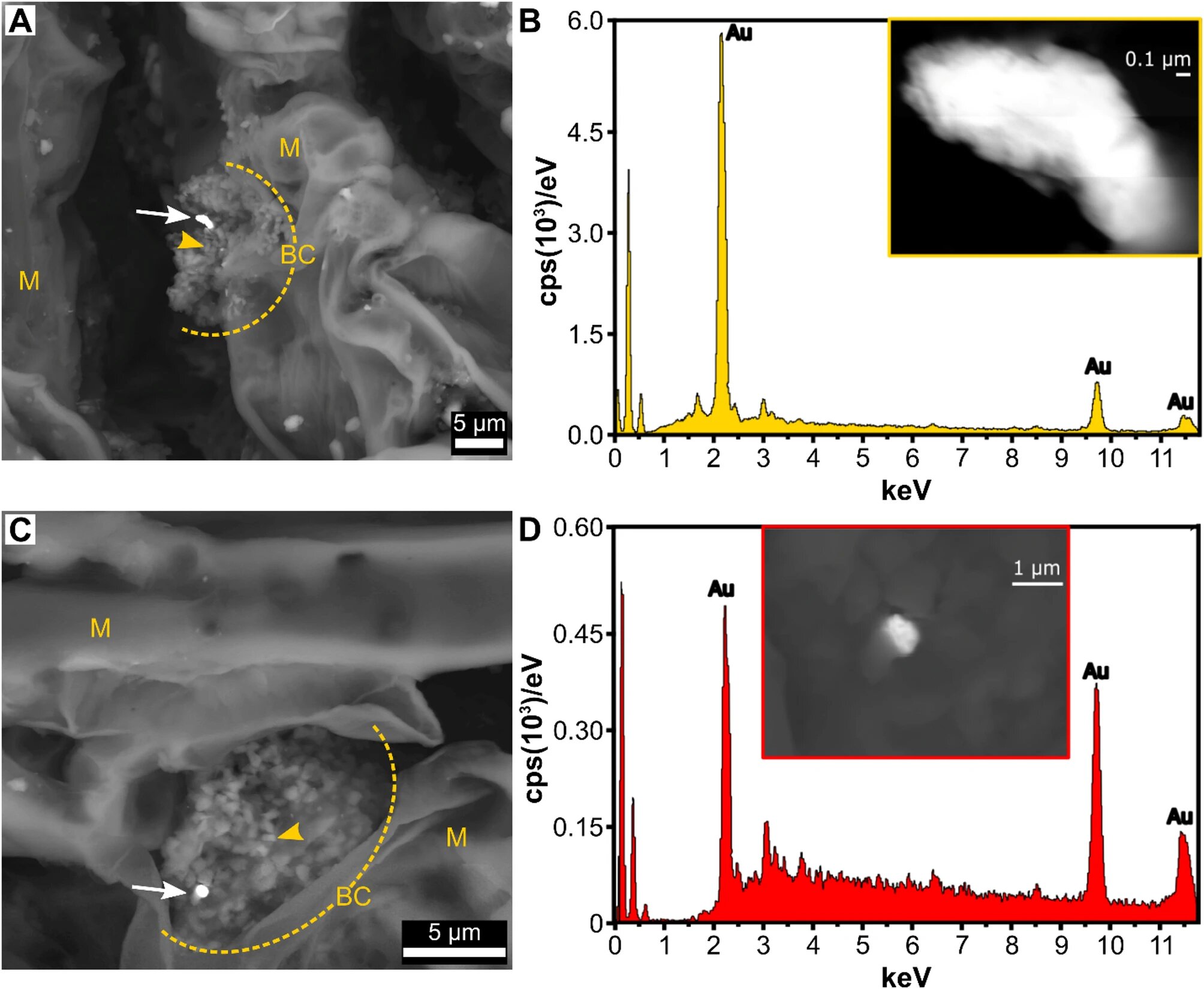
“Our recent study provides preliminary evidence of how gold moves into plant shoots and how gold nanoparticles can form inside needles,” Dr. Lehosmaa explains. “In the soil, gold is present in a soluble, liquid form. Carried by water, the gold moves into spruce needles. The tree’s microbes can then precipitate this soluble gold back into solid, nanosized particles.”
This gold dust, however, cannot be seen with the naked eye, and the nanoparticles—only a millionth of a millimeter in size—are far too small to be collected for commercial use.
In the study, researchers from the University of Oulu and Geological Survey Finland collected 138 needle samples from 23 spruce trees on a satellite mineral deposit of the Kittilä gold mine in Finland. In four trees, gold nanoparticles were found inside the needles, surrounded by bacterial biofilms. DNA sequencing of these biofilms revealed that certain bacterial groups—such as P3OB-42, Cutibacterium, and Corynebacterium—were more common in gold-containing needles.
“This suggests that these specific spruce-associated bacteria can help transform soluble gold into solid particles inside the needles. This insight is useful, since screening for such bacteria in plant leaves may facilitate gold exploration,” Dr. Lehosmaa says.
The findings offer a foundation for bio-based and environmentally friendly mineral exploration methods. Similar approaches could also be applied to other minerals and in plants beyond spruce. “Metals can, for example, precipitate within moss tissues. Studying biomineralization also allows us to explore how bacteria and microbes living in aquatic mosses could help remove metals from water,” says Dr. Lehosmaa.
More information:
Kaisa Lehosmaa et al, Biomineralized gold nanoparticles along with endophytic bacterial taxa in needles of Norway spruce (Picea abies), Environmental Microbiome (2025). DOI: 10.1186/s40793-025-00770-x
Citation:
Bacteria may influence accumulation of gold nanoparticles in spruce tree needles (2025, October 6)
retrieved 7 October 2025
from https://phys.org/news/2025-10-bacteria-accumulation-gold-nanoparticles-spruce.html
This document is subject to copyright. Apart from any fair dealing for the purpose of private study or research, no
part may be reproduced without the written permission. The content is provided for information purposes only.