
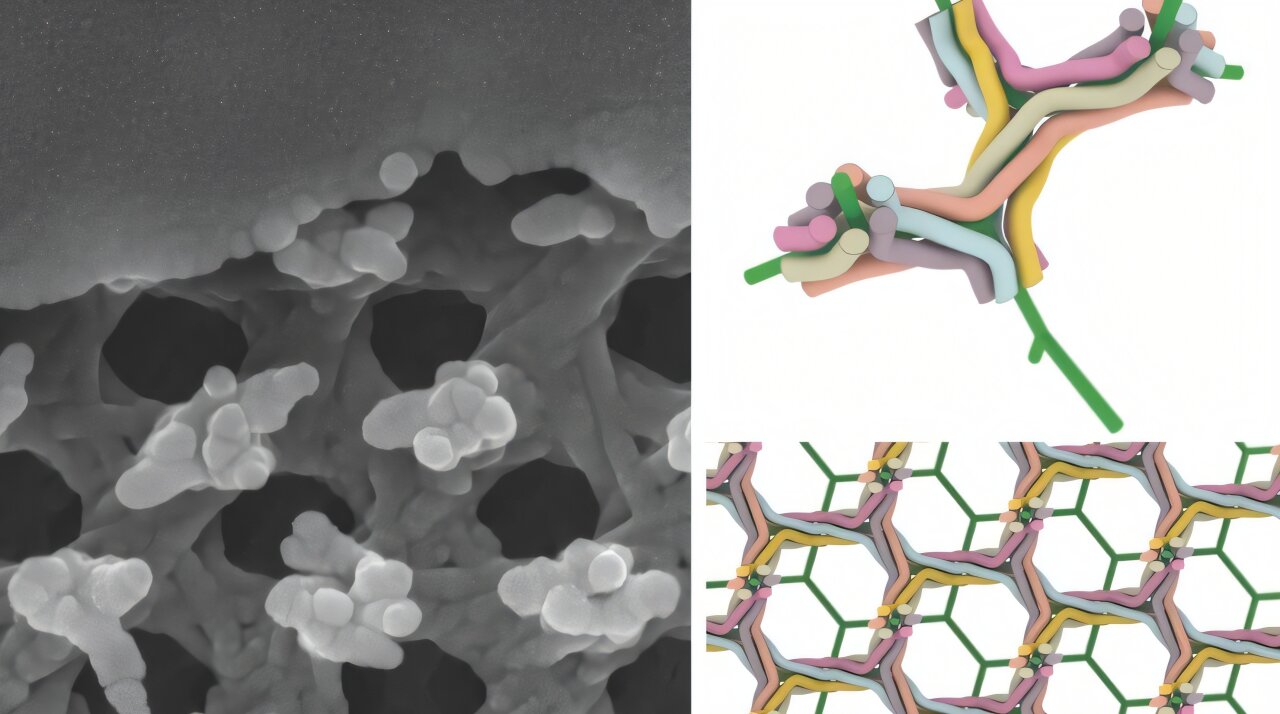
The metamorphosis of butterflies from larvae to pupae to adulthood is a natural wonder. By investigating the developmental processes that occur within the pupa, transforming it into a butterfly, scientists have discovered a new twist in a process that forms an intricate nanostructure responsible for the vibrant green colors of their wings.
The butterfly in question is the Emerald-patched Cattleheart (Parides sesostris), a neotropical butterfly found in Gamboa, Panama. Pupae were reared at the Smithsonian Tropical Research Institute, and tissue samples were extracted from the developing wings.
This species’ wings contain the gyroid, a porous nanomaterial based on a highly symmetric three-dimensional network. When realized in the scales of the Cattleheart butterfly, it acts as a photonic crystal and generates the distinctive green coloration through a structural interference mechanism that does not require chemical pigments.
Until now, scientists believed gyroid structures had a smooth internal surface. But new research from Murdoch University, The University of Western Australia and international colleagues, published in the Proceedings of the National Academy of Sciences, discovered the wing scales developed as a structure woven from fibers—like a braid or rope—disputing the commonly held assumption that they form as smooth constructs.
Dr. Annie Jessop, the lead author of the study, said the findings suggested an additional stage of development during wing scale growth that had not been previously observed.
“What we found is that the gyroid in the developing scales is not smooth at all, it looks like a braid or a rope. So small that you need an electron microscope to see it,” she said.
“But when the butterfly is fully developed, the weaving is no longer visible, and the structure appears smooth. How that happens is the next piece of this puzzle we need to solve.”
Associate Professor Peta Clode, from UWA’s Center for Microscopy Characterization and Analysis, said the discovery of an intermediate stage during wing scale formation changed the paradigm for how complex network-like structures form in butterflies and insects.
“It is still unclear how highly ordered structures like these rapidly develop within a cell and ultimately form complex wing scales,” she said. “We hope to shed more light on this with our future work using novel and interdisciplinary imaging and analytical approaches.”
Dr. Jessop said that beyond the extraordinary ability of the butterfly species to form intricate nanoshapes, the study had broad relevance because of the ubiquity of the gyroid structure in nature.

“Structures like the gyroid are widespread in convoluted inner-cellular membranes and other tissue structures across all kingdoms of life. Yet, we don’t fully understand their formation and function.
“What’s holding us back is the difficulty of studying these structures in vivo. Establishing the Parides butterfly as a model system helps our broader understanding of nature’s use of gyroid-like structures.”
Professor Gerd Schröder-Turk, from the School of Mathematics, Statistics, Chemistry and Physics at Murdoch University, said that demonstrating that a weaving of fibers into a gyroid was not only theoretically possible but a reality in functional tissue, would likely inspire new research across biological, synthetic and bioinspired material systems.
“Nature’s ingenuity in making amazing shapes is endless. Whenever we think we understand her ways, she reveals yet another beautiful mystery,” he said.
“There is so much in nature to inspire ideas for functional nanomaterials. The foundation for that knowledge translation is understanding why and how nature uses these nanostructures. We’re trying to do just that.”
More information:
Anna-Lee Jessop et al, Hierarchical woven fibrillar structures in developing single gyroids in butterflies, Proceedings of the National Academy of Sciences (2025). DOI: 10.1073/pnas.2507297122
Citation:
Braided nanostructures reveal 3D tapestry behind vibrant green butterfly coloration (2025, September 30)
retrieved 30 September 2025
from https://phys.org/news/2025-09-braided-nanostructures-reveal-3d-tapestry.html
This document is subject to copyright. Apart from any fair dealing for the purpose of private study or research, no
part may be reproduced without the written permission. The content is provided for information purposes only.