
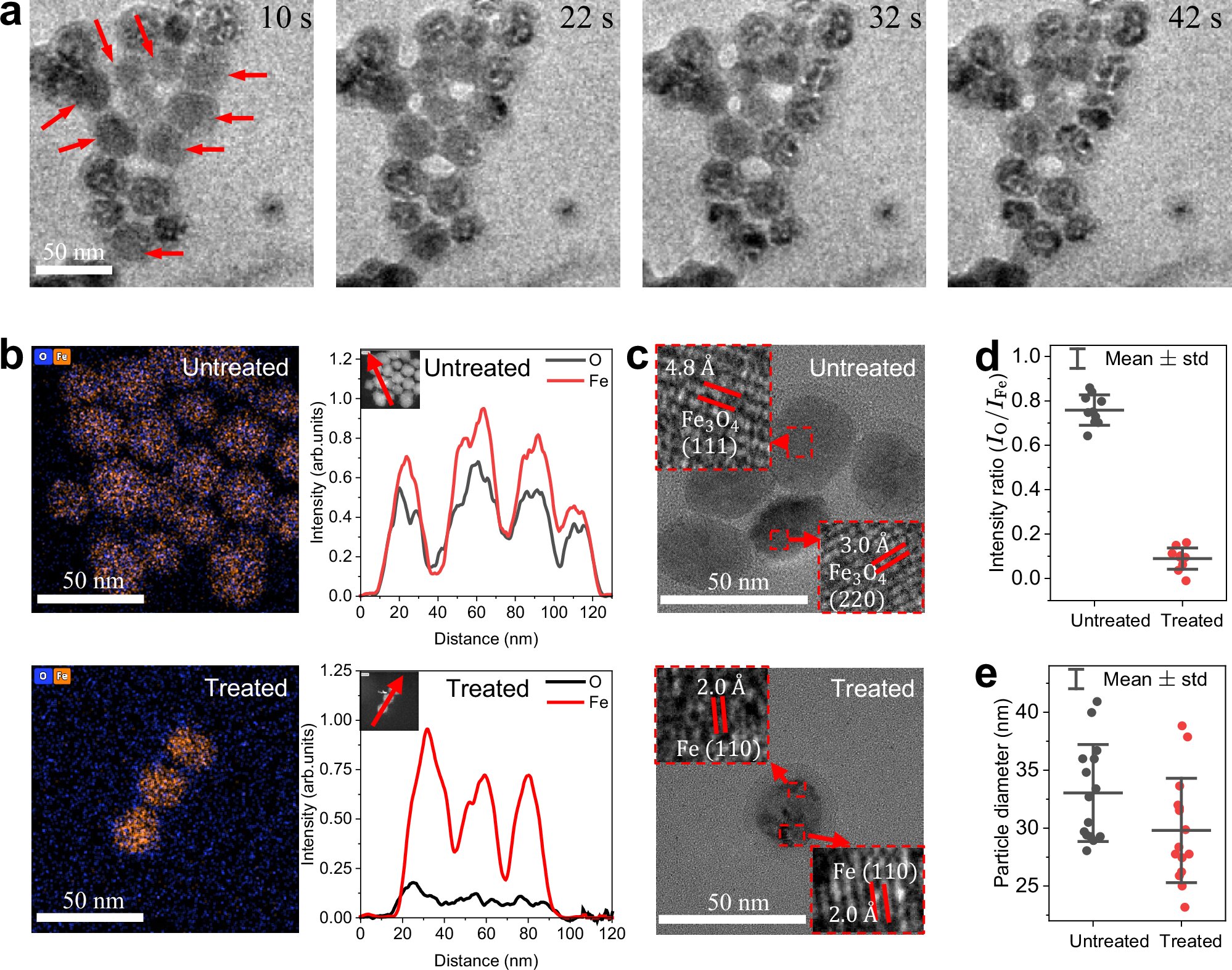
A research team at the University of Minnesota Twin Cities has investigated a new method to produce iron, the main component of steel. For the first time, the researchers were able to observe chemical reactions and iron formation in real-time at the nanometer scale.
This breakthrough has the potential to transform the global iron and steel production industry by improving energy efficiency and lowering costs. The study was recently published in Nature Communications.
According to the paper, the iron and steel industry is the largest industrial emitter of carbon dioxide, responsible for approximately 7% of the total global carbon dioxide emissions. Traditional methods for producing iron are pollution-heavy, relying on coke–a type of coal–to remove oxygen from iron ore—a process that has remained largely unchanged for centuries.
This method eliminates the CO2 emissions that have traditionally come from iron-making that can be performed at room temperature. This makes it potentially more efficient and desirable to industry and opens new pathways to innovation in the U.S.-based manufacturing industry.
The new process uses hydrogen gas plasma, an ionized gas which dissociates the hydrogen gas, producing an abundance of highly reactive hydrogen atoms. When the iron is exposed to this plasma, the highly reactive hydrogen atoms strip the oxygen from the ore producing pure iron and water vapor.

“We developed a new technique that allows us to monitor plasma-material interactions at the nanometer scale, which has never been done before,” said Jae Hyun Nam, first author on the paper and a Ph.D. student in the University of Minnesota Department of Mechanical Engineering.
The team partnered with Hummingbird Scientific, a company that builds products for electron, X-ray and ion microscopy, to create a specialized holder that fits inside of a transmission electron microscope.
“Overcoming the technical challenges of this research was one of the most difficult experiments we’ve done,” said Peter Bruggeman, a senior author on the paper and University of Minnesota Distinguished McKnight University Professor in the Department of Mechanical Engineering. “Generating plasmas on a scale around the size of a human hair, which is required to obtain the nanometer resolution, creates significant engineering challenges which we collaboratively tackled with Hummingbird Scientific.”
Previous optical methods could only be viewed at a few hundred nanometers—about a thousand times smaller than the diameter of a human hair. This new method will allow researchers to see things at a nanometer resolution, which is 100 times better than previous research.
“Creating plasma could be energetically a lot more efficient than heating the material,” said Andre Mkhoyan, a senior author on the paper, professor, and Ray D. and Mary T. Johnson Chair in the University of Minnesota Department of Chemical Engineering and Materials Science. “This innovation could lead to materials being modified with lower energy consumption, ultimately making processes more economically efficient.”
More information:
Jae Hyun Nam et al, Revealing the mechanisms of non-thermal plasma-enabled iron oxide reduction through nanoscale operando TEM, Nature Communications (2025). DOI: 10.1038/s41467-025-62639-4
Citation:
Steel production could get a makeover: Study captures real-time iron formation at the nanoscale (2025, September 29)
retrieved 30 September 2025
from https://phys.org/news/2025-09-steel-production-makeover-captures-real.html
This document is subject to copyright. Apart from any fair dealing for the purpose of private study or research, no
part may be reproduced without the written permission. The content is provided for information purposes only.