
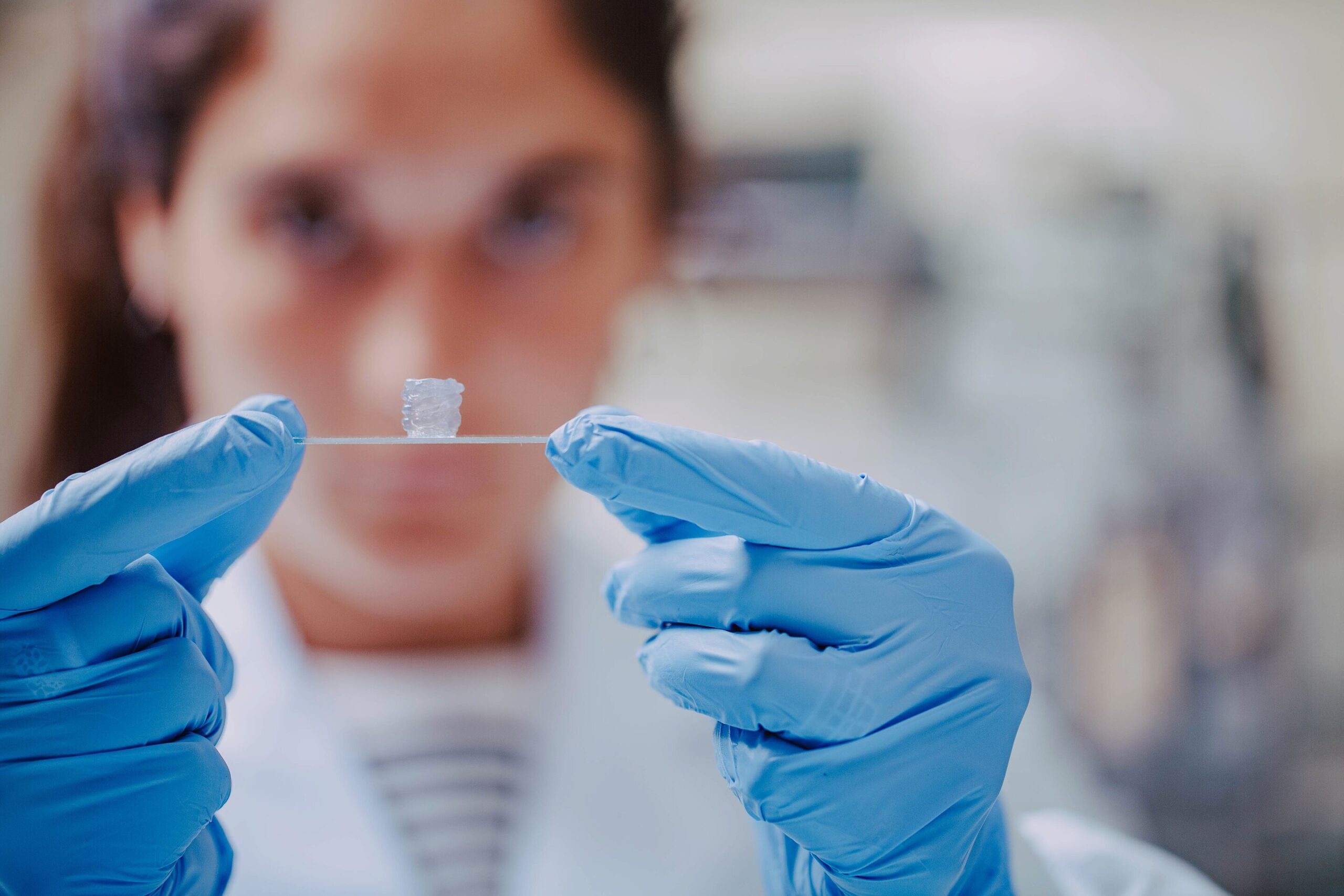
To explore possible treatments for various diseases, either animal models or human cell cultures are usually used first; however, animal models do not always mimic human diseases well, and cultures are far removed from tissue complexity. Advances in 3D printing, together with knowledge of biomaterials, are making it possible to recreate complex 3D tissue models in the laboratory.
CIC biomaGUNE’s Hybrid Biofunctional Materials group, led by the Ikerbasque Research Fellow Dorleta Jimenez de Aberasturi, is exploring how to combine advanced bioprinting techniques with nanomaterials to obtain tissue models containing vessels with various layers and which can respond when external stimuli are applied.
Body tissue is supplied with blood vessels that provide it with oxygen and nutrients, so it is important to develop new methods of producing them. The more realistic the organ and tissue models are, the better the causes of different diseases can be understood, the better the efficacy of new preparations with therapeutic potential can be studied, and the better they can be used as grafts, even.

Dr. Dorleta Jimenez de Aberasturi, Dr. Uxue Aizarna and Dr. Malou Henriksen of CIC biomaGUNE have made significant progress in the field of 3D bioprinting to develop materials enabling tissue models that are increasingly close to actual tissue to be produced for laboratory research purposes.
The researchers have published two papers in ACS Applied Materials & Interfaces, titled “Hybrid Plasmonic Bioresins and dECM-Based Materials for Volumetric Bioprinting of Vascular-Inspired Architectures” and “The Route to Artery Mimetics: Hybrid Bioinks for Embedded Bioprinting of Multimaterial Cylindrical Models.”
High-precision printers are used to produce materials of this type, and the “ink” has to have specific features. One of the challenges in this field is finding materials that can be used for printing and which also have optimal properties allowing the cells to survive.
Both the printing method and the properties of these materials are very important when it comes to producing high-quality tissue quickly and accurately; that is why this field of research is continuing to innovate to achieve increasingly better results.
It is also important to “find materials that can be combined to enable multi-material printing to be carried out, and thus stable structures to be created using various layers of each of these materials,” said Jimenez de Aberasturi.
Enhanced materials for more complex structures
In collaboration with a group from the University of Maastricht (Netherlands), the CIC biomaGUNE team managed, through embedded bioprinting, to “print soft or liquid materials that cannot be printed in air, as they would become distorted or collapse before solidifying. The ink used in this type of bioprinting promotes the survival of the cells used,” explained Jimenez de Aberasturi.
Using this technique, they managed to produce a model of a blood vessel with concentric cylinders that mimics the various layers of an artery.
Moreover, in collaboration with a team from the University of Utrecht (Netherlands), the team of researchers used volumetric bioprinting to get as far as adding valves to the artery model; this “involves forming the whole volume of the structure at the same time by projecting images of the design onto a specific volume of the resin or material developed, and then curing (hardening) the material, rather than gradually adding one layer after another.
“This technique allows complex shapes to be achieved at high speed,” added the CIC biomaGUNE researcher. The researchers managed “with great precision to design and print a valve that can be opened and closed by applying an external stimulus, similar to those found in the heart.” So, “we were able to print a valve, artery or a vein by copying the image of one belonging to an actual patient.”

In both pieces of work, methacrylated gelatin was used for the base; it is a soft material made from gelatin and which can be chemically modified so that it can become solid when exposed to light.
This type of gelatin is very useful in bioprinting, because it is compatible with cells and its viscosity can be modified. An extracellular matrix (i.e. the microscopic scaffolding between cells that supports body tissue) obtained from a pig’s pulmonary artery was added to this gelatin.
“The type of mechanical forces to which blood vessels are subjected due to changes in blood pressure is something important but difficult to recreate. These changes are important if we want to obtain realistic responses in the cells,” explained Dr. Jimenez de Aberasturi, lead researcher at the laboratory.
To do this, the researchers used gold nanoparticles, which have a special capability for interacting with light in a very intense and controlled manner.
Using this innovative combination of materials and bioprinting techniques, the CIC biomaGUNE team managed to make progress in producing artificial arteries that mimic the arterial pulse in response to a laser.
“By combining these improved materials and various printing techniques, we managed to produce more complex structures that are much more similar to those found in the human body,” they said.
However, they stressed that “this is a very complex process. Although we are now very close to making these arteries very real, there are still steps to be taken. And every step is a world unto itself.”
More information:
Uxue Aizarna-Lopetegui et al, Hybrid Plasmonic Bioresins and dECM-Based Materials for Volumetric Bioprinting of Vascular-Inspired Architectures, ACS Applied Materials & Interfaces (2025). DOI: 10.1021/acsami.5c03880
Uxue Aizarna‐Lopetegui et al, The Route to Artery Mimetics: Hybrid Bioinks for Embedded Bioprinting of Multimaterial Cylindrical Models, Advanced Functional Materials (2025). DOI: 10.1002/adfm.202419072
Citation:
3D bioprinting advances enable creation of artificial blood vessels with layered structures (2025, September 29)
retrieved 29 September 2025
from https://phys.org/news/2025-09-3d-bioprinting-advances-enable-creation.html
This document is subject to copyright. Apart from any fair dealing for the purpose of private study or research, no
part may be reproduced without the written permission. The content is provided for information purposes only.