
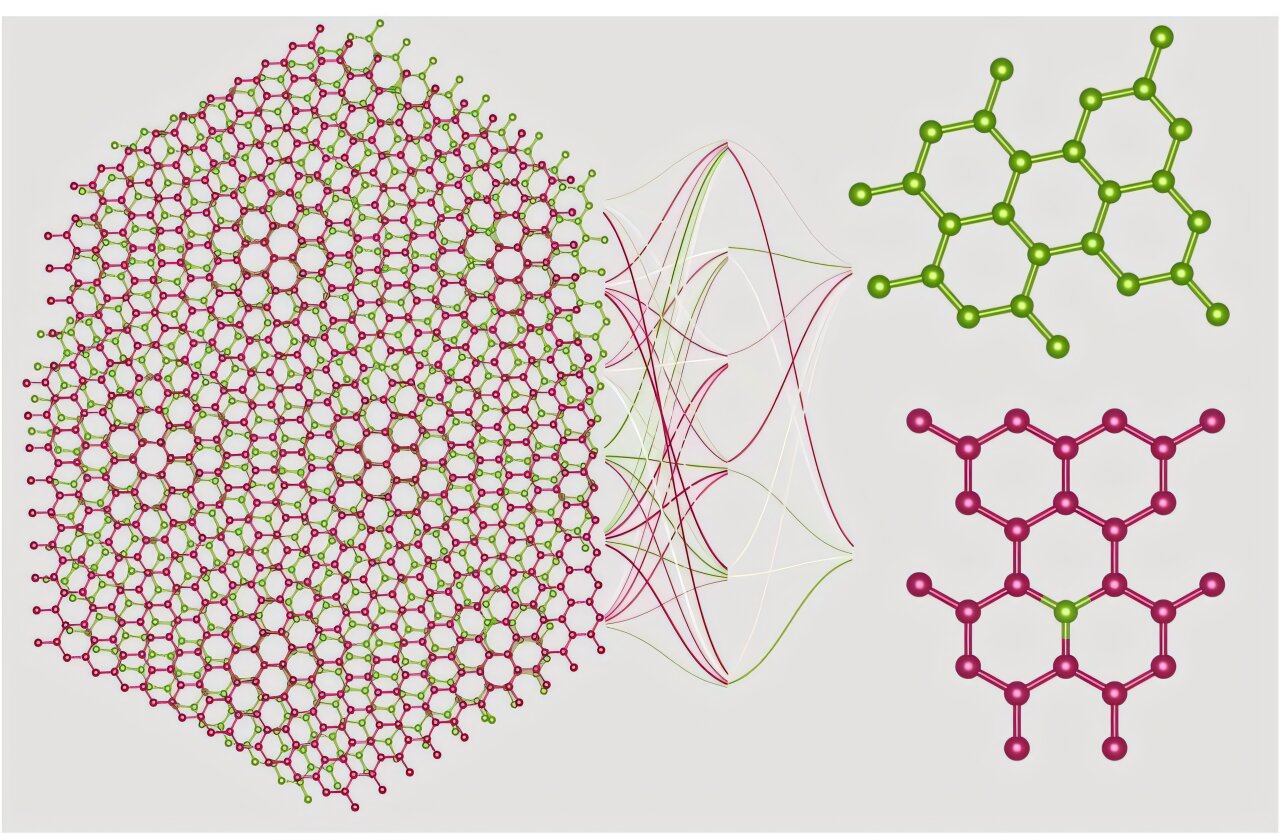
Researchers with the Department of Energy’s Oak Ridge National Laboratory and the University of Tennessee, Knoxville, have created an innovative method to visualize and analyze atomic structures within specially designed, ultrathin bilayer 2D materials. When precisely aligned at an angle, these materials exhibit unique properties that could lead to advancements in quantum computing, superconductors and ultraefficient electronics.
The research paper, published in the journal Nano Letters, provides details about the innovative method for visualizing atomic structures in 2D materials. These developments bolster U.S. leadership in materials innovation, energy technologies and secure communication, and they lay the groundwork for a future defined by leading-edge progress.
Visualizing atoms in moiré materials
Layering the 2D materials at a slight angle creates intricate moiré patterns, similar to the wavy distortion seen when two window screens overlap. While visually striking, the patterns complicate efforts to identify individual atoms, even with advanced imaging tools such as scanning transmission electron microscopy (STEM).
But knowing the locations of individual atoms is a crucial step for controlling defects or fine-tuning the material’s characteristics through techniques such as doping, where small amounts of other elements are added. The team’s findings challenge existing theories about atomic behavior in these complex materials.
“Theoretical models suggested that the substitutional site of a dopant atom in the material depended on its position within the moiré pattern. It has been very difficult or impossible to test those models with existing analysis tools. However, we devised a neural network trained to identify the location and layer of the dopant atoms in relation to the moiré pattern and conducted a detailed statistical analysis, which ultimately disproved that theory for our material synthesis technique.
“We were surprised to discover that the position of the atoms in the moiré pattern had no impact on the ease of atom substitution,” said Sumner Harris, an R&D staff scientist at the Center for Nanophase Materials Sciences at ORNL and co-author of the study. The machine learning model the team developed is called Gomb-Net, short for groupwise combinatorial network.
Machine learning uncovers atomic patterns
“Gomb-Net enables us to separate the layers, overcoming the limitations of traditional analysis methods,” Harris said. “Using the model, we deepened our understanding of how atoms are arranged within these complex structures, setting the stage for future research into understanding the unique properties of twisted 2D materials.”
Gomb-Net can be used on today’s personal computers, democratizing access to advanced analysis of moiré materials and is perfect for real-time deployment on electron microscopes for autonomous exploration of materials.
For the study’s experiment, the researchers added selenium, a nonmetal element that can tune a material’s electronic and optical behavior, to a twisted stack of two tungsten disulfide monolayers. These ultrathin layers, composed of tungsten and sulfur atoms just a few atoms thick, behave differently than the bulk material.
“By selectively replacing sulfur atoms in the stack with selenium, we aimed to investigate how the selenium was distributed within the intricate moiré patterns formed by the overlapping layers,” said Kai Xiao, a distinguished ORNL staff scientist in the Functional Hybrid Nanomaterials Group at CNMS, and co-author of the study.
The UT researchers used advanced STEM to visualize individual atoms in the twisted tungsten disulfide bilayer stack. This visualization provides vital information about the exact positions of the atoms and any possible defects that occurred during the material’s creation.
Implications for future technologies
Replacing sulfur with selenium can tune the electronic properties and adjust the band gap—the energy needed for electron motion, which is critical for semiconductors—while enhancing optical properties, or how the material interacts with light. This knowledge is essential for advancing technologies such as lasers and LED lights, making them more efficient and effective. Additionally, this tailored approach helps reduce defects, leading to more reliable and innovative technologies such as quantum computers.
This advancement extends beyond a specific material system, opening opportunities for all moiré materials. “We have talked to other microscopists studying moiré materials across the country, and in every conversation, they have an idea for how this analysis can be used for a system they are studying,” said Austin Houston, lead author and a doctoral student at UT. “This is really encouraging because it means we are working on something useful that has real potential to impact research across this field.”
More information:
Austin C. Houston et al, Atom Identification in Bilayer Moiré Materials with Gomb-Net, Nano Letters (2025). DOI: 10.1021/acs.nanolett.5c01460
Citation:
Scientists visualize atomic structures in moiré materials (2025, September 23)
retrieved 25 September 2025
from https://phys.org/news/2025-09-scientists-visualize-atomic-moir-materials.html
This document is subject to copyright. Apart from any fair dealing for the purpose of private study or research, no
part may be reproduced without the written permission. The content is provided for information purposes only.