
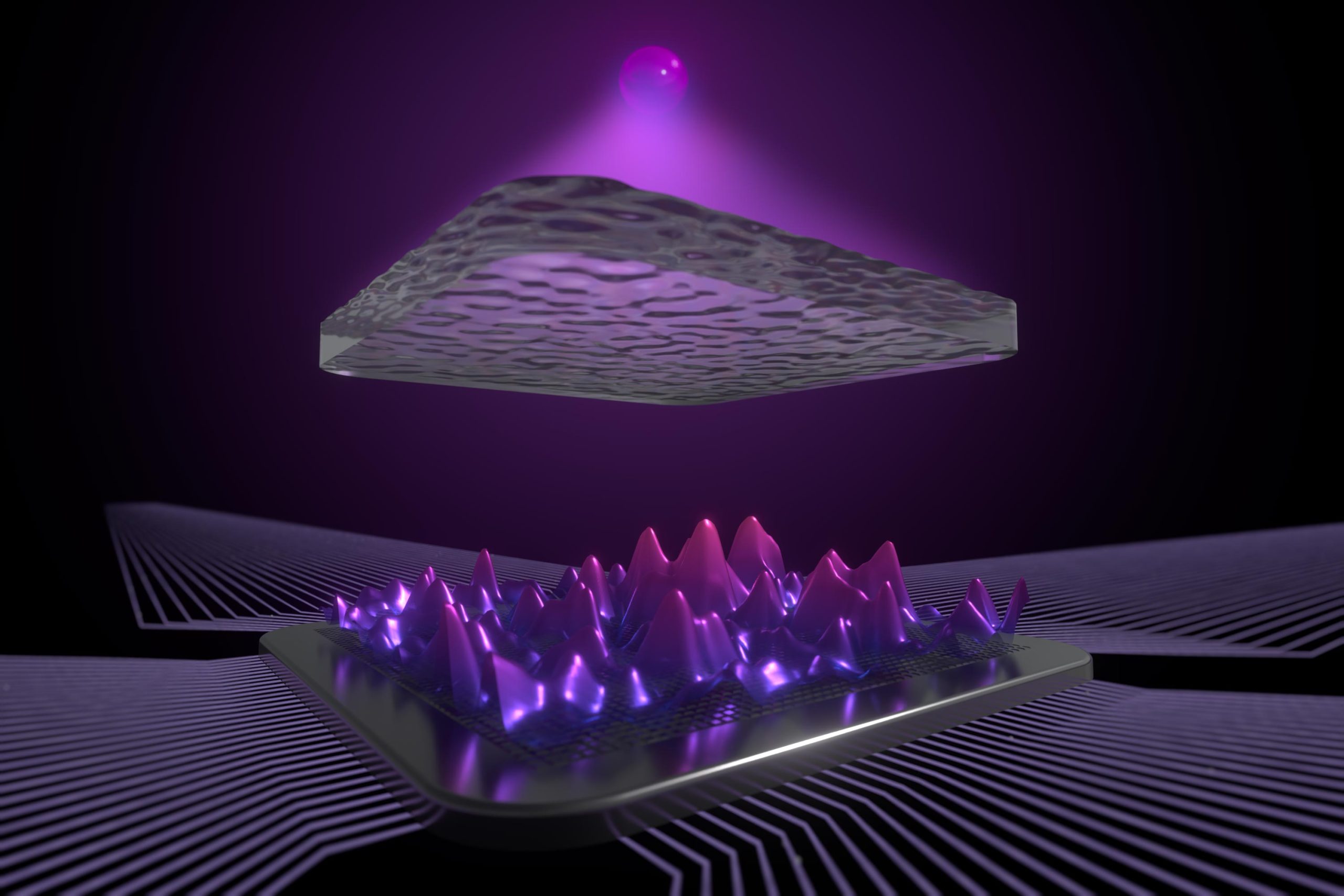
How precisely can an object be measured when all you have is a blurred image? At TU Wien, researchers have pushed the boundaries of possibility using artificial intelligence.
No image can ever be perfectly sharp. For over 150 years, scientists have understood that even the most advanced microscopes and cameras are subject to fundamental resolution limits that cannot be overcome. It is impossible to pinpoint the exact position of a particle with infinite accuracy, and some level of blur is always present. This constraint isn’t due to flaws in the technology, but rather stems from the inherent nature of light and how information is transmitted.
In light of this, researchers from TU Wien, the University of Glasgow, and the University of Grenoble set out to answer a fundamental question: What is the ultimate level of precision that optical techniques can achieve? And is it possible to get as close as possible to this theoretical boundary? The international team managed to define the lowest achievable limit of precision in theory and developed artificial intelligence systems based on neural networks that, after sufficient training, performed remarkably close to this limit. Their method is now being prepared for practical use in imaging technologies, including those found in medical diagnostics.
An absolute limit to precision
“Let’s imagine we are looking at a small object behind an irregular, cloudy pane of glass,” says Prof Stefan Rotter from the Institute of Theoretical Physics at TU Wien. “We don’t just see an image of the object, but a complicated light pattern consisting of many lighter and darker patches of light. The question now is: how precisely can we estimate where the object actually is based on this image – and where is the absolute limit of this precision?”
Such scenarios are important in biophysics or medical imaging, for example. When light is scattered by biological tissue, it appears to lose information about deeper tissue structures. But how much of this information can be recovered in principle? This question is not only of technical nature, but physics itself sets fundamental limits here.
The answer to this question is provided by a theoretical measure: the so-called Fisher information. This measure describes how much information an optical signal contains about an unknown parameter – such as the object position. If the Fisher information is low, precise determination is no longer possible, no matter how sophisticatedly the signal is analyzed. Based on this Fisher information concept, the team was able to calculate an upper limit for the theoretically achievable precision in different experimental scenarios.
Neural networks learn from chaotic light patterns
While the team at TU Wien was providing theoretical input, a corresponding experiment was designed and implemented by Dorian Bouchet from the University of Grenoble (F) together with Ilya Starshynov and Daniele Faccio from the University of Glasgow (UK). In this experiment, a laser beam was directed at a small, reflective object located behind a turbid liquid, so that the recorded images only showed highly distorted light patterns. The measurement conditions varied depending on the turbidity – and therefore also the difficulty of obtaining precise position information from the signal.
“To the human eye, these images look like random patterns,” says Maximilian Weimar (TU Wien), one of the authors of the study. “But if we feed many such images – each with a known object position – into a neural network, the network can learn which patterns are associated with which positions.” After sufficient training, the network was able to determine the object position very precisely, even with new, unknown patterns.
Almost at the physical limit
Particularly noteworthy: the precision of the prediction was only minimally worse than the theoretically achievable maximum, calculated using Fisher information. “This means that our AI-supported algorithm is not only effective, but almost optimal,” says Stefan Rotter. “It achieves almost exactly the precision that is permitted by the laws of physics.”
This realization has far-reaching consequences: With the help of intelligent algorithms, optical measurement methods could be significantly improved in a wide range of areas – from medical diagnostics to materials research and quantum technology. In future projects, the research team wants to work with partners from applied physics and medicine to investigate how these AI-supported methods can be used in specific systems.
Reference: “Model-free estimation of the Cramér–Rao bound for deep learning microscopy in complex media” by Ilya Starshynov, Maximilian Weimar, Lukas M. Rachbauer, Günther Hackl, Daniele Faccio, Stefan Rotter and Dorian Bouchet, 28 May 2025, Nature Photonics.
DOI: 10.1038/s41566-025-01657-6
Never miss a breakthrough: Join the SciTechDaily newsletter.