
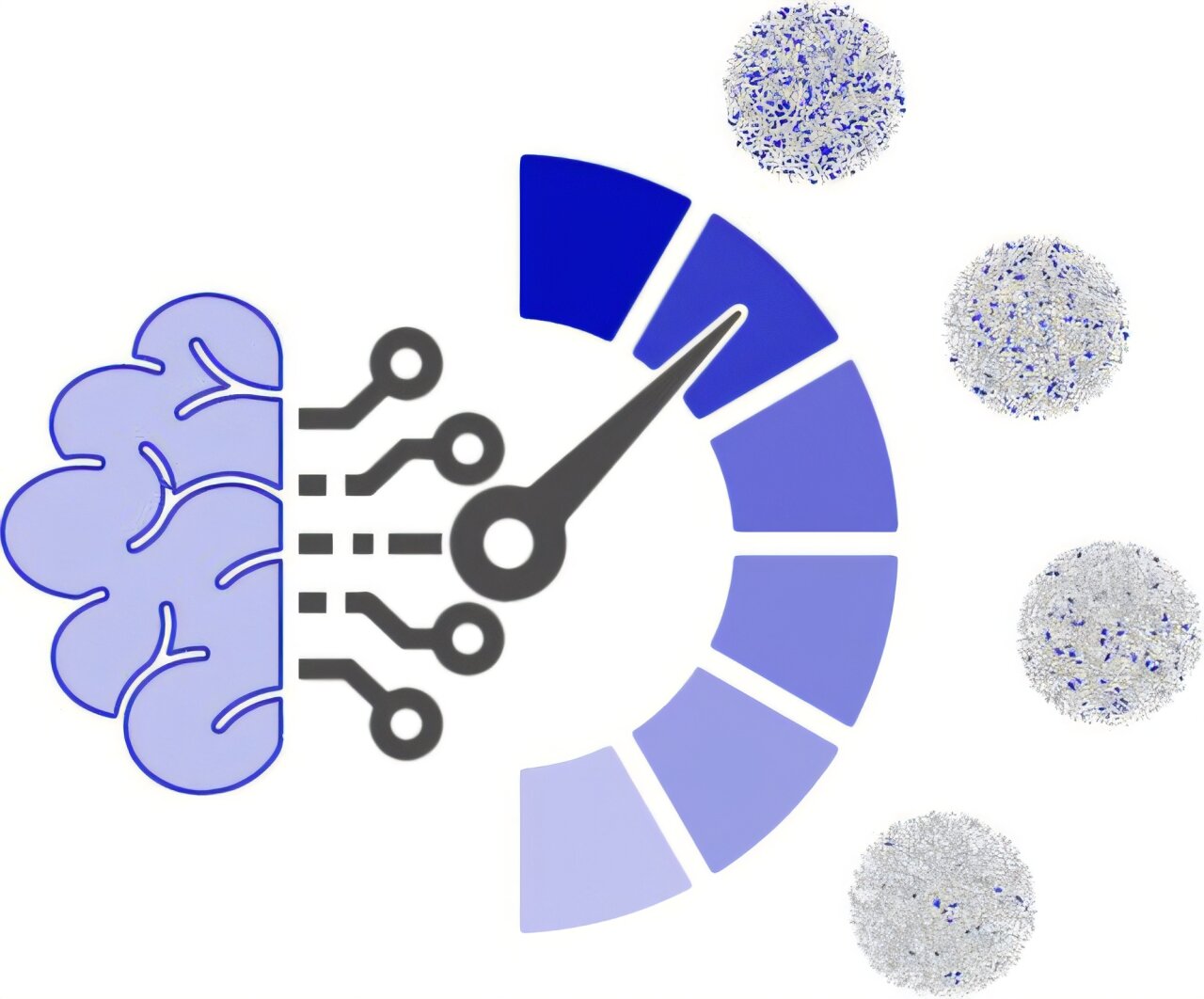
Biomedical engineers at Duke University have developed a platform that combines automated wet lab techniques with artificial intelligence (AI) to design nanoparticles for drug delivery. The approach could help researchers deliver difficult-to-encapsulate therapeutics more efficiently and effectively.
In a proof of concept, the team used the platform to create nanoparticles capable of delivering a difficult-to-encapsulate therapy for leukemia and optimized the design of a second anti-cancer nanoparticle. The research is published in the journal ACS Nano.
AI-based tools have transformed the drug development landscape by enabling researchers to better predict the biological, chemical and physical properties of potential therapeutic molecules. While this approach has been successful enough to identify drug candidates that are currently advancing through clinical trials, a majority of these platforms only focus on early-stage drug discovery.
Finding the right molecule is only half the battle, however, because a new drug still needs to be delivered to the right location. But the use of AI for these later stages of drug development, which could help researchers optimize formulation safety and delivery mechanisms, is still relatively unexplored.
“When you’re creating a nanoparticle, how well it works doesn’t just depend on the recipe, but also on the quantity of the various ingredients, including both the active drug and inactive materials,” said Zilu Zhang, a Ph.D. student in the lab of Daniel Reker, an assistant professor of BME. “Existing AI platforms can only handle one or the other, which limits their overall effectiveness.”
For example, researchers have developed several machine learning models to accelerate nanoparticle design by improving the materials selection process. These systems are trained using large data sets with fixed material ratios, but this rigidity also prevents the algorithms from learning how different ratios of materials could make these delivery systems more effective.
“AI can help us identify promising delivery molecules, but if you don’t mix them with the drug at a certain ratio, they won’t form a stable nanoparticle,” said Reker. “If we can identify the optimal mixture ratios, then we can form the particles and maintain their stability.”

Besides an inability to consider both ingredients and their quantities, current approaches face other challenges as well. More complex AI platforms are good at identifying properties and efficient ratios, but they require massive datasets for effective training. And while simpler approaches can use smaller datasets, they struggle to differentiate between similar materials.
Reker and Zhang hope to address these challenges using their new Tunable Nanoparticle platform guided by AI, called TuNa-AI. Using an automated liquid handling platform, the team created a dataset of 1,275 distinct formulations made up of different therapeutic molecules and excipients, which are nonactive substances like coloring agents, preservatives and other molecules that improve a drug’s physical properties and absorption.
“By using robotics, we were able to combine many different ingredients in many different recipes very systematically,” said Zhang. “Our AI model was then able to look at that data for how different materials perform under different conditions and extrapolate that knowledge to select an optimized nanoparticle.”
The team found that their TuNa-AI model resulted in a 42.9% increase in successful nanoparticle formation compared to standard approaches. As a proof of concept, they showed that their platform could successfully formulate a nanoparticle that more effectively encapsulated venetoclax, a chemotherapy used to treat leukemia. The venetoclax nanoparticles showed improved solubility and were able to more effectively halt leukemia cell growth in the laboratory compared to the non-encapsulated drug alone.
In a second case study, their AI-guided platform also reduced the use of a potentially carcinogenic excipient by 75% in a second chemotherapy drug’s formulation while preserving the drug’s efficacy and improving its biodistribution in mouse models.
“We showed that TuNa-AI can be used not only to identify new nanoparticles but also optimize existing materials to make them safer,” said Zhang.
Beyond expanding their platform to process other types of biomaterials for various therapeutic and diagnostic applications, the team is also actively collaborating with researchers and physicians both inside and outside of Duke to use this platform to improve drug delivery for difficult-to-treat diseases.
“This platform is a big foundational step for designing and optimizing nanoparticles for therapeutic applications,” said Reker. “Now, we’re excited to look ahead and treat diseases by making existing and new therapies more effective and safer.”
More information:
Zilu Zhang et al, TuNa-AI: A Hybrid Kernel Machine To Design Tunable Nanoparticles for Drug Delivery, ACS Nano (2025). DOI: 10.1021/acsnano.5c09066
Citation:
AI engineers nanoparticles for improved drug delivery (2025, September 22)
retrieved 23 September 2025
from https://phys.org/news/2025-09-ai-nanoparticles-drug-delivery.html
This document is subject to copyright. Apart from any fair dealing for the purpose of private study or research, no
part may be reproduced without the written permission. The content is provided for information purposes only.