
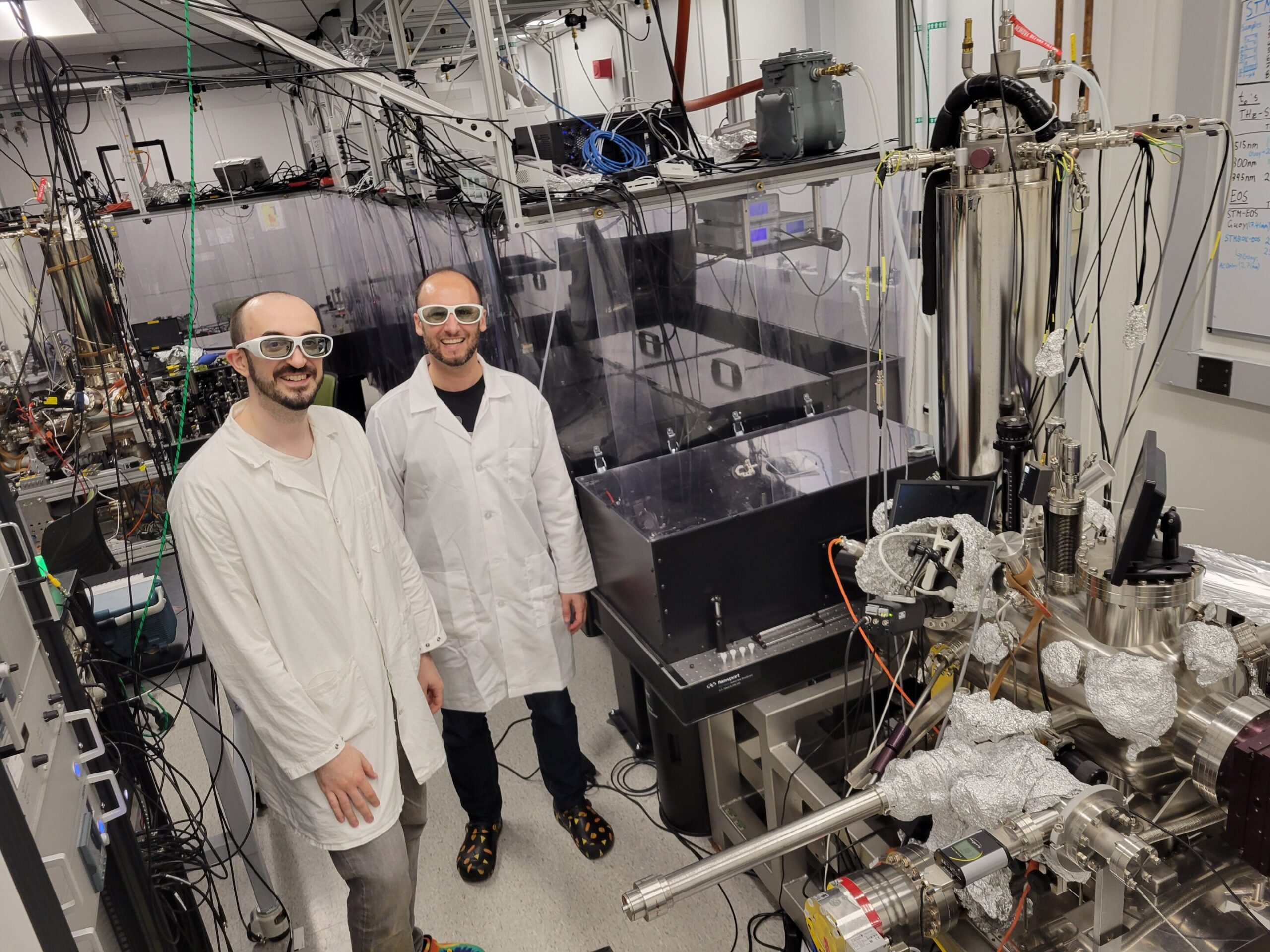
Researchers at Michigan State University have figured out how to use a fast laser to wiggle atoms in a way that temporarily changes the behavior of their host material. Their novel approach could lead to smaller and more efficient electronics—like smartphones—in the future.
Tyler Cocker, an associate professor in the College of Natural Science, and Jose L. Mendoza-Cortes, an assistant professor in the colleges of Engineering and Natural Science, have combined the experimental and theoretical sides of quantum mechanics—the study of the strange ways atoms behave at a very small scale—to push the boundaries of what materials can do to improve electronic technologies we use every day. The findings are published in the journal Nature Photonics.
“This experience has been a reminder of what science is really like because we found materials that are working in ways that we didn’t expect,” said Cocker. “Now, we want to look at something that is going to be technologically interesting for people in the future.”
Using a material called tungsten ditelluride, or WTe2, which is made up of a layer of tungsten, or W atoms, sandwiched between two layers of tellurium, or Te atoms, Cocker’s team conducted a series of experiments where they placed this material under a specialized microscope they built.
While microscopes are typically used to look at things that are hard for the human eye to see, like individual cells, Cocker’s scanning tunneling microscope can show individual atoms on the surface of a material. It does this by moving an extremely sharp metal tip over the surface, “feeling” atoms through an electrical signal, like reading braille.
While looking at the atoms on the surface of WTe2, Cocker and his team used a super-fast laser to create terahertz pulses of light that were moving at speeds of hundreds of trillions of times per second. These terahertz pulses were focused onto the tip.
At the tip, the strength of the pulses was increased enormously, allowing the researchers to wiggle the top layer of atoms directly beneath the tip and gently nudge that layer out of alignment from the remaining layers underneath it. Think of it like a stack of papers with the top sheet slightly crooked.

While the laser pulses illuminated the tip and WTe2, the top layer of the material behaved differently, exhibiting new electronic properties not observed when the laser was turned off. Cocker and his team realized the terahertz pulses, together with the tip, could be used like a nanoscale switch to temporarily change the electrical properties of WTe2 to upscale the next generation of devices. Cocker’s microscope could even see the atoms moving during this process and photograph the unique “on” and “off” states of the switch they had created.
When Cocker and Mendoza-Cortes realized that they were working on similar projects from different perspectives, Cocker’s experimental side joined with Mendoza’s theoretical side of quantum mechanics. Mendoza-Cortes’ research focuses on creating computer simulations. By comparing the results of Mendoza’s quantum calculations to Cocker’s experiments, both labs yielded the same results—independently and by using different tools.
“Our research is complementary; it’s the same observations but through different lenses,” said Mendoza-Cortes. “When our model matched the same answers and conclusions they found in their experiments, we have a better picture of what is going on.”
The Mendoza lab computationally found that the layers of WTe2 shift by 7 picometers while they are wiggling, which is hard to observe by the specialized microscope alone. Also, they were able to confirm that the frequencies at which the atoms wiggle match between the experiment and theory, but the quantum calculations can tell which way they wiggle and by how much.
“The movement only occurs on the topmost layer, so it is very localized,” said Daniel Maldonado-Lopez, a fourth-year graduate student in Mendoza’s lab. “This can potentially be applied in building faster and smaller electronics.”
Cocker and Mendoza-Cortes hope this research will lead to the use of new materials, lower costs, faster speeds and greater energy efficiency for future phones and computer technology.
“When you think about your smartphone or your laptop, all of the components that are in there are made out of a material,” said Stefanie Adams, a fourth-year graduate student in Cocker’s lab. “At some point, someone decided that’s the material we’re going to use.”
More information:
Terahertz field control of surface topology probed with subatomic resolution, Nature Photonics (2025). DOI: 10.1038/s41566-025-01751-9.
Citation:
‘Wiggling’ atoms may lead to smaller, more efficient electronics (2025, September 16)
retrieved 20 September 2025
from https://phys.org/news/2025-09-wiggling-atoms-smaller-efficient-electronics.html
This document is subject to copyright. Apart from any fair dealing for the purpose of private study or research, no
part may be reproduced without the written permission. The content is provided for information purposes only.