
Soft microrobots can manipulate individual cells
Researchers in Hungary have developed microscopic tools able to capture and move individual cells with more ease and efficiency.
For decades, the dream of microscopic robots capable of performing intricate tasks within the human body and other environments has fuelled scientific research and innovation. These tiny machines, often referred to as microrobots, have the potential to revolutionise fields ranging from medicine to environmental science by offering unparalleled precision and control at the cellular level.
Now, this futuristic vision has moved another step closer to reality. Researchers in Hungary have made a significant advance by designing soft microrobots that can effortlessly capture and manipulate individual cells, without the cells needing any sort of pre-treatment.
A team at the HUN-REN Biological Research Centre, Szeged, recently published a study in Advanced Materials, describing their work. They explain how they developed flexible microrobots, guided by lasers, able to gently capture and release cells. Unlike previous methods that required cells to be treated beforehand, these microrobots can hold and move cells without any special preparation. This innovation allows for more efficient and less invasive methods.
Single-cell analysis has become a cornerstone of biological research, enabling scientists to delve into the genetic and proteomic makeup of individual cells. Achieving this feat requires the manipulation of delicate objects at tiny scales with extreme precision, often involving complex and cumbersome techniques. Traditional methods like microgrippers and optical tweezers have made significant strides, but they still face challenges, particularly concerning the treatment and potential damage to cells.
The new, soft microrobots developed at HUN-REN can overcome these limitations through their elasticity and precise control. As well as capturing and moving, another key advantage is their ability to release the cells at any time. The team demonstrated this versatility by designing three types of structures, each able to handle a distinct cell manipulation task:
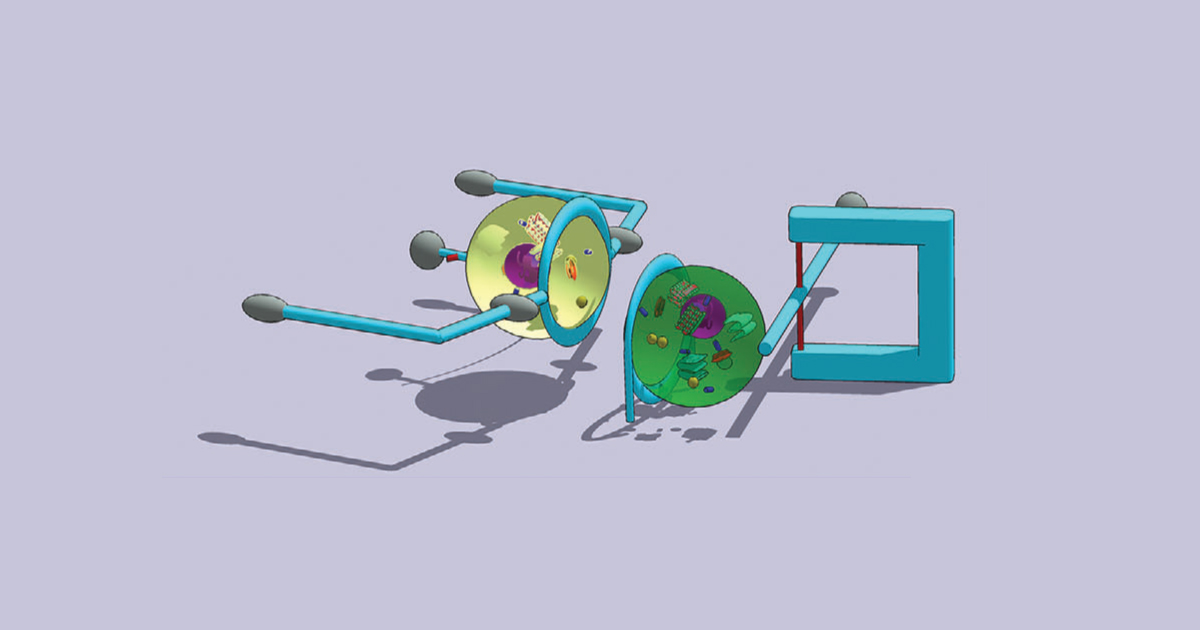
1. Cell Transporter: This structure is designed to enclose and move a cell selected from among many surrounding cells in a microfluidic environment. It consists of two half-spheres that open to accommodate the cell, allowing it to be transported with minimal force and released at any desired location.
2. Cell Holder: The second type is somewhat the opposite to the first: it holds a cell firmly, restricting its movement to within 50 nanometres. This tool’s purpose is to keep the cell still for imaging. A huge additional benefit is being able to rotate it to any preferred orientation under the microscope to access imaging directions at will. The team demonstrated this microtool’s potential by using it to improve the optical resolution of 3D fluorescence imaging of cells.
3. Cell Interaction Initiator: This setup uses two structures to facilitate controlled cell-cell interactions. One structure holds a cell firmly, while the other manoeuvres a second cell into contact, enabling precise observation of the interaction process and the changes at a molecular level.
The microrobots are made using a laser-based, additive microfabrication technique known as two-photon polymerisation. This method allows the creation of intricate 3D structures that are both robust and flexible. The deformable parts of the structures are as thin as 300 nanometres, which is necessary for the optical tweezers to bend them.
“We believe that the presented optical tweezers-based methodology using task-specific microtools will allow the investigation of single, non-adherent cells in a much more efficient way,” the researchers write. “This proves that soft micro-robotics has huge potential in biological applications.”
Comments »
If you enjoyed this article, please consider sharing it: