
Polymer-based conductive nanocomposites, particularly those incorporating carbon nanotubes, are highly promising for the development of flexible electronics, soft robotics and wearable devices. However, CNTs are difficult to work with as they tend to agglomerate, making it hard to obtain a uniform dispersion. Moreover, conventional methods limit control over CNT distribution and shape.
To overcome these challenges, researchers are turning to additive manufacturing (AM) or 3D printing methods, such as vat photopolymerization (VPP), which offer excellent design freedom with high printing accuracy.
In this method, a light is used to selectively cure and harden layers of an ink within a vat, gradually building a 3D object. Despite its advantages, it also poses several challenges. The presence of CNTs affects the printability and curing properties of the inks. Moreover, simultaneously achieving high stretchability and electrical conductivity is a major challenge.
Now, a research team led by Professor Keun Park and Associate Professor Soonjae Pyo from the Department of Mechanical System Design Engineering at Seoul National University of Science and Technology in Korea has successfully fabricated highly stretchable, electrically conductive CNT-nanocomposites, using VPP-type 3D printing.
“Our new CNT-nanocomposites are optimized specifically for VPP-based processes, allowing fabrication of highly complex 3D structures,” explains Prof. Park. “We also used these materials to additively manufacture new piezoresistive sensors and integrated them into a wearable health monitoring device.”
Their study is published in the journal Composite Structures.
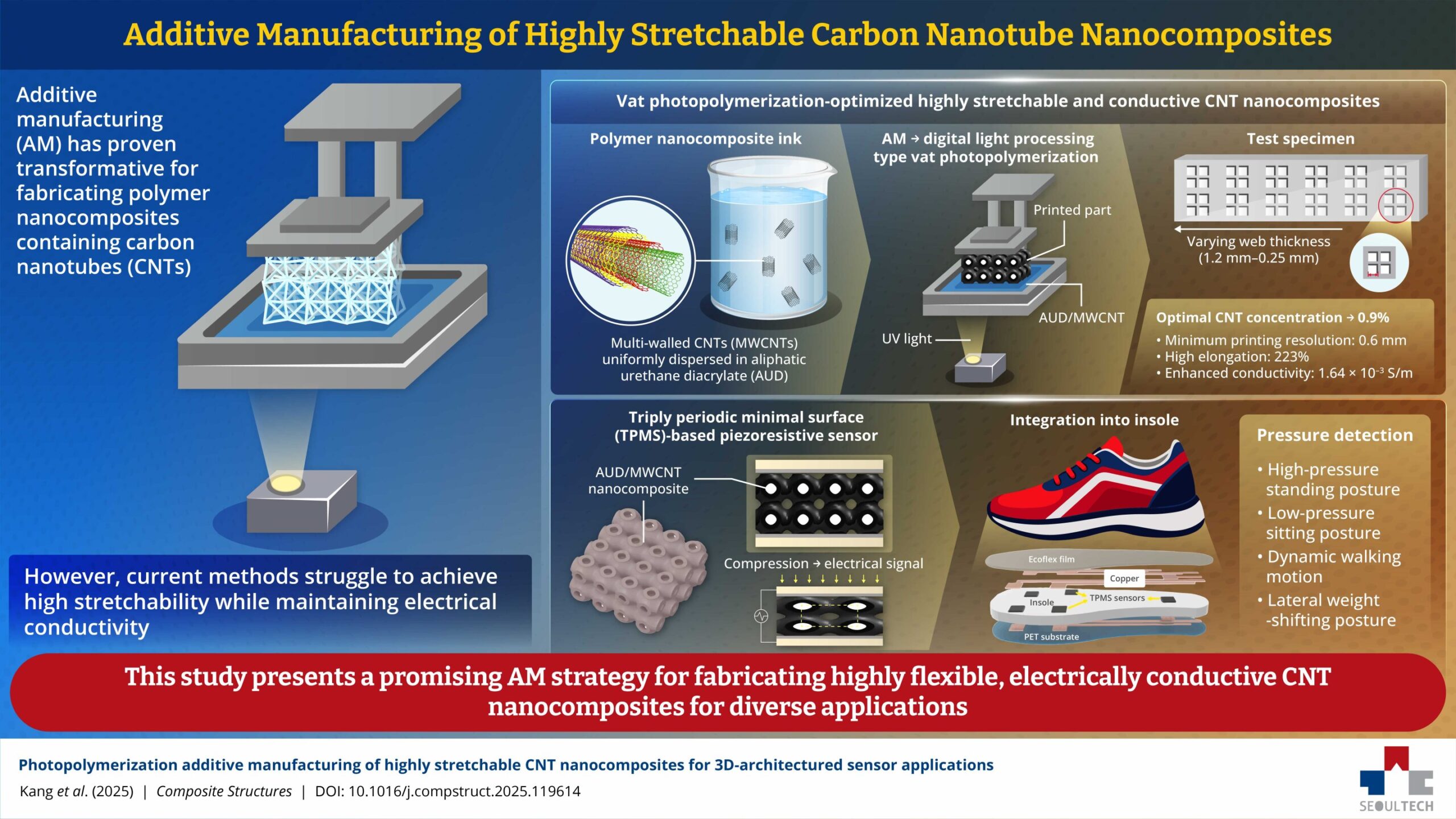
The team first prepared polymer nanocomposite inks by uniformly dispersing multi-walled carbon nanotubes (MWCNTs) into an aliphatic urethane diacrylate (AUD) resin, with concentrations ranging from 0.1 to 0.9 weight%. To achieve uniform dispersion, they agitated the mixture using ultrasonic waves. The prepared inks were then analyzed to determine the optimal printing conditions.
Next, the team additively manufactured test specimens using the various inks and tested them for their mechanical and electrical properties, as well as printing resolution (the minimum thickness that can be printed). Results showed that the formulation with 0.9 weight% CNT offered the best balance of properties.
It could stretch up to 223% of its original length before breaking, while still achieving a remarkable electrical conductivity of 1.64 ×10⁻³ S/m, surpassing that of previously reported materials. It also achieved a printing resolution of 0.6 mm.
To demonstrate practical applicability, the researchers used the optimized CNT nanocomposite to 3D print flexible triply periodic minimal surface (TPMS)-based piezoresistive sensors that showed high sensitivity and reliable performance. Importantly, they integrated these sensors into an insole to create a smart-insole platform.
Using this platform, the team could monitor the pressure distribution at the bottom of the foot in real time, detecting different human movements and postures.
“The developed smart-insole device demonstrates the potential of our CNT nanocomposites for 3D printing the next generation of highly stretchable and conductive materials,” said Prof. Pyo. “We believe these materials will be indispensable for wearable health monitors, flexible electronics and smart textiles.”
More information:
Jiwan Kang et al, Photopolymerization additive manufacturing of highly stretchable CNT nanocomposites for 3D-architectured sensor applications, Composite Structures (2025). DOI: 10.1016/j.compstruct.2025.119614
Citation:
3D-printed carbon nanotube sensors show potential for smart health monitoring (2025, September 26)
retrieved 26 September 2025
from https://phys.org/news/2025-09-3d-carbon-nanotube-sensors-potential.html
This document is subject to copyright. Apart from any fair dealing for the purpose of private study or research, no
part may be reproduced without the written permission. The content is provided for information purposes only.