
30 TB hard drive launched by Seagate
The capacity of data storage has reached another new level with Seagate launching the first ever 30 terabyte (TB) hard drive, just three years after the 20 TB milestone.
Launched in 1980, Seagate’s first product, the ST-506, had a storage capacity of 5 megabytes (MB). It also became the first ever 5.25″ hard disk drive (HDD), making it possible to put drives in personal computers at volume. Seagate established itself as a prominent industry player and began shipping millions of units.
In the 45 years since its founding, the company has passed numerous milestones, with each new generation of HDDs offering leaps in density. The first HDDs to reach 1 gigabyte (GB) emerged in the early 1990s, with capacities of 1 terabyte (TB) following in the late 2000s. Data reading and writing speeds have also improved greatly, with faster revolutions per minute (RPM), alongside the introduction of solid-state drives (SDDs).
These innovations have made the ST-506’s capacity appear laughably small by comparison. Six million of them would be needed to match today’s standards – equivalent to filling the volume of about 490 shipping containers. And yet, the world’s demand for storage continues to increase rapidly, year after year.
In fact, the need for improved hard drives has never been greater, with exponentially growing volumes of data from high-definition video content, generative AI, extensive scientific datasets, and the ever-increasing digital footprint of businesses and individuals alike. In 2023, the cumulative volume of data created globally reached 120 zettabytes, which is 120 billion terabytes, or 14.8 terabytes for every human being on Earth. This figure is likely to surpass 147 zettabytes in 2024, according to German company Statista.
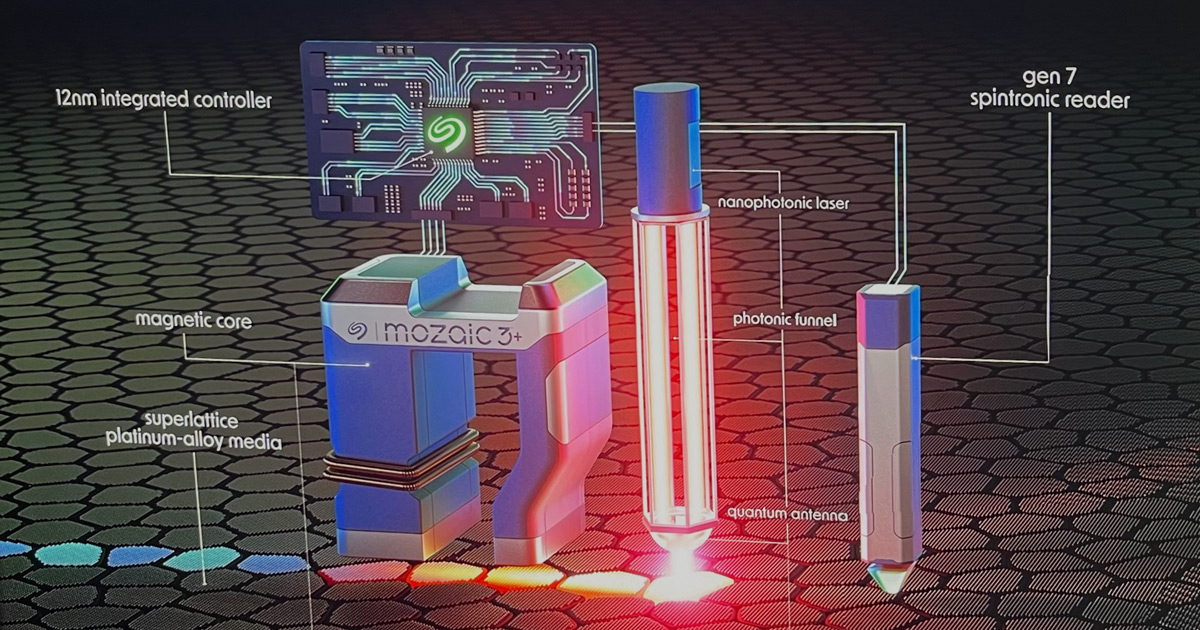
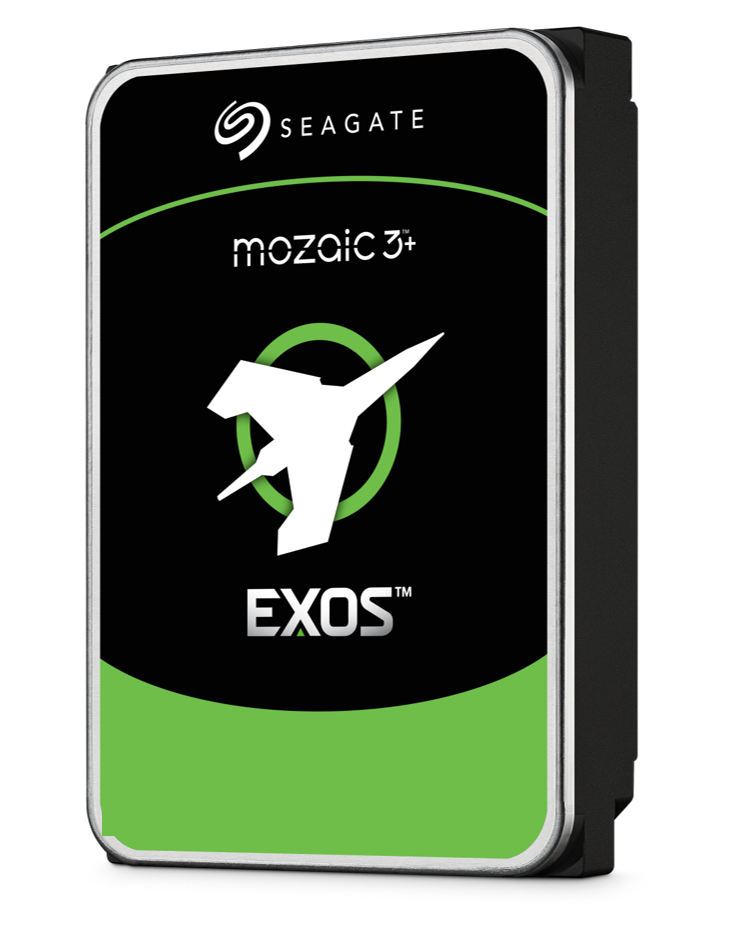
This month, Seagate is launching the Mozaic 3+ hard drive platform, part of its flagship Exos product family. This incorporates Heat-Assisted Magnetic Recording (HAMR) technology, which significantly increases data density on the drive platters. HAMR achieves this by using a “nanophotonic laser” to heat the disk material during the writing process, allowing for much narrower data tracks and smaller data bits. As illustrated below, this also incorporates the Gen 7 Spintronic Reader, one of the world’s smallest and most sensitive magnetic field reading sensors, alongside a 12 nanometre (nm) integrated controller.
Mozaic 3+ can offer areal densities of 3 TB per platter, with 10 platters allowing a total of 30 TB per drive. If upgrading from a 16 TB conventional perpendicular magnetic recording (PMR) hard drive (the average capacity in large-scale data centres), this effectively doubles capacity in the same footprint.
This represents an inflection point in storage, according to Seagate, which has a roadmap for 4 TB and 5 TB+ per platter in the coming years. The company is aiming to achieve 50 TB hard drives by 2026 and may reach 100 TB by 2030.
“Hard drive areal density improvements are critical for economically and efficiently expanding the installed base of hard drive-based mass storage, especially in data centres,” said John Rydning, Research Vice President at IDC Global DataSphere, in a press release. “Seagate’s innovative areal density breakthrough is timely and will enable it to deliver increasingly higher capacity hard drive products for many years.”
Energy use in data centres has become an increasing concern in recent years, given the climate and other environmental impacts. The new Mozaic 3+ platform will provide a 40% improvement in per terabyte power consumption and a 55% reduction in embodied carbon per terabyte, compared to traditional PMR drives.
“Seagate is the world’s only hard drive manufacturer with the areal density capability to get to 3 TB per platter and with 5 TB on the horizon,” said Dave Mosley, Seagate’s CEO. “As AI use cases put a premium on raw data sets, more companies are going to need to store all the data they can. To accommodate the resulting masses of data, areal density matters more than ever.”
“The Mozaic 3+ platform represents more than just HAMR technology,” he added. “It comprises several industry-first innovations that we’ve integrated to help us scale areal density.”
Comments »
If you enjoyed this article, please consider sharing it: