
More heat is transferred between objects that are just a few nanometers apart than physics theory predicts. A research team at the University of Oldenburg has now confirmed this phenomenon, which was first observed several years ago, using extremely precise measurements.
In the current issue of Physical Review Letters, the researchers, led by Prof. Dr. Achim Kittel and PD Dr. Svend-Age Biehs, report that across distances of just a few nanometers the heat transfer values from a warm measuring probe to a cold sample surface are around a hundred times higher than theoretical predictions would suggest.
This measurement confirms the results of experiments carried out by the Oldenburg group in 2017, according to which radiative heat values in the “extreme near-field regime” are significantly higher than the theoretical predictions. The underlying cause of this phenomenon is not yet understood.
The radiation laws formulated by physicists Max Planck and Gustav Kirchhoff describe heat transfer between two objects via thermal radiation. Planck’s fundamental formulas can be used to calculate the maximum amount of energy that a body can radiate as heat.
Scientists have known for some time that this limit no longer applies in the near-field region—which corresponds to distances of less than ten micrometers. At such distances, the heat flux from one body to another can exceed the value predicted by Planck’s law by a factor of a thousand. This phenomenon is well understood, both experimentally and in theory.
“In principle, any material can transfer far more heat in the near field than should be possible according to Planck’s radiation law,” explains Biehs.
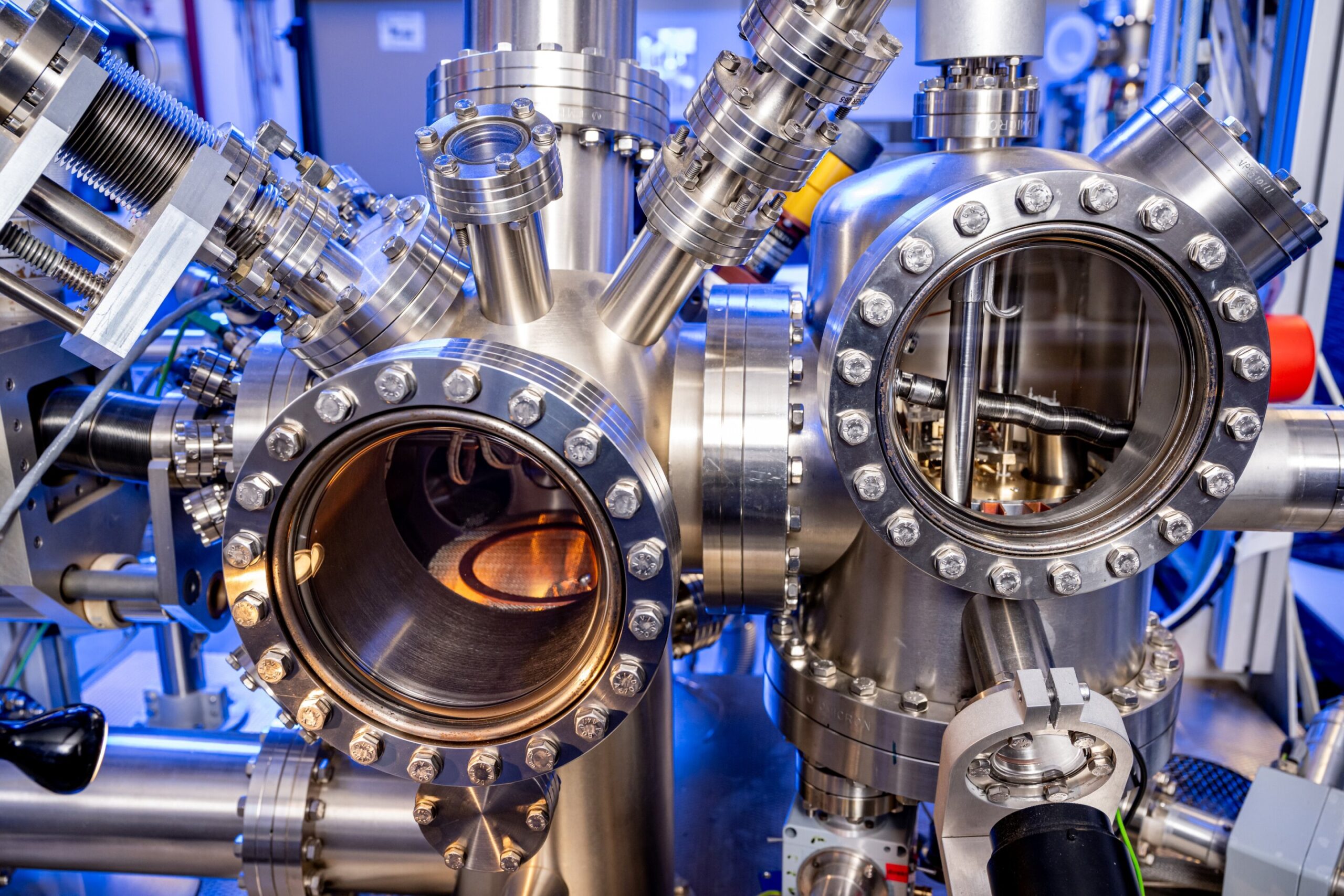
In 2017, an Oldenburg team led by Kittel and Biehs found evidence that at even smaller distances—less than ten nanometers—heat transfer values increase dramatically. The scientists performed their measurements using a unique near-field scanning thermal microscope, a type of thermal camera especially developed in Oldenburg for measuring heat currents with nanometer resolution. However, at the time the team was unable to entirely rule out the possibility of the effect being caused by impurities or measurement errors.

In the current study, the researchers changed their measurement set-up to be able to investigate the transition from near-field to extreme near-field radiative heat transfer with high precision at various distances. Before initiating the measurements, both the measuring probe and the sample, a thin gold film, underwent a particularly thorough multi-step cleaning process.
In addition, instead of a sharp tip, this time a gold-coated sphere was used as the probe of the thermal microscope. This decreased the lateral resolution of the heat transfer drastically but enabled highly precise measurements of the transferred heat values to larger distances.
“We basically turned a Ferrari into a tractor, but in doing so we increased the accuracy of heat transfer measurements in the transition regime between the near-field and the extreme near-field regime,” Kittel explains.
The experiments were carried out by undergraduate Fridolin Geesmann as part of his bachelor’s thesis, with assistance from Philipp Thurau and Sophie Rodehutskors. The results of the experiments indicate that heat transfer in the extreme near field increases by a factor of one hundred compared to the predicted values. The team is now confident that any measurement uncertainty is ruled out and that this is indeed an effect which is not explained by existing theoretical models.
“This is without doubt of far-reaching significance, because the result calls into question our current understanding of heat transfer in the nanometer range,” says Kittel, adding that more systematic studies aimed at finding an explanation would be worthwhile.
The new insights could also make it possible for researchers to better control the temperature of nanosystems in fields such as nanoelectronics or nanooptics where it may be necessary to heat or cool objects—for instance, the mirrors used in high-precision laser experiments—without touching them.
More information:
F. Geesmann et al, Transition from Near-Field to Extreme Near-Field Radiative Heat Transfer, Physical Review Letters (2025). DOI: 10.1103/lcz1-f5v9
Provided by
Carl von Ossietzky-Universität Oldenburg
Citation:
Unexpectedly high heat transfer on the nanoscale confirmed (2025, October 23)
retrieved 23 October 2025
from https://phys.org/news/2025-10-unexpectedly-high-nanoscale.html
This document is subject to copyright. Apart from any fair dealing for the purpose of private study or research, no
part may be reproduced without the written permission. The content is provided for information purposes only.