
Graphene, which is comprised of a single layer of carbon atoms arranged in a hexagonal lattice, is a widely used material known for its advantageous electrical and mechanical properties. When graphene is stacked in a so-called rhombohedral (i.e., ABC) pattern, new electronic features are known to emerge, including a tunable band structure and a non-trivial topology.
Due to these emerging properties, electrons in rhombohedral graphene can behave as if they are being influenced by “hidden” magnetic fields, even if no magnetic field is applied to them. While this interesting effect is well-documented, closely studying how electrons organize themselves in the material, with their spins and valley states pointing in different directions, has so far proved challenging.
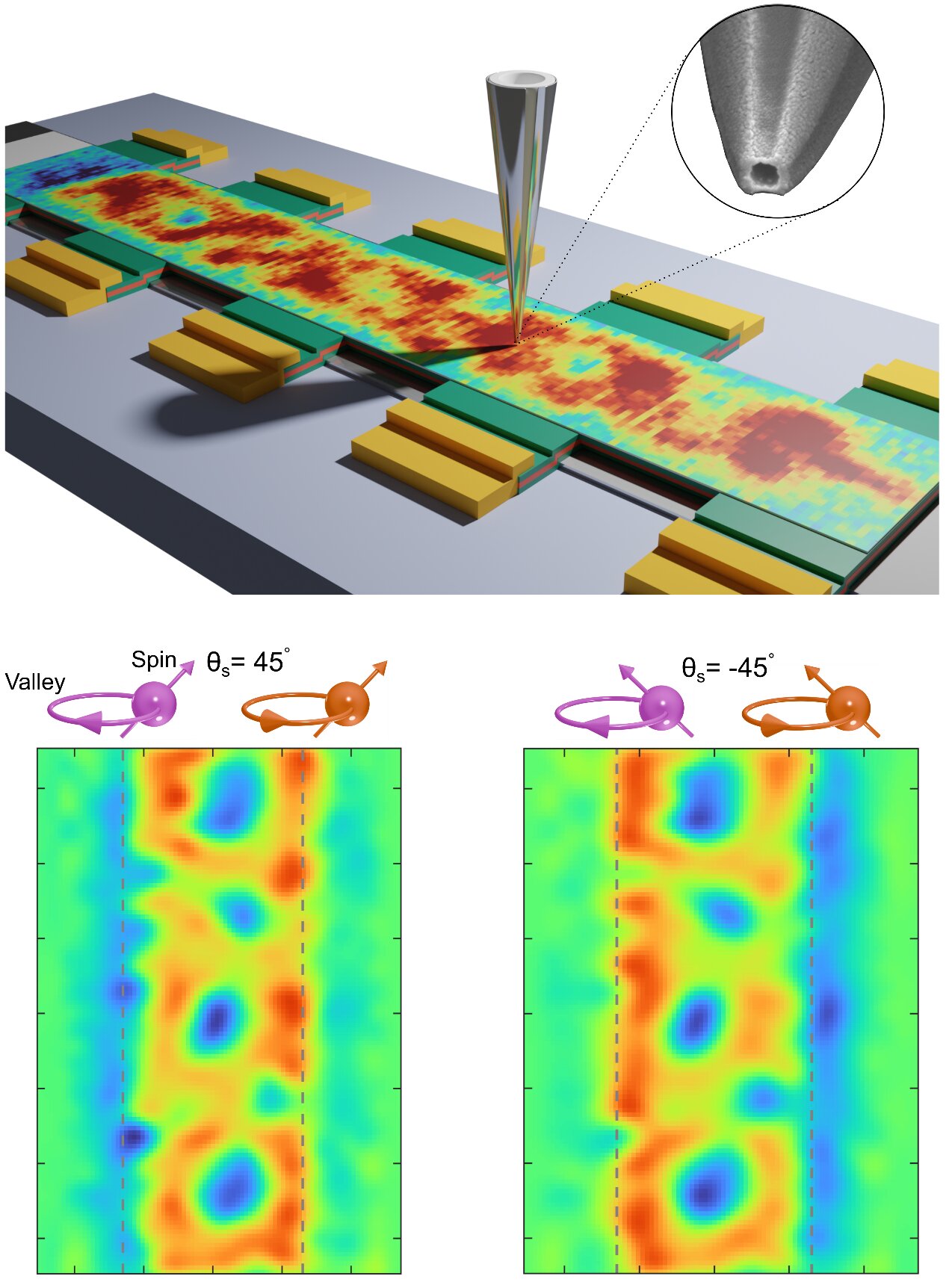
Researchers at Weizmann Institute of Science recently set out to further examine the local magnetization textures in rhombohedral graphene, using a nanoscale superconducting quantum interference device (nano-SQUID). Their paper, published in Nature Physics, offers new insight into the physical processes governing the correlated states previously observed in the material.
“Our paper began with a simple question: in rhombohedral multilayer graphene, how do the four isospin flavors (two spins, two valleys) magnetically order in the absence of external magnetic field at low temperature?” Prof. Eli Zeldov, group leader and senior author of the paper, told Phys.org.
“In these systems, the large density of states promotes a Stoner-like instability that lifts the fourfold degeneracy of the nominal metallic state, producing half-metal (two-fold) and quarter-metal (one-fold) phases as the carrier density is reduced. These symmetry-broken metals are promising for non-volatile memory and a fertile arena for correlated physics, so resolving their magnetic textures and underlying electron-electron interacting energy scales is essential.”
Most earlier studies aimed at uncovering the isospin texture of rhombohedral graphene relied on bulk, high-magnetic field probes. These probes can identify isospin degeneracies in materials, yet they do not yield much insight into the local magnetic anisotropy and the underlying interacting energy scales at a magnetic field close to zero.
As part of their study, Prof. Zeldov’s group thus employed a nano-SQUID-on-tip probe, which is essentially a tiny but ultrasensitive superconducting sensor built on the apex of a sharp pipette. This probe, operated at millikelvin temperatures, allowed them to directly image isospin-related magnetic textures in multilayer graphene for the first time.
“We scanned a few hundreds of nanometers above the dual-gated rhombohedral tetralayer graphene devices inside a vector magnetic field,” explained Dr. Surajit Dutta, co-first author of the paper. “The sensor is extremely sensitive and able to measure magnetic field strength down to 10 nanotesla. To get the magnetic pattern, we modulate the electron density by applying small a.c. voltages to the gates. This tiny density wiggle changes the sample’s magnetization, which in turn produces a local ac stray magnetic field, detected by the SQUID-on-tip.”
The researchers ultimately gathered the first experimental insight into the patterns of directionally dependent magnetism (i.e., magnetic anisotropy) in two exotic quantum phases of multilayer rhombohedral graphene. These phases are known as the spin-polarized half metal and the spin-valley polarized quarter metal phases.
“We find that in the half metal the spins have very weak anisotropy—field of just tens of millitesla are sufficient to tilt the spins in any direction—whereas in the quarter metal phase the spins are strongly pinned along the valley polarized out-of-plane direction,” said Dr. Dutta.
“This clear contrast in the anisotropy allows us to set a lower bound on an electron-electron interaction energy scale, Hund’s exchange coupling. This energy scale had not been extracted through any prior experiment in the rhombohedral multilayer graphene systems despite its key role in setting the energetics hierarchy among competing symmetry-broken states.”
This recent study by Dr. Auerbach, Dr. Dutta, Mr. Uzan and their colleagues highlights the potential of SQUID-on-tip devices for probing local magnetic phenomena in two-dimensional (2D) materials. Similar methods could be used to map the magnetic textures in other materials, potentially yielding insight that could inform the future engineering of spintronic and quantum technologies.
In their experiment, the researchers collected measurements at a base temperature of a dilution refrigerator, which is around 20 mK. In their next studies, they plan to slowly increase the temperature in the cooling device and observe how the magnetic texture changes at different temperatures.
“This will let us pinpoint the Curie temperature—the temperature at which the magnetism finally switches off—and track how the corresponding magnetic anisotropy evolves,” added Prof. Zeldov. “Beyond that, our bigger future goal is to see how the magnetic ordering of isospins in the symmetry-broken states shapes the integer and fractional quantum anomalous Hall states, and whether it can spark unconventional superconductivity across the multilayer rhombohedral graphene family.”
Written for you by our author Ingrid Fadelli, edited by Gaby Clark, and fact-checked and reviewed by Robert Egan—this article is the result of careful human work. We rely on readers like you to keep independent science journalism alive.
If this reporting matters to you,
please consider a donation (especially monthly).
You’ll get an ad-free account as a thank-you.
More information:
Nadav Auerbach et al, Isospin magnetic texture and intervalley exchange interaction in rhombohedral tetralayer graphene, Nature Physics (2025). DOI: 10.1038/s41567-025-03035-z.
© 2025 Science X Network
Citation:
Ultrasensitive sensor maps magnetization textures in rhombohedral graphene (2025, October 16)
retrieved 17 October 2025
from https://phys.org/news/2025-10-ultrasensitive-sensor-magnetization-textures-rhombohedral.html
This document is subject to copyright. Apart from any fair dealing for the purpose of private study or research, no
part may be reproduced without the written permission. The content is provided for information purposes only.