
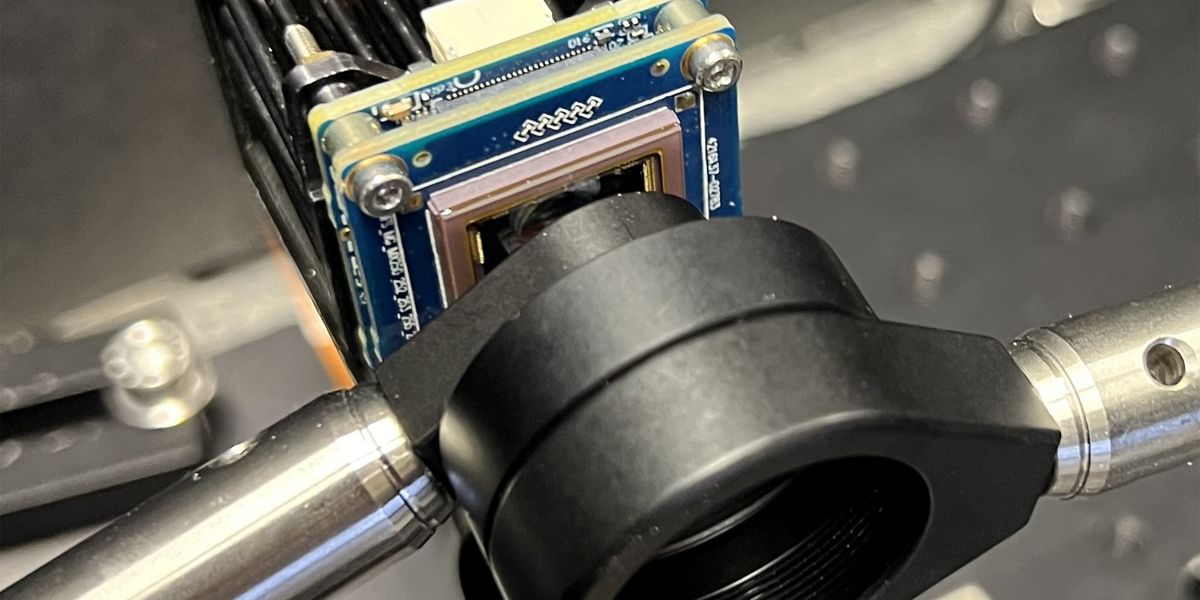
Using the kind of light-warping physics that make “invisibility cloaks” possible, scientists have developed a small, lightweight camera that can take photos as good as or better than commercial digital cameras more than 100 times as large in volume, for potential use in smartphones and other portable devices, a new study finds.
Modern cameras typically have multiple lenses that help them capture high-quality images but also make the cameras large and heavy. This bulk keeps high-end cameras from being easily getting integrated into mobile devices such as smartphones, drones, and video equipment.
The new single-lens device took comparable-resolution images as a pro-grade Sony camera, occupying a volume that is less than one percent of the Sony’s optics.
To miniaturize cameras, scientists are increasingly exploring flat optics made of metastructures—materials whose structures contain repeating patterns at scales that are smaller than the characteristic wavelengths of whatever the structures are being designed to manipulate. Optical metastructures, which are made to manipulate electromagnetic radiation, can bend light in unexpected ways, resulting in nanoscale invisibility cloaks and other devices.
Another strategy to help miniaturize cameras is computational imaging, which uses software to correct for any shortcomings of the optical components. Previous research suggested that combining optics made from metamaterials (also known as meta-optics) augmented by computational imaging could potentially lead to high-quality pictures using optics just micrometers thick.
A major problem when it comes to designing meta-optics is the extraordinary difficulty researchers face in computationally modeling the complex interactions between light and all the optical components. This means that although meta-optics theoretically have a great deal of potential, the meta-optic materials that scientists end up fabricating often deliver significantly inferior image quality than conventional optical methods, says study coauthor Karen Egiazarian at Tampere University, in Finland.
In the new study, the researchers explored a “hardware in the loop” strategy in which they ran experiments using actual lenses and sensors instead of computationally modeling how these components might behave. This helped dramatically reduce the processing demands of developing meta-optics by at least a hundredfold and the memory needs by at least tenfold, the researchers note.
The resulting hybrid meta-optics consisted of a standard refractive lens 4.5 millimeters thick covered with a quartz meta-optic film 500 µm thick coated in square silicon nitride pillars 700 nanometers high. In experiments, the scientists used the hybrid meta-optics and computational imaging techniques to capture photos of images 0.5 to 1.8 meters away.
The new single-lens device took full-color pictures whose quality was as good or better than ones captured by a commercial Sony Alpha 1 III mirrorless camera with a Sony SEL85F18 compound lens, the researchers say.
“This hardware-in-the-loop methodology is able to produce better optics compared with the state-of-the-art,” says study coauthor Vladimir Katkovnik, also at Tampere University.
At the same time, the new device was less than 1 percent of the volume of the Sony system.
“I believe the most impactful application at the moment is the design of a new generation of customized cameras for smartphones,” says study lead author Samuel Pinilla at the Science and Technology Facilities Council, in Harwell, England. “We are also interested in biomedical applications.” Future research can also explore meta-optics applications such as hyperspectral imaging and image classification, Egiazarian says.
The hybrid meta-optics of the new device were only 5 mm wide. In the future, the researchers suggest they could develop even wider meta-optics that collect more light for higher image quality. However, fabricating such optics “is still a developing area, and more breakthroughs here are needed to successfully implement a given design,” says study coauthor Igor Shevkunov, at Tampere.
The scientists detailed their findings online 26 May in the journal Science Advances.