
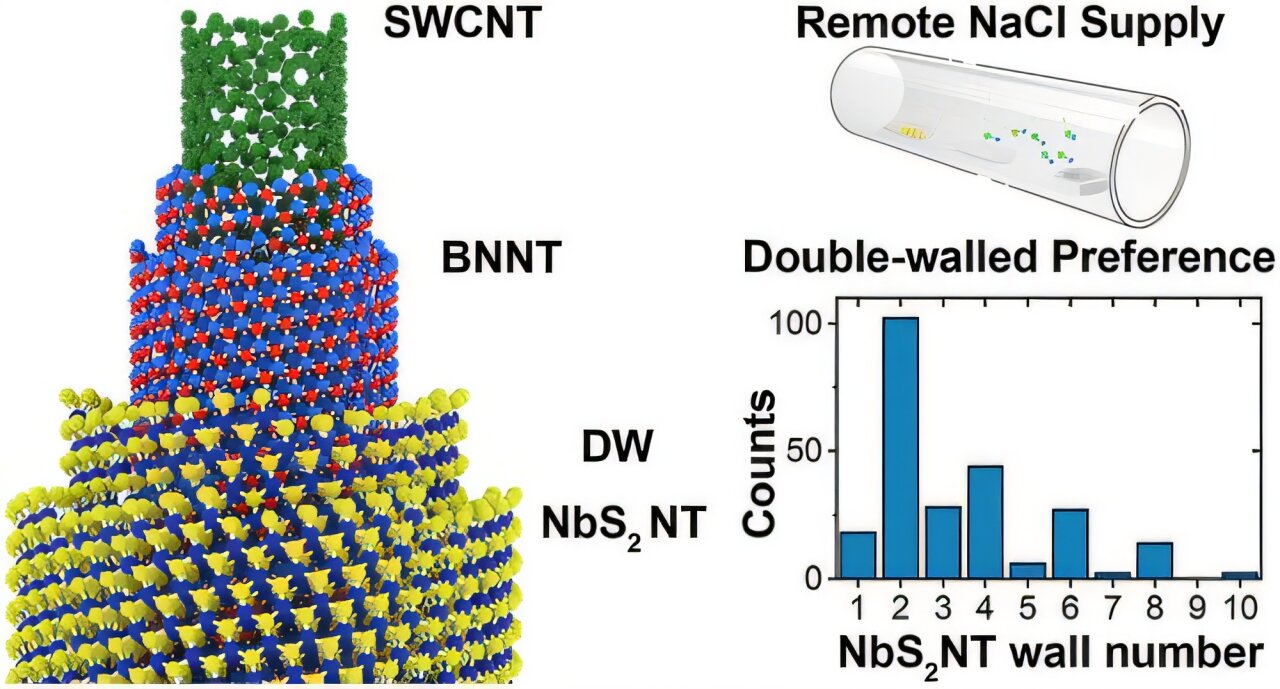
For the first time, researchers have made niobium sulfide metallic nanotubes with stable, predictable properties, a long-sought goal in advanced materials science. According to the international team, including a researcher at Penn State, that made the accomplishment, the new nanomaterial that could open the door to faster electronics, efficient electricity transport via superconductor wires and even future quantum computers was made possible with a surprising ingredient: table salt.
They published their research in ACS Nano.
Nanotubes are structures so small that thousands of them could fit across the width of a human hair. The tiny hollow cylinders are made by rolling up sheets of atoms; nanotubes have an unusual size and shape that can cause them to behave very differently from 3D, or bulk, materials.
They can be stronger than steel but lighter than plastic, carry electricity with little resistance, conduct heat efficiently and even display exotic quantum effects.
These properties make them promising building blocks for future technologies, according to study author Slava V. Rotkin, professor of engineering science and mechanics, professor of physics and a member of Penn State’s Materials Research Institute.
Rotkin explained that the properties can be tailored by using specific types of atoms to make the nanotubes. That is one reason researchers were eager to make niobium disulfide nanotubes. Until now, scientists could reliably make nanotubes from carbon—which can act as either semiconductors or semimetals—and from insulating boron nitride, but not from true metals, which behave very differently at the atomic scale.
“What we have now are metallic shells that can, in principle, show phenomena like superconductivity and magnetism, which are impossible in insulating or semiconducting versions,” Rotkin said. “Previous semimetal carbon nanotubes did not show superconductivity or ferromagnetism because of low density of electrons.”
The team worked with niobium disulfide, a metal known in bulk for unusual properties such as superconductivity, which allows electricity to flow with zero resistance. They managed to coax this metal into tubes only billionths of a meter wide, wrapping it around a template made from carbon and boron nitride nanotubes.
Getting the material to take on that rolled-up shape was the breakthrough, Rotkin said. Normally, these kinds of materials prefer to spread out in flat sheets. The researchers discovered that adding a tiny amount of ordinary salt at just the right time in the growth process made all the difference.
“In a sense, it was a bit like alchemy in the Middle Ages,” Rotkin said. “You add a tiny ingredient and, suddenly, the reaction changes. Without the salt, the niobium disulfide grows flat. With the salt, it envelopes the nanotube and forms the shells we need.”
The nanotubes revealed another surprise. Instead of making mostly single-layer tubes, the material preferred to make two layers, like a pair of nested straws.
“We found that the largest number of small diameter nanotubes were two-shell, not one-shell,” Rotkin said. “That means making two shells is somehow more favorable than making one, which is not what you would normally expect.”
Rotkin and colleagues said they believe the double-shell growth resulted from electricity moving between the shells. With two layers, electrons can hop from one to the other, acting a bit like an atomic-size capacitor that stabilizes the whole structure. Rotkin proposed a new model and ran computer model simulations that backed up that idea.
The rolled shape of these nanotubes also solves a problem that has challenged engineers working with flat, 2D materials. To make nanowires from flat sheets, scientists must carve them out using lithography, a process similar to etching patterns onto silicon chips. But at such tiny scales, carving leaves rough edges that disrupt the material’s properties.
“If you roll it up, you have a shell with no dangling bonds,” Rotkin said. “The diameter of the shell tells you exactly what the behavior will be. Nanotubes are much less random than nanowires cut from two-dimensional sheets.”
That precision could make metallic nanotubes valuable for applications that demand reliability at the nanoscale, Rotkin said.
“We know that two-dimensional niobium disulfide already shows superconductivity,” Rotkin said. “If we can take advantage of that in one-dimensional nanotubes, it opens opportunities for quantum computing and for creating superconducting wires that could make electronics faster and more efficient.”
For now, the research is still in the fundamental stage, but it provides what Rotkin called an important proof of concept.
“These are early results, but they show that we can grow metallic nanotubes and begin to understand their stability,” Rotkin said. “From here, we can start to think about how to integrate them into technologies.”
Rotkin, who contributed theoretical modeling of how the shells interact, said the project shows the power of international collaboration.
“This is not work that can be done in isolation,” he said. “It takes a team with different expertise, and I was fortunate to be part of that.”
More information:
Wanyu Dai et al, Metallic NbS2 One-Dimensional van der Waals Heterostructures, ACS Nano (2025). DOI: 10.1021/acsnano.5c11180
Citation:
Table salt enables new metallic nanotubes with potential for faster electronics (2025, November 7)
retrieved 8 November 2025
from https://phys.org/news/2025-11-table-salt-enables-metallic-nanotubes.html
This document is subject to copyright. Apart from any fair dealing for the purpose of private study or research, no
part may be reproduced without the written permission. The content is provided for information purposes only.