
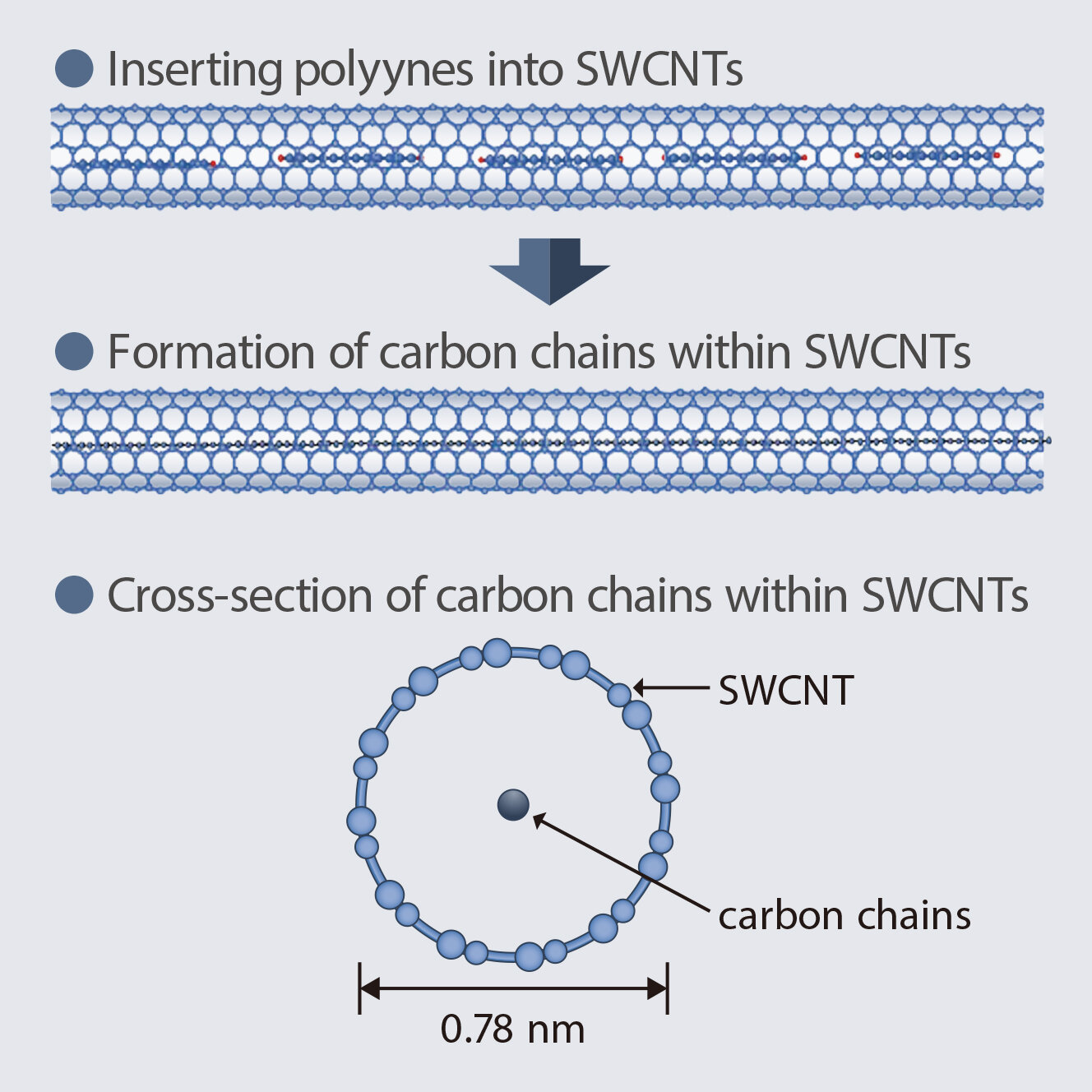
Carbynes, or long linear carbon chains (LLCCs), have received significant attention in recent years due to their predicted exceptional properties. However, experimentally, their properties have been hard to probe due to their low stability. To improve stability, it is necessary to encapsulate LLCCs in small diameter carbon nanotubes (CNTs).
Now, researchers have developed a new method to synthesize small diameter single-walled carbon nanowires (SWCNWs), featuring high-density LLCCs encapsulated in single-walled CNTs. Their research is published in Chemical Physics Letters.
Carbon is famous for existing in many different physical forms, or allotropes. It appears in three-dimensional (3D) forms, like graphite and diamond, in two-dimensional (2D) structures, like graphene, or even in linear carbon chains (LCCs).
Among them, carbynes, extremely long chains of single carbon atoms, also known as long LCCs (LLCCs), have attracted significant attention among researchers. They are predicted to have outstanding theoretical mechanical strength and thermal conductivity, making them promising for a variety of applications in fields such as nanotechnology and energy storage.
Experimentally, however, researchers have struggled to study the properties of LLCCs in detail. This is because they are unstable under ambient conditions, owing to the high reactivity of exposed carbon atoms.
One proven way to address this issue is to insert LLCCs into carbon nanotubes (CNTs), creating so-called carbon nanowires (CNWs).
Over the last decade, a promising method has been developed for synthesizing CNWs, where small carbon-based molecules confined inside CNTs are heated at high temperatures. LLCCs are most stable inside single-walled carbon nanotubes (SWCNTs) with diameters of 0.7–0.8 nanometers (nm). But most previous attempts have produced single-walled CNWs (SWCNWs) with diameters larger than 0.9 nm.
Addressing this challenge, a research team led by Professor Takahiro Maruyama from the Department of Applied Chemistry at Meijo University, Japan, has developed a highly efficient method for synthesizing small-diameter SWCNWs with a high density of LLCCs.
“Recently, it has been shown that by encapsulating polyyne in SWCNTs, it is possible to achieve small-diameter carbon nanowires,” explains Prof. Maruyama.
“Building on this, we have synthesized single-walled carbon nanowires with even smaller diameters, while also achieving significantly higher LLCC concentrations.”
To make the nanowires, the team first mixed open-ended SWCNTs with a solution of n-hexane, containing purified polyyne molecules at different concentrations. The mixture was then heated to a temperature of 80°C for 24 hours in a high-pressure reactor, allowing the polyyne molecules to enter the SWCNTs.
The resulting polyyne-filled SWCNTs (polyyne@SWCNTs) were then heated to 700°C under a high vacuum for four hours, transforming them into LLCCs@SWCNTs, or in other words, the SWCNWs.
The team confirmed the efficient encapsulation of polyyne molecules into SWCNTs in the first step and the subsequent formation of SWCNWs using Raman spectroscopy.
Experiments also revealed that the concentration of LLCCs in the SWCNWs increased with the concentration of polyyne molecules in the initial n-hexane solution. By optimizing this concentration, the researchers were able to synthesize SWCNWs with record-high LLCC density.
Notably, the resulting SWCNW samples had diameters of just 0.73–0.77 nm, much smaller than those reported in previous studies. Such a small diameter could be achieved because of the small size of polyyne molecules.
As Prof. Maruyama explains, “In our experiments, polyyne molecules with a slender linear shape were used as the carbon source, exhibiting a diameter nearly the same as the van der Waals diameter of carbon atoms. In contrast, previous studies used relatively larger precursor molecules, resulting in SWCNWs with diameters larger than 0.9 nm.”
Additionally, the L-band to G-band ratio in the Raman spectrum, a measurement that reflects the amount and density of LLCCs, reached 3.6 for the optimized samples, the highest value reported to date for such small-diameter SWCNWs.
“Our method for synthesizing high-density small-diameter SWCNWs will help researchers probe the exact properties of LLCCs,” adds Prof. Maruyama. “This can lead to breakthroughs in many fields ranging from nanotechnology to sensors and energy storage.”
Overall, this work presents a major step forward for LLCC research, bringing researchers closer to unlocking the full potential of long linear carbon chains.
More information:
Takahiro Maruyama et al, Highly efficient synthesis of small-diameter single-walled carbon nanowires through transformation of polyyne molecules into long linear carbon chains inside single-walled carbon nanotubes, Chemical Physics Letters (2025). DOI: 10.1016/j.cplett.2025.142308
Citation:
Synthesis method enables small-diameter, high-density carbon nanowires (2025, October 29)
retrieved 31 October 2025
from https://phys.org/news/2025-10-synthesis-method-enables-small-diameter.html
This document is subject to copyright. Apart from any fair dealing for the purpose of private study or research, no
part may be reproduced without the written permission. The content is provided for information purposes only.