
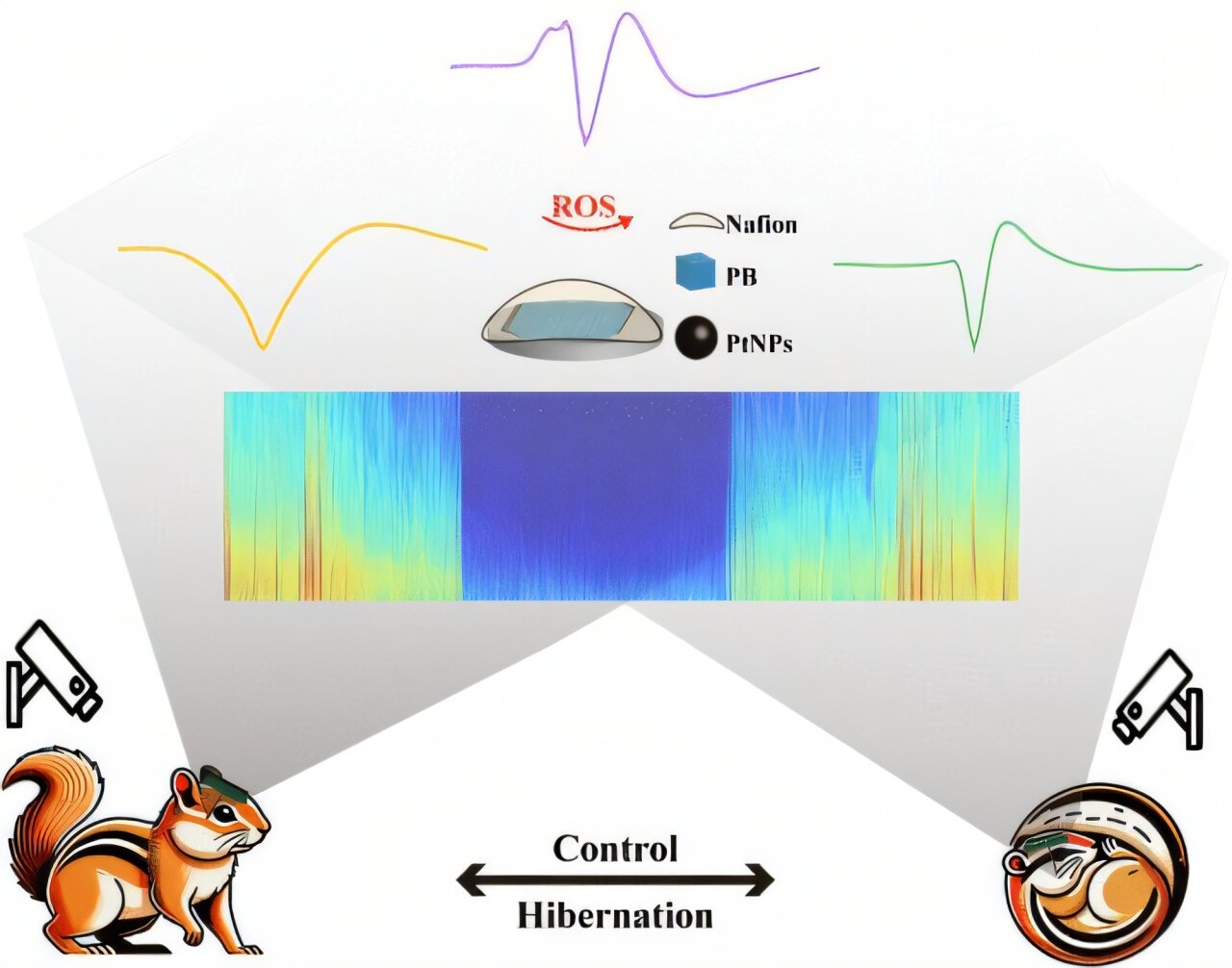
A research team has developed a nanocomposite-modified microelectrode array (MEA) that enables long-term, high-sensitivity monitoring of neuronal activity during hibernation. Their findings were recently published in ACS Sensors.
The study, led by Prof. Cai Xinxia from the Aerospace Information Research Institute of the Chinese Academy of Sciences, sheds light on how specific brain cells sustain life under extremely low metabolic states.
By modifying MEAs with platinum nanoparticles (PtNPs) and Prussian blue (PB), the researchers enhanced the electrodes’ ability to capture faint neural signals while reducing inflammation and improving stability over extended monitoring periods.
“Studying how neurons function in near-dormant states offers opportunities for medicine and space exploration,” said Prof. Cai. “Our nanocomposite-modified microelectrode design allows us to detect neuronal signals that were previously too weak to capture reliably.”
The improved electrodes achieved a signal-to-noise ratio of 15.53 ± 6.73—more than three times higher than that of traditional MEAs—allowing scientists to record even the faintest discharges of individual neurons. In vitro stability tests showed that the electrodes maintained reliable performance for up to three months, while in vivo experiments enabled chronic neural monitoring during natural hibernation bouts in Siberian chipmunks (Tamias sibiricus).
Additionally, the researchers identified three distinct types of neurons, each showing unique response patterns during hibernation. Notably, Type 3 neurons remained active even under extremely low metabolic conditions, helping chipmunks maintain deep hibernation without brain damage. The researchers also observed a sharp increase in the theta frequency band of local field potentials during arousal, which marked the restoration of consciousness and served as a reliable predictor of arousal.
The introduction of PB in the nanocomposite not only enhanced detection sensitivity but also mitigated the effects of reactive oxygen species. This reduced inflammation and improved recording quality, ensuring reliable long-term performance.
To validate the neuronal signals, the team employed ion channel protein techniques and combined them with transcriptome analysis, which revealed changes in the expression of genes such as ATP7A, KCNH8, and TMEM175 that are linked to neuronal activity during hibernation.
This study provides a new tool for uncovering how the brain protects itself in extreme states, which could inspire therapies for neurological diseases where energy metabolism is disrupted, the researchers noted.
More information:
Yiding Wang et al, PtNPs/Prussian Blue-Modified Microelectrode Arrays for Detection of Key Neurons Regulating Hibernation State, ACS Sensors (2025). DOI: 10.1021/acssensors.5c00310
Citation:
Scientists develop microelectrode array for monitoring neuronal activity during hibernation (2025, September 29)
retrieved 29 September 2025
from https://phys.org/news/2025-09-scientists-microelectrode-array-neuronal-hibernation.html
This document is subject to copyright. Apart from any fair dealing for the purpose of private study or research, no
part may be reproduced without the written permission. The content is provided for information purposes only.