
Researchers from the Yong Loo Lin School of Medicine, National University of Singapore (NUS Medicine), have developed a novel RNA-based therapy that could transform treatment for metabolic dysfunction-associated steatohepatitis (MASH), previously known as non-alcoholic fatty liver disease (NAFLD), which affects approximately 25% of people worldwide, and up to 40% of adults in Singapore.
In its severe form, the condition can progress to liver cancer or liver failure. Currently, only two drugs have been approved by the US Food and Drug Administration (FDA) for MASH, and these drugs benefit just 30% of patients, highlighting the urgent need for more effective therapies.
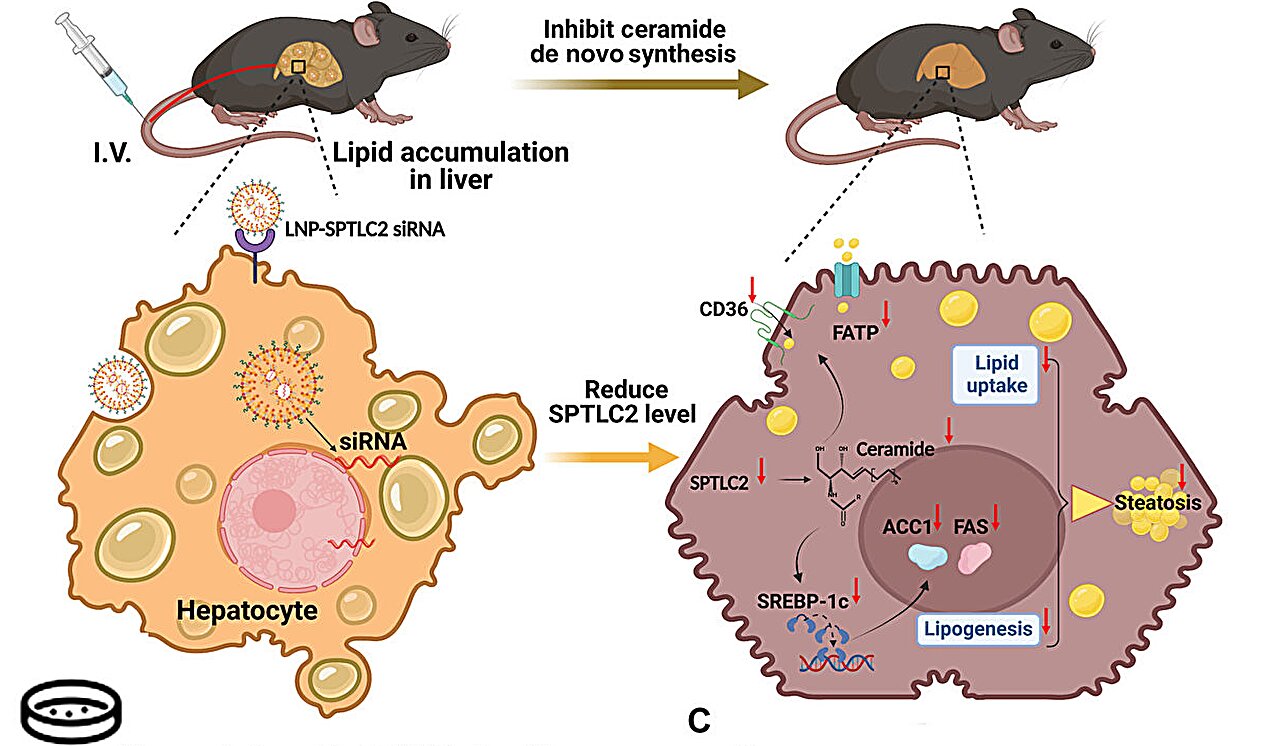
Led by Assistant Professor Wang Jiong-Wei from the Department of Surgery, Cardiovascular Research Institute and the Nanomedicine Translational Research Program (TRP), NUS Medicine, the team created a tiny medicine made of lipid nanoparticles—fat-like particles that can safely deliver genetic drugs (siRNA) into liver cells.
Once inside, the siRNA silences a gene called SPTLC2, which produces ceramides—a type of fat that drives liver fat build-up, inflammation, and fibrosis when the levels are elevated.
Asst Prof. Wang said, “Our study shows that shutting down harmful liver fats with RNA nanomedicines can significantly reduce liver fat, inflammation, and scarring. It identifies a clear molecular target in fatty liver disease and demonstrates how liver-targeted RNA medicines can directly address the root cause.
“By targeting a key driver of liver damage, the approach offers a more precise and potentially safer alternative compared to current systemic therapies.”
Published in Science Advances, the study found that laboratory models, as well as liver and plasma samples of patients with fatty liver disease, showed abnormally high ceramide levels, linked to overactivation of the SPTLC2 enzyme.

Using the team’s tiny medicine made of lipid nanoparticles carrying siRNA to switch off SPTLC2 in liver cells, the team observed lower ceramide levels in both the liver and bloodstream, which reduced fat accumulation, improved liver inflammation and scarring, and slowed disease progression.
Importantly, the treatment worked in both short-term and long-term laboratory models, suggesting broad therapeutic potential, with no harmful effects on other organs.
The team’s research paves the way for RNA nanomedicines as a new treatment class for fatty liver disease. By lowering harmful ceramides, it could provide a much-needed therapeutic option for millions of patients worldwide. Beyond liver disease, this approach could eventually benefit patients with a broad range of metabolic disorders, as ceramides are also linked to heart disease, obesity and diabetes.
Dr. Mark Muthiah, Senior Consultant, Division of Gastroenterology and Hepatology, Department of Medicine, National University Hospital, and Adjunct Associate Professor at the Department of Medicine, NUS Medicine, and part of the research team, said, “As a clinician caring for patients with fatty liver disease, I see first-hand the challenges and anxieties they face.
“Lifestyle changes remain the cornerstone of treatment, but they are often difficult to sustain, while current drugs only benefit a minority of patients. This breakthrough in liver-targeted RNA therapy opens up a new frontier that could complement existing care and make a meaningful difference for more patients.”
The team is working to refine the therapy to make it longer-lasting with fewer doses, and to conduct long-term safety studies. They also plan to explore its use in other conditions where ceramides play a harmful role, such as diabetes and cardiovascular disease, with the goal of moving toward human clinical trials.
“This research shows the power of lipid nanoparticle technologies, which is best known for COVID-19 vaccines, to tackle chronic diseases like fatty liver,” commented Associate Professor Asim Shabbir, Head, Department of Surgery, NUS Medicine, and Head & Senior Consultant, Department of Surgery, National University Hospital.
More information:
Xiaodong Yu et al, Targeted inhibition of hepatic de novo ceramide synthesis ameliorates MASH, Science Advances (2025). DOI: 10.1126/sciadv.adx2681
Citation:
Researchers develop fat-like nanoparticles to treat fatty liver disease (2025, October 3)
retrieved 3 October 2025
from https://phys.org/news/2025-10-fat-nanoparticles-fatty-liver-disease.html
This document is subject to copyright. Apart from any fair dealing for the purpose of private study or research, no
part may be reproduced without the written permission. The content is provided for information purposes only.