
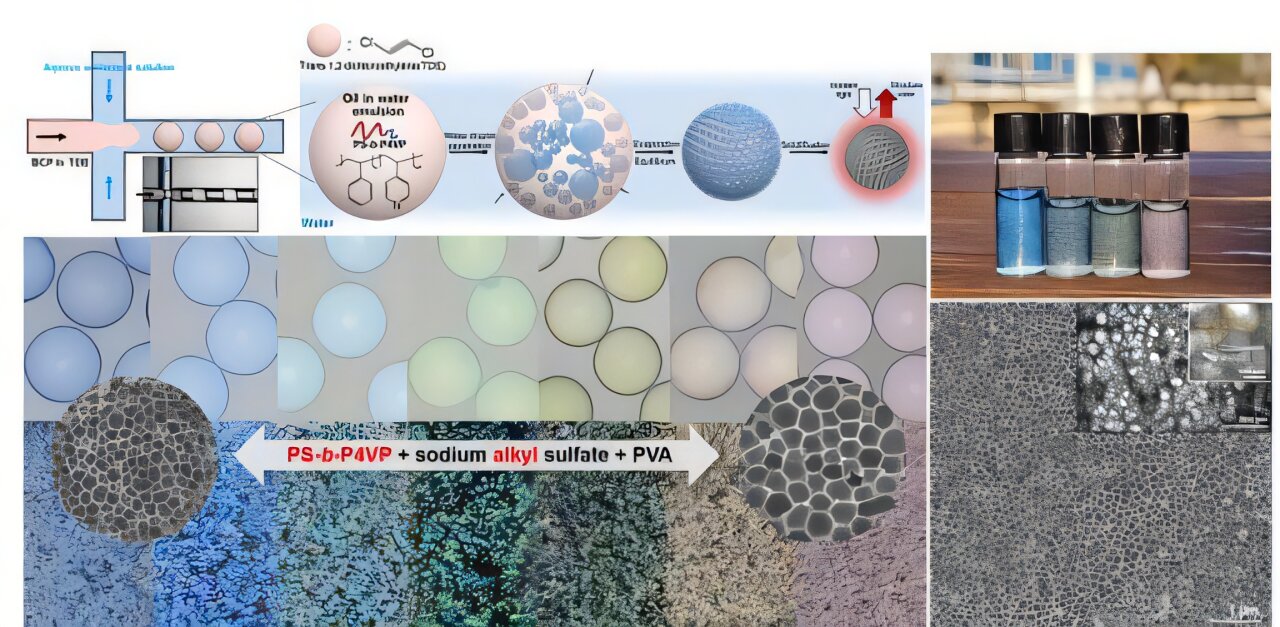
A research team affiliated with UNIST has developed a novel method to synthesize polymer-based particles that mimic the stunning iridescence of opal gemstones. This innovative approach employs nanostructured, porous microparticles composed of linear block copolymers, offering a sustainable and scalable alternative to conventional dyes and pigments.
The study is published in Angewandte Chemie International Edition.
Opal gemstones are renowned for their mesmerizing, color-shifting appearance, which arises from their unique internal nanostructure of silica spheres arranged in a specific pattern.
Inspired by this natural architecture, Professor Kang Hee Ku and her research team in the School of Energy and Chemical Engineering at UNIST utilized amphiphilic linear block copolymers—specifically poly(styrene-block-4-vinylpyridine) (PS-b-P4VP)—to create inverse photonic glass microparticles with angle-independent, vivid colors.
These particles feature nanoscale pores arranged within a polymer matrix, enabling the production of structurally colored pigments without relying on chemical dyes that fade over time.
The key innovation lies in a scalable emulsion-templating process that induces water infiltration at the interface, forming nanoscale aqueous domains within the organic phase. As the solvent evaporates, these domains solidify into porous, nanostructured particles resembling the inverse of natural opal’s silica sphere arrangement.
The resulting microparticles are approximately tens of micrometers in size, with internal pore structures that are hundreds of times smaller, effectively controlling their optical properties.
This process exploits principles of interfacial science, where water penetrates the polymer particles through surface instability phenomena. The outer shell of the particles is composed of polystyrene, which is hydrophobic and prevents water infiltration, while the internal structure is driven by the self-assembly characteristics of the block copolymer.
The distinct chemical composition of the blocks enables precise tuning of pore size, shell thickness, and consequently, the visible color output across the entire spectrum.
Remarkably, the pigments produced exhibit consistent color regardless of viewing angle—a significant advantage over natural opal, which displays color variations depending on the angle of observation.
The researchers demonstrated versatile color control by adjusting surfactant types, molecular weights, and chemical modifications of the copolymers. They also successfully dispersed these particles into high-moisture-content hydrogels to fabricate optical inks, capable of producing intricate printed patterns via standard printing techniques.
Professor Ku commented, “By employing relatively simple linear block copolymer structures, we have developed a versatile platform for generating vibrant, angle-independent structural colors. This technology holds promise for applications in displays, security features, and functional coatings.”
More information:
Juyoung Lee et al, Disordered Inverse Photonic Beads Assembled From Linear Block Copolymers, Angewandte Chemie International Edition (2025). DOI: 10.1002/anie.202511262
Citation:
Polymer particles mimic opal’s iridescence with nano-hole architecture (2025, October 22)
retrieved 22 October 2025
from https://phys.org/news/2025-10-polymer-particles-mimic-opal-iridescence.html
This document is subject to copyright. Apart from any fair dealing for the purpose of private study or research, no
part may be reproduced without the written permission. The content is provided for information purposes only.