
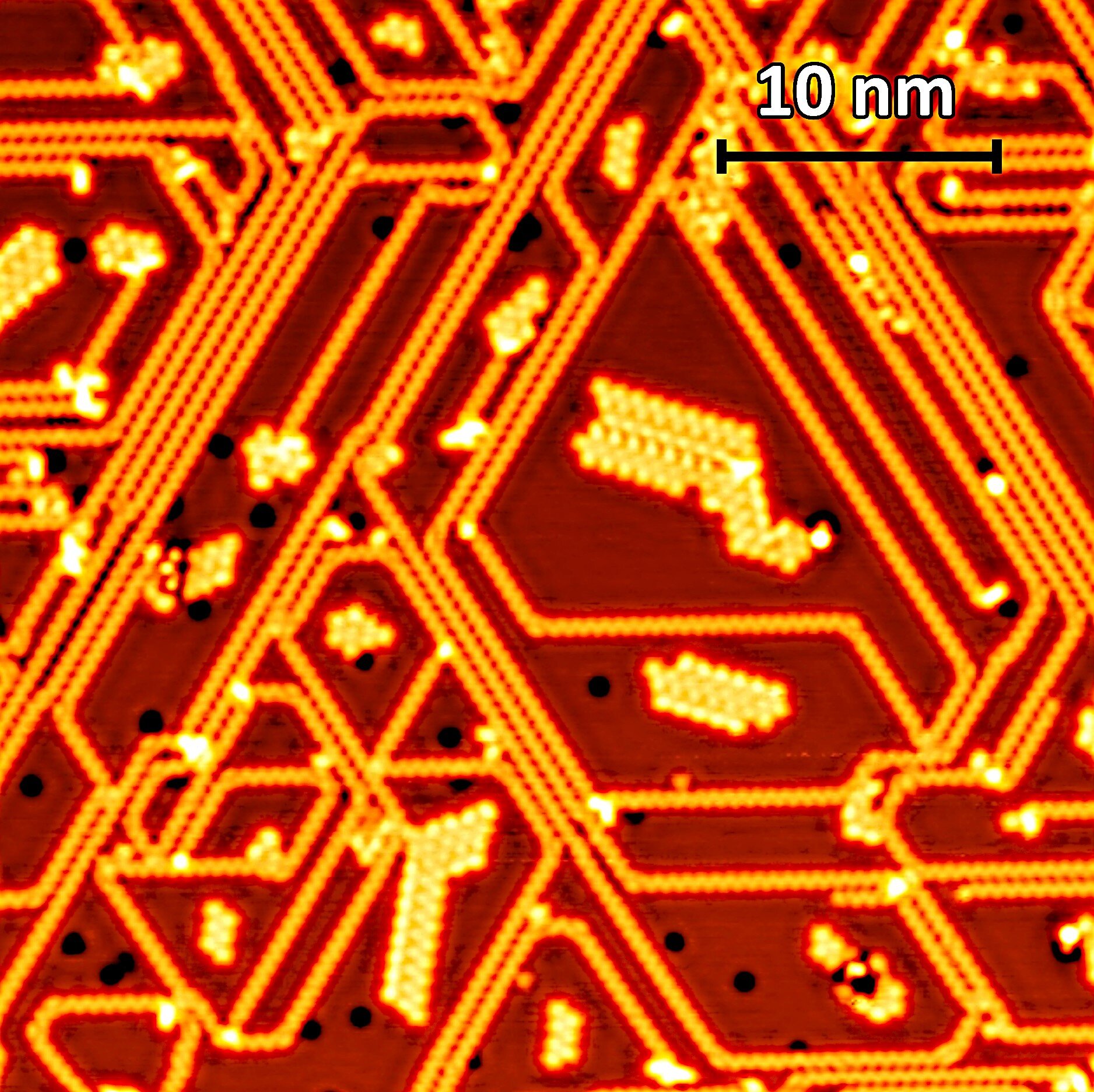
For the first time, a team at BESSY II has succeeded in demonstrating the one-dimensional electronic properties of a material through a highly refined experimental process.
The samples consisted of short chains of phosphorus atoms that self-organize at specific angles on a silver substrate. Through sophisticated analysis, the team was able to disentangle the contributions of these differently aligned chains. This revealed that the electronic properties of each chain are indeed one-dimensional. Calculations predict an exciting phase transition to be expected as soon as these chains are more closely packed. While material consisting of individual chains with longer distances is semiconducting, a very dense chain structure would be metallic.
The work is published in the journal Small Structures.
The material world consists of atoms that combine into manifold different substances. As a rule, atoms bond with each other both in one plane and in one perpendicular to it. However, some atoms such as carbon can also form graphene, a two-dimensional (2D) hexagonal network in which they are connected only in one plane. Also, the element phosphorus can form stable 2D networks.
2D materials are an exciting area of research due to their amazing electronic and optical properties. Theoretical considerations suggest that the electro-optical properties of one-dimensional structures could be even more extraordinary.
Chains of phosphorus atoms
Recently, it has become possible to produce one-dimensional structures. Under certain conditions, phosphorus atoms arrange themselves into short lines on a silver substrate. These chains are morphologically one-dimensional. However, it is likely that they interact laterally with other chains. Such interactions influence the electronic structure, potentially destroying the one-dimensionality. Until now, however, it has not been possible to measure this accurately in experiments.
“Through a very thorough evaluation of measurements at BESSY II, we have now shown that such phosphorus chains really do have a one-dimensional electronic structure,” says Professor Oliver Rader, head of the Spin and Topology in Quantum Materials department at HZB.

ARPES at BESSY II shows a 1D electronic structure
Dr. Andrei Varykhalov and his team first produced and characterized phosphorus chains on a silver substrate using a cryogenic scanning tunneling microscope (STM). The resulting images revealed the formation of short P chains in three different directions on the substrate, at 120 degree angles to each other.
“We achieved very high-quality results, enabling us to observe standing waves of electrons forming between the chains,” says Varykhalov. The team then investigated the electronic structure using angle-resolved photoelectron spectroscopy (ARPES) at BESSY II, a method with which they already have a great deal of experience.
Phase transition with density predicted
Dr. Maxim Krivenkov and Dr. Maryam Sajedi did pioneering work. By carefully analyzing the data, they were able to distinguish the contributions of the three differently oriented phosphorus chains.
“We could disentangle the ARPES signals from these domains and thus demonstrate that these 1D phosphorus chains actually possess a very distinct 1D electron structure too,” says Krivenkov.
Calculations based on density functional theory confirm this analysis and make an exciting claim: The closer these chains are to each other, the stronger their interaction. These results predict a phase transition from semiconductor to metal as the density of the chain array increases—as a conclusion, a two-dimensional phosphorus chain structure would be metallic.
“We have entered a new field of research here, uncharted territory where many exciting discoveries are likely to be made,” says Varykhalov.
More information:
Maxim Krivenkov et al, Revealing the 1D Nature of Electronic States in Phosphorene Chains, Small Structures (2025). DOI: 10.1002/sstr.202500458
Citation:
Phosphorus chains display true 1D electronic properties on a silver substrate (2025, October 21)
retrieved 22 October 2025
from https://phys.org/news/2025-10-phosphorus-chains-display-true-1d.html
This document is subject to copyright. Apart from any fair dealing for the purpose of private study or research, no
part may be reproduced without the written permission. The content is provided for information purposes only.