
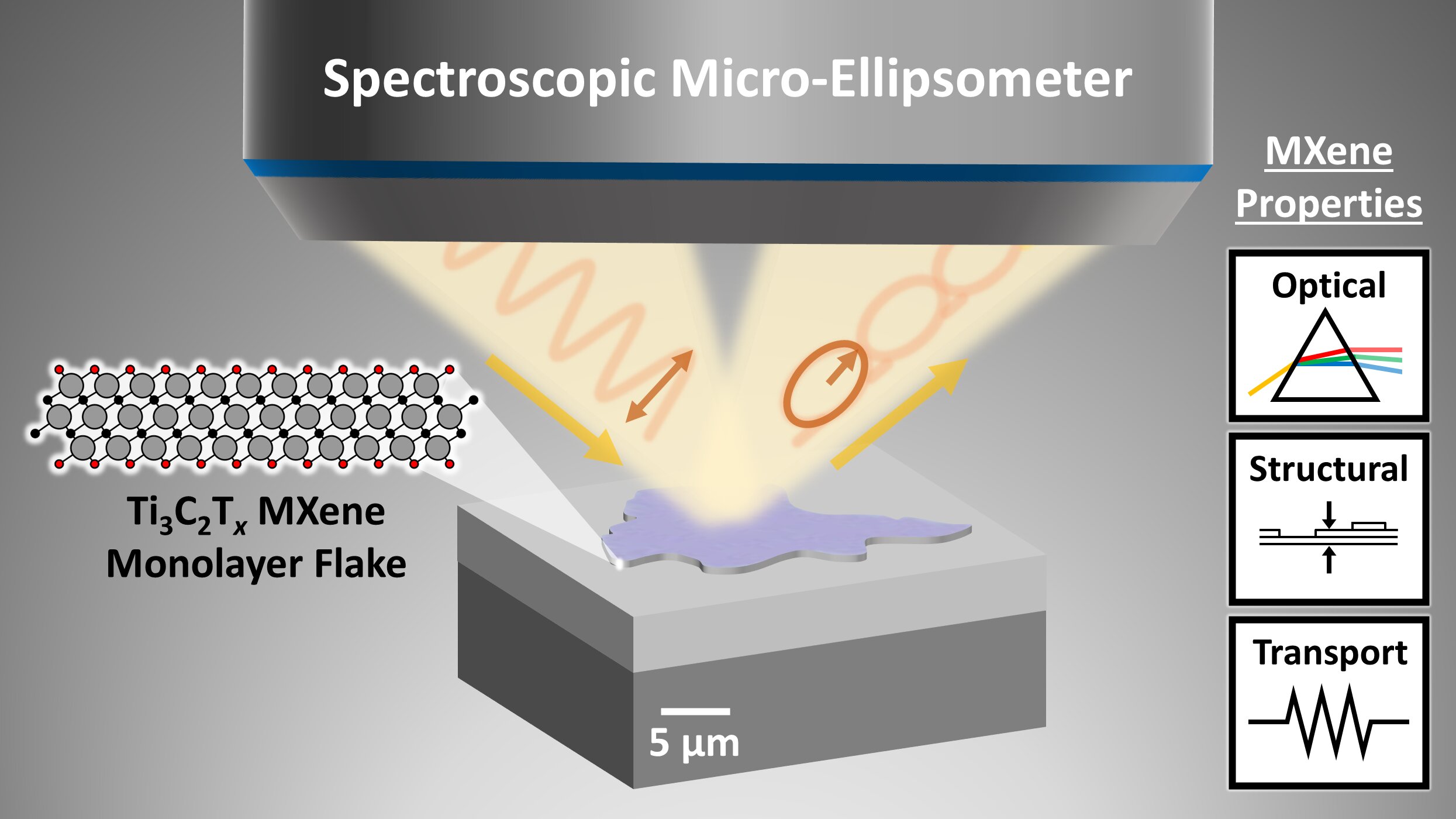
Researchers have for the first time measured the true properties of individual MXene flakes—an exciting new nanomaterial with potential for better batteries, flexible electronics, and clean energy devices.
By using a novel light-based technique called spectroscopic micro-ellipsometry, they discovered how MXenes behave at the single-flake level, revealing changes in conductivity and optical response that were previously hidden when studying only stacked layers. This breakthrough provides the fundamental knowledge and tools needed to design smarter, more efficient technologies powered by MXenes.
MXenes are ultra-thin materials only a few atoms thick, celebrated for their ability to conduct electricity, store energy, and interact with light. Until now, however, most studies examined MXenes in bulk form—as thin films made up of many overlapping flakes. That approach, while useful, masked the unique properties of single flakes, leaving unanswered questions about their true potential.
The new study was led by Dr. Andreas Furchner from Helmholtz-Zentrum Berlin (HZB), together with Dr. Ralfy Kenaz from the Hebrew University’s (HUJI’s) Institute of Physics—a strong collaboration between the research groups of Dr. Tristan Petit and Prof. Ronen Rapaport, respectively. It reveals, for the first time, how individual MXene flakes behave when isolated and studied at the nanoscale. The findings were recently published in ACS Nano.
Ellipsometry is one of the most advanced noninvasive optical techniques for material characterization. However, conventional ellipsometers inherently struggle to measure areas smaller than 50 microns—roughly the width of a human hair—making them unsuitable for analyzing the microscopic structures common in modern technology and research.
As a result, ellipsometry measurements on MXenes have been limited to macroscopic thin films made of stacked, overlapping flakes. This limitation has prevented direct measurements of individual MXene flakes, whose lateral dimensions are much smaller, thereby hindering a true understanding of their intrinsic properties.
To crack the problem, the researchers employed an advanced, patented technique they developed and call spectroscopic micro-ellipsometry (SME)—essentially a kind of “optical fingerprinting”—which allowed them to measure the optical, structural, and electronic properties of single MXene flakes with high lateral resolution and without damaging them.
In the study, individual MXene flakes of varying thicknesses were synthesized in HZB and sent to HUJI for SME measurements. Complementary nanoscale measurements were performed at HUJI’s Nano Center, and all data analyses were carried out collaboratively by both groups.
By shining light with defined polarization states on microscopic flakes as thin as a single molecular layer and analyzing how that light reflected back, the researchers mapped how the material’s ability to conduct electricity and interact with light changes depending on thickness and structural properties. They discovered that as MXene flakes become thinner, their electrical resistance increases—a critical insight for building reliable, high-performance devices.
The method was so precise that it matched nanoscale imaging tools like atomic force microscopy (AFM) and scanning transmission electron microscopy (STEM), confirming its power as a noninvasive diagnostic tool.
Dr. Furchner of Helmholtz-Zentrum Berlin, who brought his extensive expertise in ellipsometry to the MXene field, noted, “Measuring how single MXene flakes depolarize light enabled us to pinpoint structural intra-flake variations in thickness at the nano level. We were excited to see how well the results match destructive techniques like STEM.”
Dr. Kenaz of Hebrew University, developer and co-inventor of the SME technique, said, “What is truly outstanding with this work is that in less than one minute, we can directly measure the optical properties, thickness, structural properties, and conductivity of individual MXene flakes—all in a nondestructive way. Normally, these measurements require three different instruments, are time-consuming and destructive, and in the end, not as reliable as spectroscopic micro-ellipsometry.”
Dr. Petit of Helmholtz-Zentrum Berlin explained, “This opens new fields of research for operando characterization, which were previously only possible with synchrotron techniques such as STXM (Scanning Transmission X-ray Microscopy). We now have a novel, high-throughput technique to understand how MXenes evolve in different environments—a lab-based tool that complements X-ray imaging experiments, for example.”
MXenes are being explored for a wide range of applications—from ultrafast batteries and water purification systems to flexible electronics and solar energy harvesting. Understanding how the material behaves at the single-flake level is essential for designing devices that are both efficient and scalable.
Prof. Rapaport of Hebrew University added, “This work provides a roadmap for integrating MXenes into real technologies by offering a direct view of their intrinsic properties, without the interference of stacked layers or impurities. By refining how we study these materials using our SME technique, we are paving the way for their use in optoelectronic devices, energy solutions, and beyond.”
The study not only unlocks fundamental knowledge about MXenes but also establishes spectroscopic micro-ellipsometry as a new standard for analyzing 2D materials. With this breakthrough, scientists worldwide may soon gain the ability to probe other emerging nanomaterials in the same way.
As Dr. Petit of Helmholtz-Zentrum Berlin concluded, “This is a powerful demonstration of how international collaboration and advanced physics can accelerate materials science. MXenes are just the beginning.”
More information:
Ralfy Kenaz et al, Optical, Structural, and Charge Transport Properties of Individual Ti3C2Tx MXene Flakes via Micro-Ellipsometry and Beyond, ACS Nano (2025). DOI: 10.1021/acsnano.5c06938
Citation:
How MXenes truly work: Novel technique shines light on next-gen nanomaterials (2025, October 6)
retrieved 6 October 2025
from https://phys.org/news/2025-10-mxenes-technique-gen-nanomaterials.html
This document is subject to copyright. Apart from any fair dealing for the purpose of private study or research, no
part may be reproduced without the written permission. The content is provided for information purposes only.