
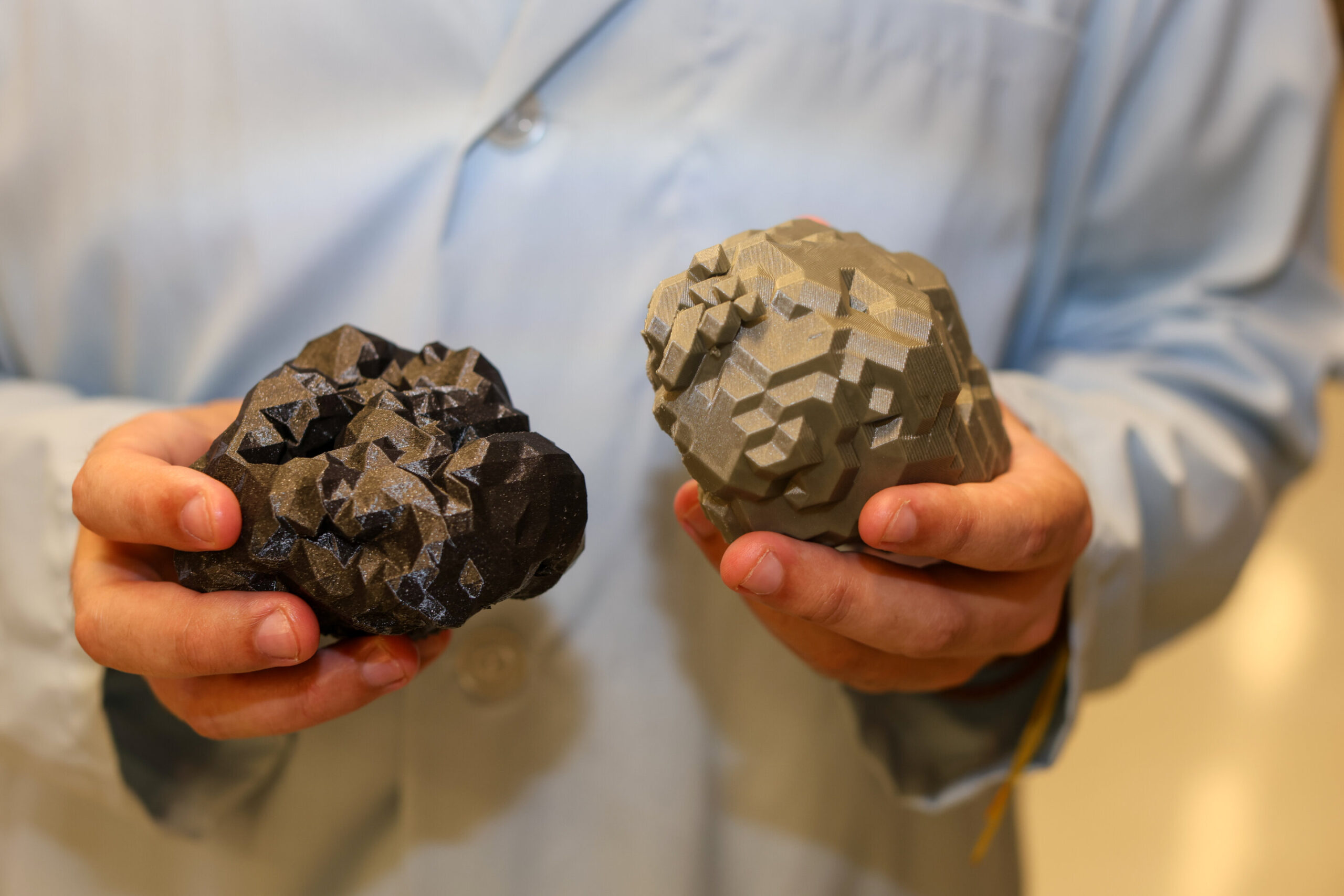
Lipid nanoparticles (LNPs) are the delivery vehicles of modern medicine, carrying cancer drugs, gene therapies and vaccines into cells. Until recently, many scientists assumed that all LNPs followed more or less the same blueprint, like a fleet of trucks built from the same design.
Now, in Nature Biotechnology, researchers from the University of Pennsylvania, Brookhaven National Laboratory and Waters Corporation have characterized the shape and structure of LNPs in unprecedented detail, revealing that the particles come in a surprising variety of configurations.
That variety isn’t just cosmetic: As the researchers found, a particle’s internal shape and structure correlates with how well it delivers therapeutic cargo to a particular destination.
“Treating LNPs like one model of car has worked, as evidenced by the millions of people these particles have helped, but LNPs are not one-size-fits-all for every RNA therapy,” says Penn Engineering’s Michael J. Mitchell, Associate Professor in Bioengineering and a co-senior author of the paper.
“Just as pickups, delivery vans and freight trucks best suit different journeys, we can now begin to match LNP designs to particular therapies and tissues, making these particles even more effective.”
“These results deliver a more fundamental understanding of how the composition and shape of these therapeutic particles relate to their biology,” adds Kushol Gupta, Research Assistant Professor in Biochemistry and Biophysics in Penn’s Perelman School of Medicine and the paper’s other co-senior author.
“These particles have already proven themselves in the clinic, and these insights will make them even more powerful by helping us tailor delivery to specific diseases more quickly.”
Illuminating the black box
In recent years, the Mitchell Lab, among others, has found that different LNP formulations have varying biological effects. Adding phenol groups, for instance, reduces inflammation, while branched ionizable lipids improve delivery.
“It’s almost like recipe development,” says Marshall Padilla, a Bioengineering postdoctoral fellow and the new paper’s first author. “We’ve known that different ingredients and techniques change the outcomes.”
But understanding why certain chemical tweaks lead to particular biological effects has proved challenging. “These particles are something of a ‘black box,'” adds Padilla. “We’ve had to develop new formulations mostly by trial and error.”

Bringing LNPs into focus
To visualize the particles, the researchers employed multiple techniques. Past studies, by contrast, typically relied on a single method, like freezing the particles in place.
Because of the particles’ size—it would take thousands of LNPs to encircle a human hair—prior work also frequently tagged the particles with fluorescent materials and averaged measurements, at the risk of altering the particles’ shape and obscuring variations.
“We needed to combine multiple, fundamentally dissimilar techniques that left the particles intact in solution,” says Gupta. “That way, we could be confident that agreement between the methods showed us what the particles really looked like.”
Three techniques, one study
The researchers examined four “gold-standard” LNP formulations, including those used in the COVID-19 vaccines and Onpattro, an FDA-approved therapy for a rare genetic disease.
One visualization technique, sedimentation velocity analytical ultracentrifugation (SV-AUC), involved spinning the LNPs at high speeds to separate them by density.
Another, field-flow fractionation coupled to multi-angle light scattering (FFF-MALS), gently separated the LNPs by size and measured how the nucleic acid was distributed across the different particles.

A third, size-exclusion chromatography in-line with synchrotron small-angle X-ray scattering (SEC-SAXS), allowed the researchers to study the internal structure of LNPs by hitting them with powerful beams of X-rays at the National Synchrotron Light Source II (NSLS-II), a U.S. Department of Energy (DOE) Office of Science user facility at DOE’s Brookhaven National Lab.
“We used to think LNPs looked like marbles,” says Gupta, summarizing the results. “But they’re actually more like jelly beans, irregular and varied, even within the same formulation.”
The power of collaboration
The results would have been unattainable without bringing together academia, industry and a national laboratory.
“We’ve been developing methods to measure both lipid nanoparticle size and their drug content without breaking the particles apart,” says Martin Kurnik, Wyatt Technology Principal Scientist at Waters Corporation, who led the FFF-MALS experiments.
“The capabilities at Brookhaven National Lab enabled a unique experiment that combined X-rays with ultraviolet light to quantify the particles’ geometric characteristics,” adds James Byrnes, a beamline scientist at NSLS-II, who conducted the SEC-SAXS experiments.
“This paves the way to characterizing particle formulations at scale and highlights the exciting potential for deeper collaborations between synchrotron facilities and LNP developers.”
“This entire project speaks to the power of different institutions pooling their resources and expertise,” says Padilla. “We were only able to visualize the particles in such detail because each partner saw them from a different angle.”

Testing the effects
Once the researchers had characterized the LNP formulations, they tested their effects in a range of targets, from human T cells and cancer cells to animal models.
Hannah Yamagata, a doctoral student in the Mitchell Lab, found that certain particle internal structures corresponded with improved outcomes, like more cargo being offloaded or more deliveries reaching the target. “Interestingly, it varied depending on the context,” says Yamagata.
Some LNP formulations performed better in immune cells, for instance, while others showed greater potency in animal models. “The right model of LNP depends on the destination,” adds Yamagata.
Mixing the right batch
The researchers also noticed that, depending on the method they used to prepare the LNPs, the particles’ characteristics—and potency—varied.
Microfluidic devices, which push ingredients through small tubes, led to more consistent shapes and sizes, while mixing by hand using micropipettes resulted in more variation.
Until now, researchers had assumed that microfluidic devices performed better, but Yamagata saw that micropipetting produced better results in certain cases.
“It’s kind of like baking cookies,” she says. “You can use the same ingredients, but if you prepare them differently, the final product will have a different structure.”

Future directions
The results open the door to a new era of rational LNP design, moving beyond today’s trial-and-error approach.
Rather than assuming a single “best” formulation, the study shows that particle size, shape, internal structure and preparation method must be matched to the therapeutic context. “There’s no one-size-fits-all LNP,” says Yamagata. “Every detail affects their shape and structure, and the shape and structure affect their function.”
While some of the tools used in the experiments—like a particle accelerator—are difficult to access, many of the steps can be reproduced with more common equipment. As additional labs generate structural and functional data, the field could even assemble the data sets needed to train AI for LNP design.
Ultimately, the findings point toward a future in which nanoparticles can be engineered with the same precision as drugs themselves. “This paper provides a road map for designing LNPs more rationally,” says Mitchell.
More information:
Elucidating lipid nanoparticle properties and structure through biophysical analyses, Nature Biotechnology (2025). DOI: 10.1038/s41587-025-02855-x
Citation:
Nanoparticle blueprints reveal path to smarter medicines (2025, October 23)
retrieved 23 October 2025
from https://phys.org/news/2025-10-nanoparticle-blueprints-reveal-path-smarter.html
This document is subject to copyright. Apart from any fair dealing for the purpose of private study or research, no
part may be reproduced without the written permission. The content is provided for information purposes only.