
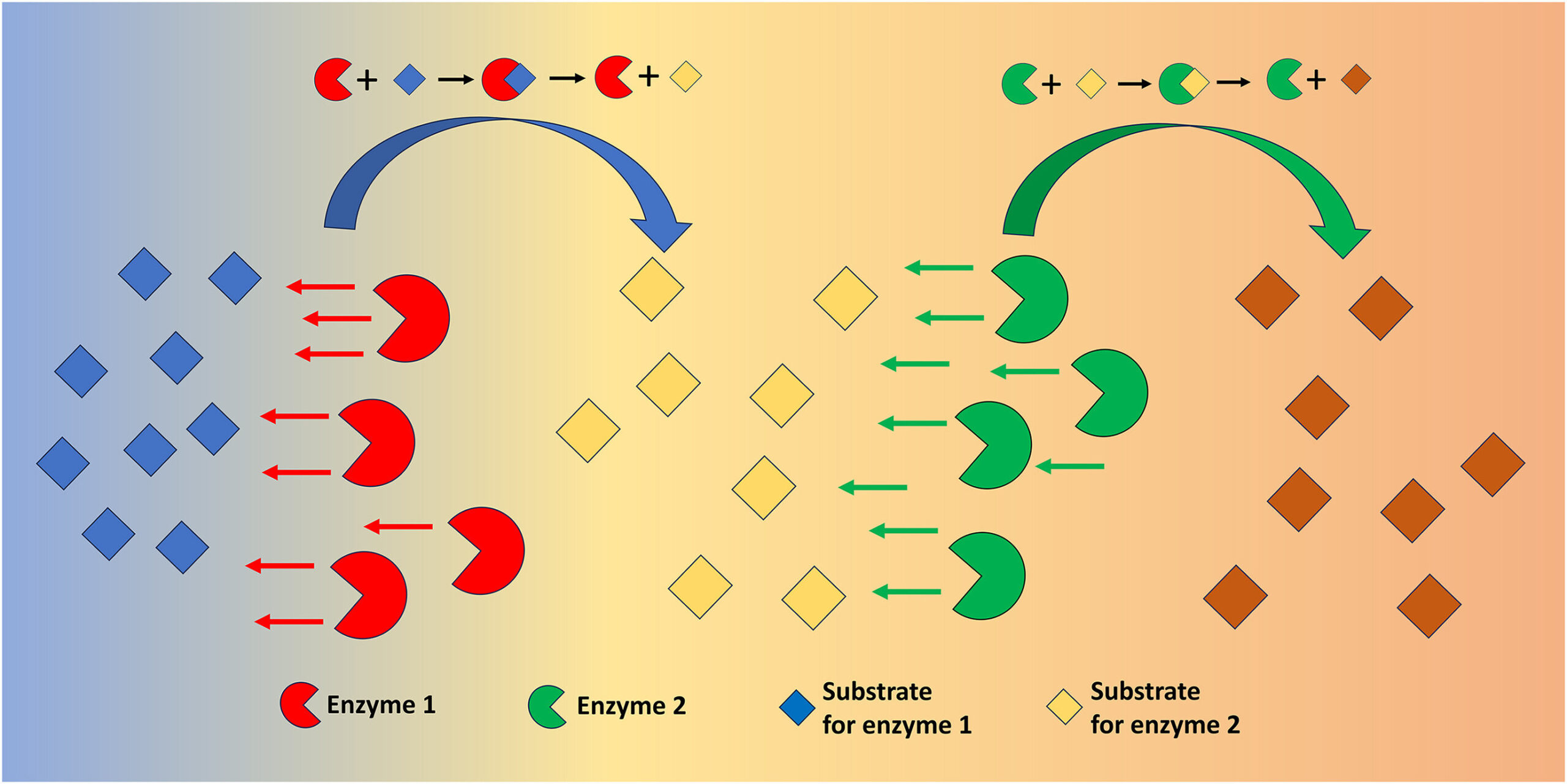

Researchers at Penn State demonstrate the first steps in the design of tiny particles that can perform specialized tasks, such as targeted delivery of drugs or other cargo.
A group of tiny particles followed “breadcrumbs” left behind by a different group of particles in new experiments demonstrating the first steps in creating intelligent communicating systems involving active particles—sometimes called nanobots—that perform specialized tasks. The experiment was possible thanks to a new microfluidic tool developed by researchers at Penn State that allowed them to observe the particles for far longer than had been previously possible.
The extended time allowed the team to watch as one group of particles followed a chemical gradient while creating a different chemical gradient in its wake, which was followed by the second group of particles. This type of system could eventually be developed for targeted delivery of drugs or other cargo, where one group of particles identifies a location, then signals for a second group of particles that delivers the cargo, the researchers explained. A paper describing the research was published in Cell Reports Physical Science.
“We are trying to create autonomous particles that can perform different tasks,” said Ayusman Sen, Verne M. Willaman Professor of Chemistry in the Eberly College of Science at Penn State and the leader of the research team. “The inspiration is social insects like ants where you have a division of labor. Some ants are soldiers, others are foragers, etc. Similarly, the design of particle populations with multiple functionalities will be greatly simplified by having different groups of communicating particles, each having its own functional response.”
The researchers built particles that move directionally based on the presence of a chemical gradient—a process called “chemotaxis.” This behavior, moving toward higher concentrations of a nutrient or away from a toxin, is seen from bacterial cells to higher organisms and specialized proteins called enzymes. For example, you might follow your nose toward an increasingly strong scent emanating from a bakery.
“Many enzymes will move autonomously toward higher concentrations of the substrate that they catalyze,” said Yu-Ching Tseng, a graduate student in chemistry at Penn State and member of the research team. “We can coat tiny particles with enzymes and expose them to a chemical gradient of their substrate to observe this experimentally, but until now we could only observe them for a very short amount of time, a few seconds.”

The team’s new microfluidic device consists of tiny channels etched into a polymer block that enables the manipulation of extremely small amounts of fluids. The researchers can then observe particle movement in the channels for minutes at a time using a fluorescent microscope.
“We worked with the Nanofabrication Laboratory at Penn State to develop a microfluidic device that is T-shaped,” said Aditya Sapre, a graduate student in chemical engineering at Penn State and member of the research team. “The particles flow across the top of the T and encounter a chemical gradient that is established from the base of the T.”
The researchers can then observe the particle behavior in a chamber at the intersection of the top and base, Sapre said.
“Many enzyme cascades, where one enzyme makes a product that is used by a second enzyme, are found in nature,” said Xiaotian Lu, a graduate student in chemical engineering at Penn State and member of the research team. “For example, particles coated with the enzyme acid phosphatase will follow a gradient of the chemical glucose-6-phosphate and convert it into glucose. Particles coated with the enzyme glucose oxidase, which in turn uses glucose as its substrate, will then follow the trail left behind by the acid phosphatase coated particles.”
One particle following another, like a predator chasing its prey, is an example of non-reciprocal interaction. It is an apparent violation of Newton’s third law of equal and opposite interactions and generally only observed in living matter, according to the researchers.
“Interest in directing motion of active particles by chemotaxis has garnered attention for drug and cargo delivery to specific locations,” Sen said. “Our new microfluidic device has allowed us to show that we can design systems where one group of particles will follow another.
“Eventually we hope that these principles can help lead, for example, to advances where a cancer drug could be delivered directly to a tumor, as opposed to current chemotherapy drugs that impact the entire body.”
More information:
Aditya Sapre et al, Non-reciprocal chemotactic movement in enzyme cascade under flow-free conditions, Cell Reports Physical Science (2025). DOI: 10.1016/j.xcrp.2025.102666
Citation:
Nanobots play ‘follow the leader’ by chasing chemical trails in microfluidic device (2025, September 10)
retrieved 18 September 2025
from https://phys.org/news/2025-09-nanobots-play-leader-chemical-trails.html
This document is subject to copyright. Apart from any fair dealing for the purpose of private study or research, no
part may be reproduced without the written permission. The content is provided for information purposes only.