
To be fair, there are lots of excellent reasons why drones haven’t been using radar for sense and avoid. The kind of radar that’s small enough and affordable enough to fit on a drone is the kind that you’re likely to find in cars with adaptive cruise control. It’s fine for close-range, mostly 2D sensing of enormous hunks of metal, but wouldn’t be of much help looking for small, faraway objects in 3D space. The kind of radar that you’d want on a drone is the kind that the military uses in its combat jets, which has a fantastically long range, very high resolution, and can scan across an enormous field of view. Of course, that kind of radar is also bulky, heavy, and you can’t afford it unless you’re the military anyway.
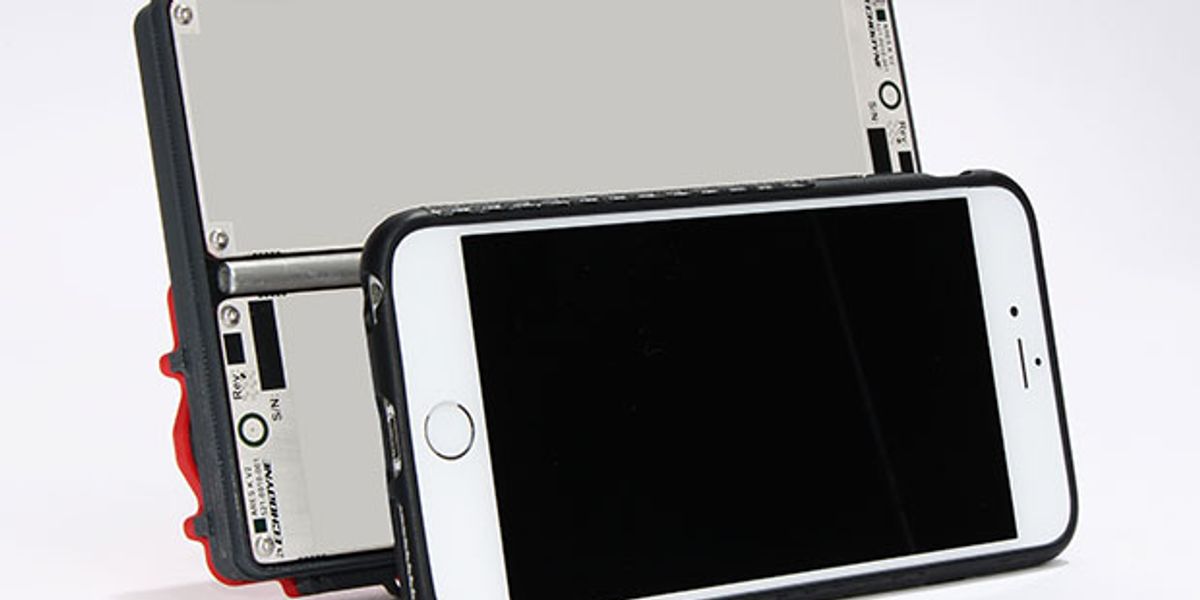
You’ve probably guessed by now that there might be a better way to get useful radar on small drones. Earlier this year, Echodyne, a Seattle-area startup backed by investors that include Bill Gates and Paul Allen, announced that it was working on a new type of radar about the size of a cellphone with performance that’s much more like the fancy phased-array radars that the military uses while costing a tenth as much or less. To build the device, Echodyne relied on what is known as a metamaterial, an artificial material specifically engineered to exhibit properties not found in nature, such as the ability to manipulate electromagnetic radiation in new ways. The company’s radar uses a metamaterial antenna that changes its physical structure to steer its beam. Physically manipulating electromagnetic waves like this is new for radar, but we’ve seen metamaterials do similar things to create better communications systems and even a kind of invisibility cloak.
Echodyne has just concluded a series of tests that illustrate what kind of performance its radar is capable of, and if you’ve ever wished your drone had a way to detect power lines, you’ll be impressed:
https://www.youtube.com/watch?v=OGy9sDNMm2Q
Not bad, right? It’s practically a point cloud. Here are the specs on the hardware:
- Field of view: 120° x 80°
- Refresh rate: 1 Hz
- Angular resolution: 2° x 6°
- Angular accuracy: 0.5° x 1.5°
- Range to target accuracy: 0.75m
- Minimum range: 2 m
- Maximum range: 1 km
- Size: 22 cm x 7.5 cm x 2.5 cm
- Weight: 820 g
- Power requirements: 20 W
This is just the development version. Early next year, Echodyne will have an upgraded model that it claims will be able to detect power lines at 800 meters, a drone the size of a DJI Phantom at 1 km, and something like a Cessna out to 3 km. And did we mention how it doesn’t even care if it’s dark out, or raining, or completely fogged in?
“Radar is the right answer for any kind of long range, all-weather sensor,” Echodyne co-founder and CEO Eben Frankenberg told us. The phased-array radars like the ones used by the military are “the pinnacle of radar technology,” he says. “They steer a narrow beam on both transmit and receive, and they can point from any one direction to any other direction very quickly. We’ve come up with a way to make essentially that, but with much simpler architecture.”
Conventional phased-array radars rely on a grid of phase shifters that are spaced a few millimeters apart, which is smaller than the wavelength of the radio wave passing through the array. Each phase shifter is capable of slightly changing the speed with which the radio wave passes through it, and by precisely adjusting when the wavefront exits each phase shifter across the grid, the radio beam can be steered very precisely. Manufacturing and controlling all of these phase shifters is a complex problem, which is why phased-array radars are bulky and expensive.
Instead of conventional phase shifters, Echodyne’s antenna uses a metamaterial array made of multiple layers of carefully patterned copper wiring. The design dramatically cuts cost and complexity and performs similarly to traditional phased-array radar.
Echodyne’s antenna swaps out all of those phase shifters with a metamaterial array, which dramatically cuts the cost and complexity. So while metamaterials may sound like an esoteric technology, Frankenberg insists their radars are “all printed circuit boards with commercial parts,” adding that “there’s no material science going on at all, and yet they perform very similarly to a phased array.” He wouldn’t describe the device in detail, but said the radar array is made of multiple layers of carefully patterned copper wiring, and beam control results from heating specific areas of the wiring. A traditional phased array does still offer some advantages, like higher power, longer range, and better beam control, but Frankenberg points out that “for the vast majority of all commercial applications, what we’re doing is more than adequate.”
It’s likely that onboard obstacle avoidance is going to be mandatory on commercial drones flying beyond line of sight, and it’s possible that Echodyne’s radar will be one of the key options enabling this in the first place: based on these performance numbers, nothing else comes close. It’s also likely that for most applications, you won’t be able to rely exclusively on radar: for anything up close that requires a substantial amount of detail (like landing), a sensor fusion approach that includes inexpensive and lightweight hardware like cameras and sonar may be necessary.
From a commercial perspective, Echodyne’s plan is to make its metamaterial radar progressively more affordable as they ramp up production: the initial version that comes out early next year will be about US $10,000. This is clearly out of range for hobbyists, but for anyone using drones to make a living, it might be an investment to consider. Echodyne says that as production goes from batches of tens or hundreds up to thousands of units, it expects the price to drop to “very low singles of thousands.”
Obviously, delivery drones aren’t the only potential application for a sensor like this, and Echodyne has had a lot of strong interest from the automotive industry, among others. We’re very much hoping it catches on there, because the way to make this thing affordable for everyone is to start cramming it into cars and producing them in the millions.
[ Echodyne ]
Related Articles Around the Web