
Imagine being able to program materials to control heat like you can control a light with a dimmer switch. By simply squeezing or stretching the materials, you can make them hotter or colder.
One of the fundamental challenges in advanced materials has been accurately predicting and controlling heat flow in complex, next-generation materials. Traditional simulation methods, which rely on simplified empirical models, fail to capture a material’s intricate atomic interactions, especially under deformation.
New research by Xiangyu Li, an assistant professor in the Department of Mechanical and Aerospace Engineering, and his Ph.D. student, Shaodong Zhang, helps alleviate that problem.
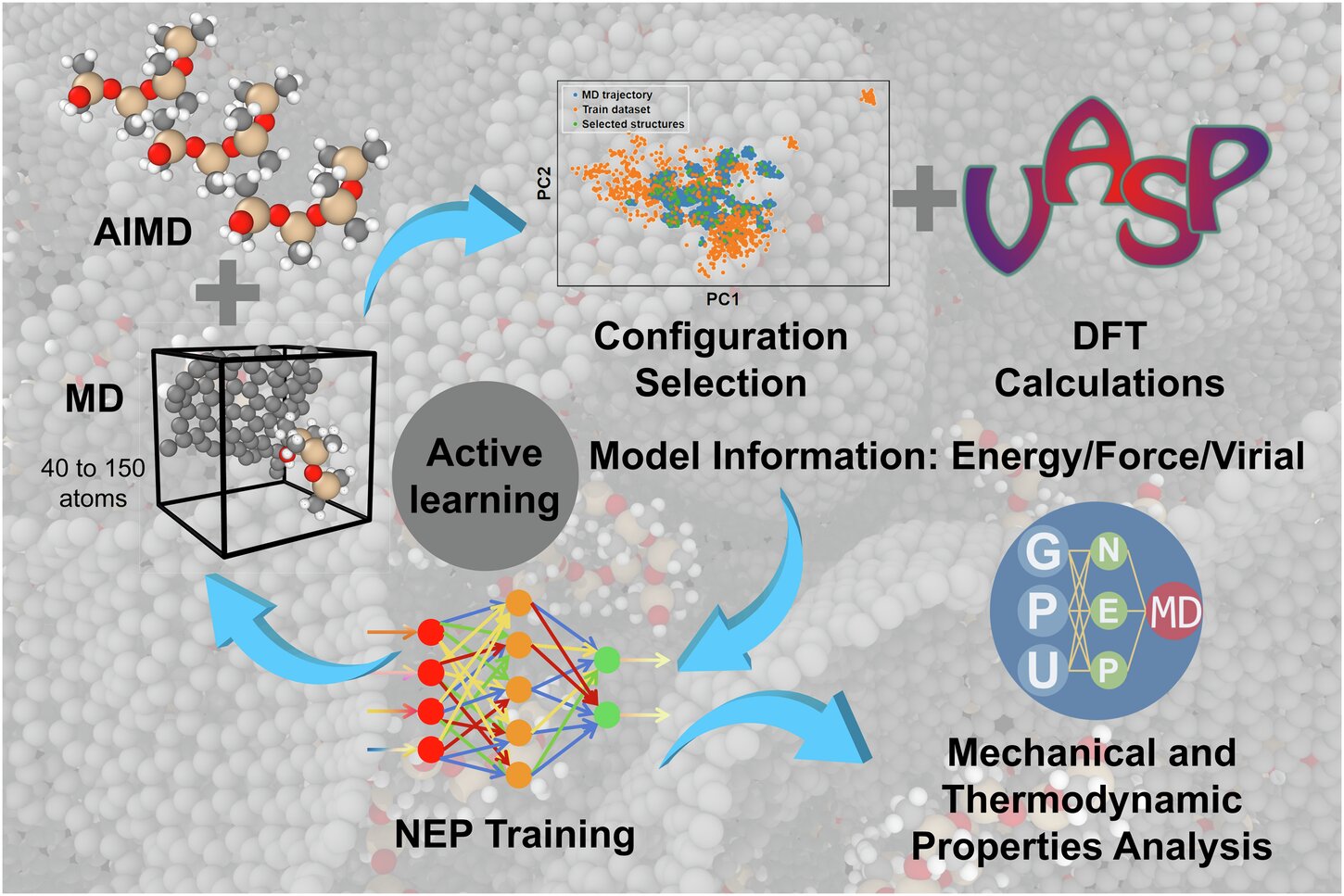
Li and Zhang used a machine learning assisted neuroevolution potential (NEP) to train computational models on how atoms interact with each other at the sub-nanometer scale. For highly porous materials like graphene foam, this technique helps predict thermal and mechanical properties by simulating atomic movements and interactions. The technique allows researchers to model how these materials behave under different conditions, such as compression, and understand how their structure changes.
Li and Zhang’s research was recently published in the International Journal of Thermal Sciences and npj Computational Materials.
“This research demonstrates that by combining the nanomaterial graphene foam with a common silicon polymer we can create a composite that is not only tougher but also possesses a remarkable ability to regulate its heat flow when deformed,” Zhang said. “This paves the way for intelligent materials that can self-adjust their thermal properties, leading to safer, more energy-efficient electronics, advanced wearable devices, and smarter thermal management systems in everything from laptops to spacecraft.”

More efficient experiments
The results from Li and Zhang’s research showed that both the thermal conductivity and thermal conductance of graphene foam increase with the increase of density at room temperature. However, the thermal conductivity experiences a downward trend followed by a subsequent upward trajectory in the compression process. The outcomes suggest that the weakening of thermal conductivity in the initial state can be attributed to the thickness reduction resulting from material compression.
“This provides a scientific blueprint for designing ‘thermal switches,’ where a material’s ability to conduct heat can be turned up or down on demand,” Zhang said.
Given the challenges of measuring and manufacturing next-generation materials, Li said having a machine-learning tool to understand how the molecular structure of different combinations can help guide the development.
“The goal is to reduce the amount of experimental efforts, and we can provide a rough estimation of the outcome,” Li said. “Ideally, we hope to predict all material properties without prior knowledge, which demands years of effort and refinement of tools. The goal is to help materials development, and make system and device designs much more streamlined, so you spend less money and time on repetitive trials and errors.”
The next-gen frontier
The breakthrough research by Li and Zhang opens the door for large-scale molecular dynamics simulations that are highly efficient and precise, bridging a key gap between atomic-scale accuracy and practical material design.
Future applications stemming from their research could include developing intelligent thermal switches for next-generation electronics; advancing flexible and wearable technology, which could lead to wearable sensors that adapt to body temperature or clothing that actively manages heat for comfort; and accelerating material discovery for water vapor adsorption.
“It’s still further away from real applications,” Li said. “But for example, it can be used with batteries, where you have to let it work within a narrow temperature range. We also hope to leverage machine learning-based molecular dynamics in other physical and chemical processes.”
More information:
Pingyang Zhang et al, Machine learning-driven molecular dynamics decodes thermal tuning in graphene foam composites, npj Computational Materials (2025). DOI: 10.1038/s41524-025-01710-6
Shaodong Zhang et al, Theoretical investigation on the dynamic thermal transport properties of graphene foam by machine-learning molecular dynamics simulations, International Journal of Thermal Sciences (2025). DOI: 10.1016/j.ijthermalsci.2024.109631
Citation:
Machine learning helps identify ‘thermal switch’ for next-generation nanomaterials (2025, October 15)
retrieved 16 October 2025
from https://phys.org/news/2025-10-machine-thermal-generation-nanomaterials.html
This document is subject to copyright. Apart from any fair dealing for the purpose of private study or research, no
part may be reproduced without the written permission. The content is provided for information purposes only.