
Monash scientists designed a fast, safe liquid battery for home solar. The system could outperform expensive lithium-ion options.
Engineers have created a new water-based battery designed to make rooftop solar storage in Australian homes safer, more affordable, and more efficient.
This next-generation “flow battery” paves the way for compact, high-performance energy systems suitable for households and is projected to cost far less than today’s lithium-ion setups, which are priced around $10,000.
Breakthrough membrane design
Although flow batteries have existed for decades, they have mostly been limited to large-scale energy storage because of their bulk and relatively slow charging times.
Wanqiao Liang, the study’s lead author and a PhD candidate in the Department of Materials Science and Engineering, explained that the team’s redesigned membrane solves this speed limitation, making the technology practical for homes and positioning it as a strong contender in the renewable energy market.
“We’ve taken a safe, affordable chemistry and made it fast enough to capture rooftop solar in real time,” Ms Liang said.
“We’ve engineered a membrane that finally makes organic flow batteries competitive for residential and mid-scale storage. It opens the door to systems that are not only cheaper, but also safer and simpler to scale.”
Outperforming industry standards
Although several companies already manufacture flow batteries, the version developed at Monash is distinctive for uniting safety, affordability, and rapid performance. Very few systems globally have been able to achieve this balance.
“The key was improving ion selectivity; letting the good ions through quickly while keeping unwanted ones out. Our new membrane achieves this balance, allowing fast, stable operation even at high current densities,” Ms Liang said.
“We outperformed the industry-standard Nafion membrane in both speed and stability – running 600 high-current cycles with virtually no capacity loss – that’s a major leap forward for this kind of battery.”
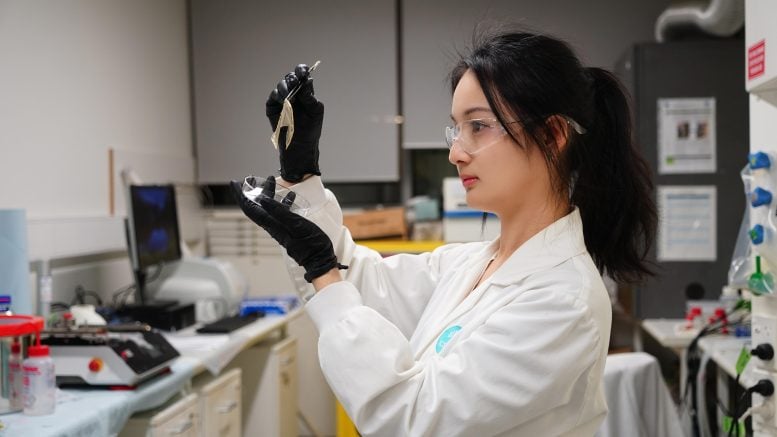
Wanqiao said a careful balance was crucial to making these batteries work for rooftop solar at home.
“This is the kind of battery you’d want in your garage,” Ms Liang said.
“It’s non-toxic, non-flammable, and made from abundant materials, all while keeping up with solar power on a sunny day.”
The team is now 3D printing prototype systems and testing them under real-world conditions.
“If the prototypes keep performing the way we expect, this could be on the market in a few years’ time,” Ms Liang said.
How flow batteries work
Dr Cara Doherty, a study co-author from the CSIRO, said flow batteries store energy in liquids rather than solid materials like those found in lithium-ion batteries, making them cheaper to manufacture, safer to operate, and easier to scale.
“Flow batteries work a bit like two fish tanks joined by a membrane barrier that allows ions to pass through, enabling energy storage and release,” Dr Doherty said.
“We’ve developed a new type of membrane inside the battery that guides the flow of materials better – kind of like adding lanes to a highway. That means faster charging, longer battery life, and better performance overall.”
In 2018, Monash installed a 1MWh redT energy (now known as Invinity energy) storage system – the largest behind-the-meter commercial setup in Australia and the first of its kind globally – as a core part of the microgrid at its Clayton campus. The Monash microgrid plays a central role in the University’s goal to become 100 per cent energy self-sufficient and is a key part of achieving Net Zero emissions by 2030.
Now, Monash is home to the next big leap in clean energy storage.
Reference: “Flow Battery with Remarkably Stable Performance at High Current Density: Development of A Nonfluorinated Separator with Concurrent Rejection and Conductivity” by Wanqiao Liang, Ehsan Ghasemiestahbanati, Nathan T. Eden, Durga Acharya, Cara M. Doherty, Mainak Majumder and Matthew R. Hill, 19 May 2025, Angewandte Chemie International Edition.
DOI: 10.1002/anie.202505383
Never miss a breakthrough: Join the SciTechDaily newsletter.