
Researchers from Japan have pioneered a novel, sustainable method for synthesizing functionalized gold nanoparticles (AuNPs) using microalgae. The work is published in the journal ACS Sustainable Chemistry & Engineering.
This “green” approach not only avoids the harsh chemicals used in conventional methods but also produces AuNPs that are more stable and less toxic to healthy cells. The breakthrough promises a more environmentally friendly and patient-friendly future for nanomedicine, including applications in photothermal cancer therapy, in alignment with the United Nations Sustainable Development Goals (SDGs).
Gold nanoparticles and cancer therapy
Gold nanoparticles are powerful tools in medicine, particularly for cancer treatment. In a technique called photothermal therapy, AuNPs are delivered to a tumor and heated with a laser.
The localized heat destroys cancer cells without harming surrounding tissue. However, traditional chemical synthesis of these nanoparticles is often costly, energy-intensive, and involves toxic substances, posing risks to both the environment and patient health. This has driven a search for safer, more sustainable production methods.
Microalgae as a sustainable solution
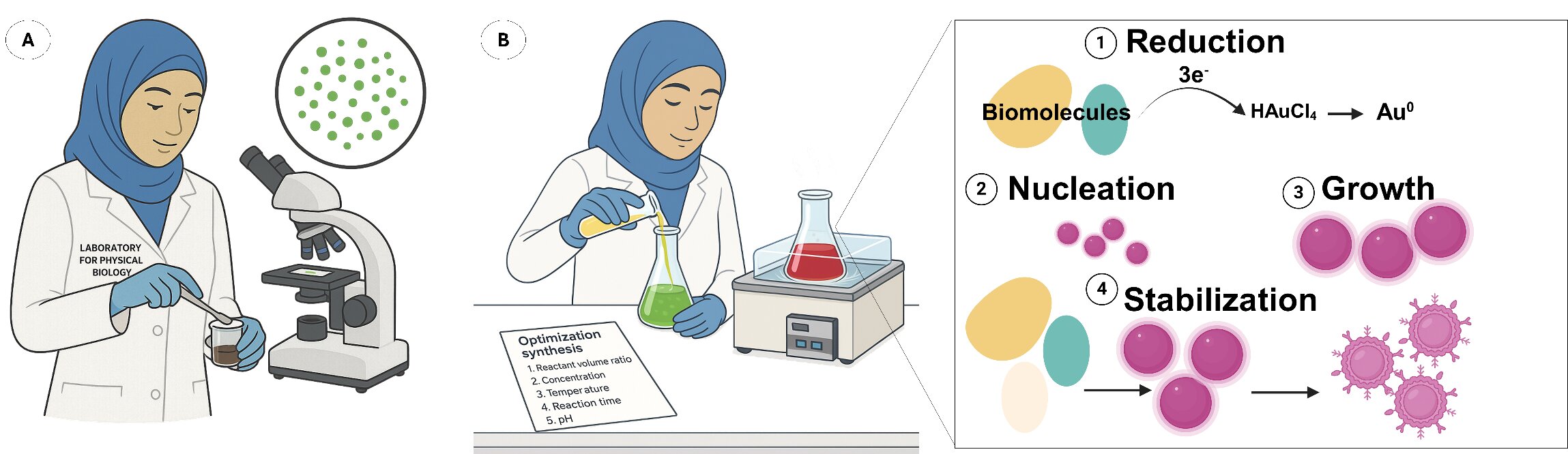
The research team successfully used microalgae as a biological factory to create AuNPs. The algae naturally produce compounds that reduce gold ions into stable nanoparticles, capping them with a protective organic layer. This biological process yields “Bio@AuNPs” which were compared against chemically synthesized “Chem@AuNPs.”
Characterization showed that the algae-mediated gold nanoparticles were highly effective at absorbing laser light and converting it to heat, successfully inducing the death of cancer cells.
Critically, the Bio@AuNPs demonstrated high biocompatibility, maintaining low cytotoxicity toward normal cells while exhibiting selective activity against cancer cells.
-

Characterization of algal-mediated gold nanoparticles (AuNPs). (A) Characterization of the AuNPs by, e.g., transmission electron microscopy (TEM), ultraviolet–visible spectroscopy (UV–Vis), and Fourier transform infrared spectroscopy (FTIR). (B) Algal corona-coated AuNPs (Bio@AuNPs) enhance colloidal stability, prevent aggregation, and improve biocompatibility compared with chemically synthesized AuNPs (Chem@AuNPs). Credit: ACS Sustainable Chemistry & Engineering (2025). DOI: 10.1021/acssuschemeng.5c07786
-

Photothermal effect: Gold nanoparticles (AuNPs) absorb laser light, release heat and reactive oxygen species, and induce cancer cell (HeLa cell) death. Credit: ACS Sustainable Chemistry & Engineering (2025). DOI: 10.1021/acssuschemeng.5c07786
Benefits and future directions
This work presents a dual benefit for society. First, it offers a sustainable and eco-friendly manufacturing process for a high-value medical material, reducing the chemical waste and environmental footprint of nanomedicine.
Second, the enhanced biocompatibility and stability of these “green” nanoparticles could lead to the development of safer and more effective cancer therapies with fewer side effects for patients. This opens the door to wider clinical use of photothermal therapy as a viable, patient-friendly treatment option.
“Our goal is to uncover how living organisms detect and respond to thermal fluctuations generated by the environment and their own biological processes at the cellular level,” says Professor Madoka Suzuki, senior author of the study.
“Our recent achievement in developing an eco-friendly, microalgae-based method to create heat-releasing gold nanoparticles provides a new tool to explore cellular thermoregulation and to advance sustainable nanomedical technologies.”
More information:
Reham Samir Hamida et al, Microalgae-Mediated Synthesis of Functionalized Gold Nanoparticles with High Photothermal Stability, ACS Sustainable Chemistry & Engineering (2025). DOI: 10.1021/acssuschemeng.5c07786
Citation:
Harnessing algae for a greener way to create functional gold nanoparticles (2025, November 11)
retrieved 11 November 2025
from https://phys.org/news/2025-11-harnessing-algae-greener-functional-gold.html
This document is subject to copyright. Apart from any fair dealing for the purpose of private study or research, no
part may be reproduced without the written permission. The content is provided for information purposes only.