
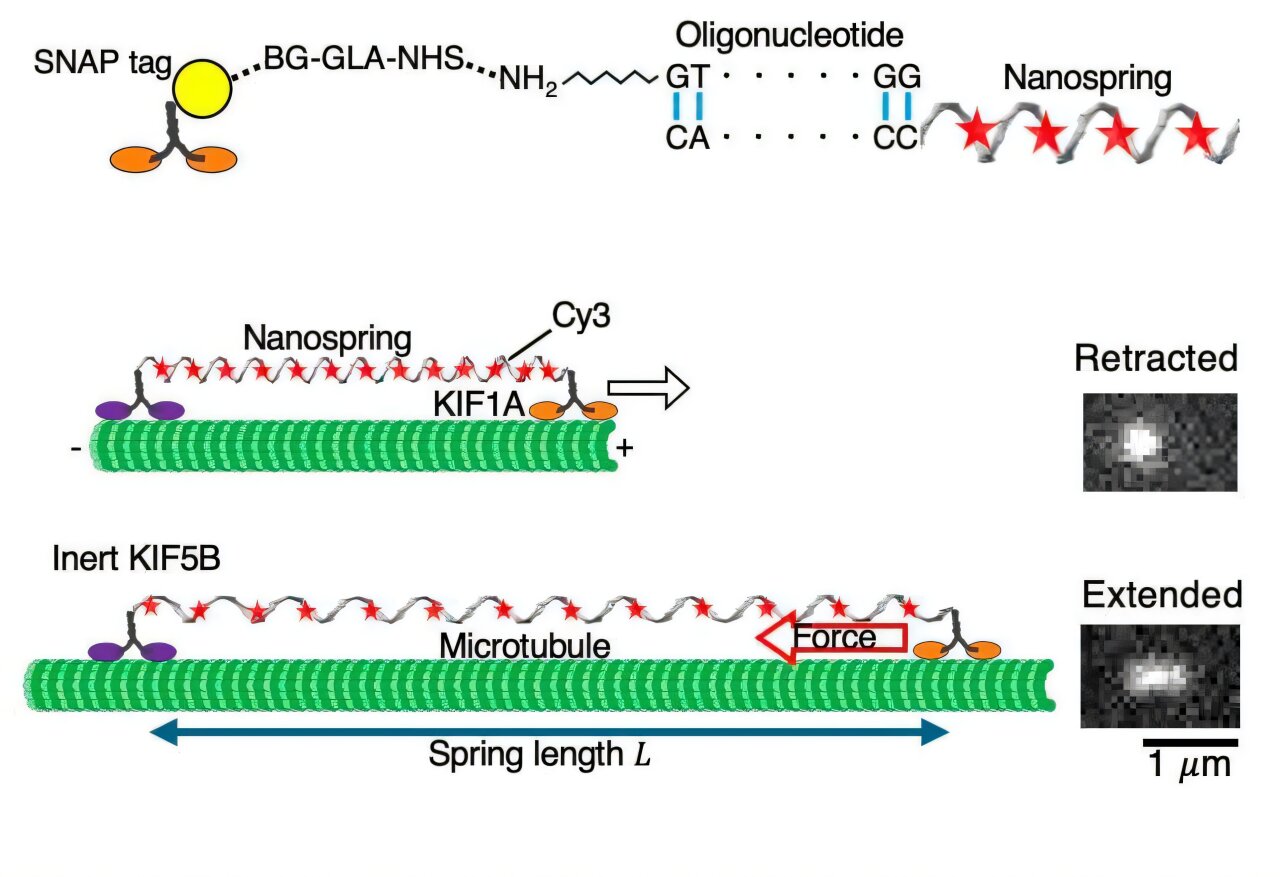
Cells all require the transport of materials to maintain their function. In nerve cells, a tiny motor made of protein called KIF1A is responsible for that. Mutations in this protein can lead to neurological disorders, including difficulties in walking, intellectual impairment and nerve degradation. It’s known that mutations in KIF1A also result in weakened motor performance, but this has been difficult to measure so far.
Researchers from the University of Tokyo and the National Institute of Information and Communications Technology (NICT) in Japan have now measured changes in the force of KIF1A using a nanospring, a tiny, coiled structure made of DNA, which could lead to improved diagnosis of diseases related to the protein’s mutations.
The work appears in eLife.
Neurological conditions such as KIF1A-associated neurological disorder (KAND) can be hugely detrimental to the lives of sufferers. So there is considerable effort put into research around them in terms of mitigating some of the symptoms. A key component of that is the initial diagnosis, as the sooner issues are caught, the sooner they can be addressed.
“KAND results from mutations in the motor protein KIF1A, and it’s been reported that some KIF1A mutants generate a motor force of less than 1 piconewton, compared to a healthy version’s 3.8 piconewtons. These forces are very hard to detect. Even a strong copy of KIF1A at 3.8 piconewtons only exerts a trillionth of the force needed to lift an apple,” said Professor Kumiko Hayashi from the Institute for Solid State Physics at the University of Tokyo.
“Previous studies attempted to use optical tweezers, based on lasers, but the signals these gave were unclear and test samples would often become detached. So, we sought a better alternative, and this led me to use a coil-shaped DNA nanospring, created by Senior Researcher Mitsuhiro Iwaki from NICT, the first of its kind.”
The name is basically self-explanatory: It’s a tiny coil only a few nanometers long, a billionth of the width of a human hair, made of DNA. It can be securely attached to both an immovable surface and to a KIF1A protein, and as you can imagine, its springlike nature means it extends depending on the force applied to it. The nanospring glows under a microscope to indicate its degree of stretching. So by carefully observing this fluorescence, Hayashi and her team were able to accurately measure how forcefully KIF1A was pulling on a DNA nanospring.
“After obtaining fluorescence images of the nanospring, it was necessary to estimate its length from the images, and we developed an estimation method to do so. Information science also proved to be important for single-molecule analysis,” said Hayashi.
The nanosprings are made using a process called DNA origami, where a long strand of DNA is folded using many shorter strands. Computer programs help design two and three-dimensional shapes at the nanoscale, and the DNA folds correctly on its own because the constituent molecules join in predictable ways. Thanks to its shape and flexibility, researchers can build tiny, spring-like structures that follow a blueprint with surprising accuracy.
Although the DNA nanospring is unlikely to lead to a treatment in itself, the fact it can aid in diagnosing KAND is a big step forward. Hayashi and her team are now developing high-throughput data analysis methods since there are more than 100 known KIF1A mutations, and they wish to build a database cataloging their force measurements.
“Since the biophysical properties of the motor protein are important for predicting disease severity, we aim to improve predictions of KAND severity by incorporating these data into AI-based models of protein performance,” said Hayashi.
More information:
Stall force measurement of the kinesin-3 motor KIF1A using a programmable DNA origami nanospring, eLife (2025). DOI: 10.7554/eLife.108477.1
Citation:
DNA nanospring that measures cellular motor power could yield improved disease diagnosis (2025, October 7)
retrieved 7 October 2025
from https://phys.org/news/2025-10-dna-nanospring-cellular-motor-power.html
This document is subject to copyright. Apart from any fair dealing for the purpose of private study or research, no
part may be reproduced without the written permission. The content is provided for information purposes only.