
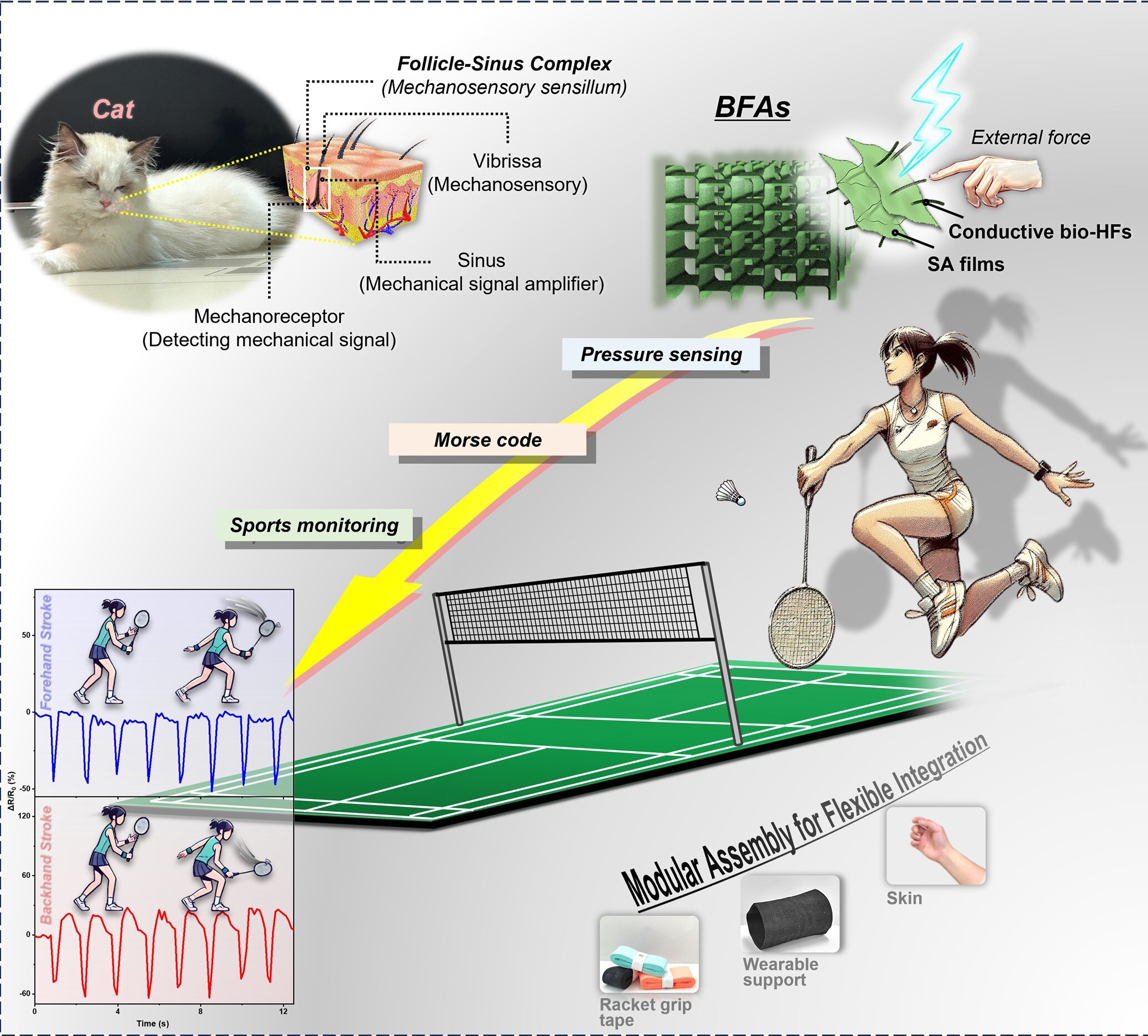
Flexible pressure sensors can detect subtle mechanical stimuli, making them suitable for use in wearable sensors for human health monitoring and motion analysis. However, current sensors suffer from insufficient sensitivity, poor durability, and subpar stability. In a new study, taking inspiration from cat whiskers, researchers developed novel biomass fiber/sodium alginate aerogel (BFA)-based sensors that demonstrated excellent pressure sensitivity, durability, and rapid response, while being suitable for human physiological monitoring and motion analysis.
The rapid development of wearable electronic sensors for use in health monitoring, motion analysis, and human-machine interaction applications has increased demand for flexible pressure sensors capable of detecting subtle mechanical stimuli. In particular, piezoresistive sensors have attracted considerable attention among researchers due to their simple structure, easy signal readout, and excellent integration capabilities. However, conventional designs suffer from poor adaptability to deformations and insufficient sensitivity during long-term use, compromising durability and stability.
Recently, carbon aerogels, including graphene, carbon nanotubes, biomass-based carbon, and MXene-aerogels, have emerged as promising alternatives owing to their ultralight weight, exceptional conductivity, and expansive specific surface areas. Biomass-based aerogels are especially promising due to their environmental friendliness, sustainability, and mechanical stability.
However, their fabrication relies on high-temperature, energy-intensive methods. Moreover, traditional post-treatment modifications can affect their long-term stability and sensitivity, while also limiting large-scale production.
To address these issues, a research team led by Associate Professor Chunhong Zhu from Shinshu University, Japan, developed innovative new cat whisker-inspired biomass fiber/sodium alginate aerogels (BFAs) for flexible pressure sensors.
“Cats, known for their exceptional agility and sensory acuity, rely highly on their well-developed sensory systems for spatial awareness,” explains Assoc. Prof. Zhu.
“Their whiskers, or vibrissae, are robust yet highly sensitive tactile detectors, deeply embedded within special structures called follicle-sinus complexes (FSCs), which amplify and convert weak mechanical signals into neural stimuli, allowing cats to detect even the smallest pressure variations in their environment. Our biomass fiber aerogels mimic both cat vibrissae and FSCs, yielding excellent sensitivity and stability.”
The team also included Dandan Xie, a Ph.D. student, also from Shinshu University. Their study was published online in the journal Advanced Functional Materials on July 23, 2025.
The researchers used long, high-strength, high-toughness, and environmentally friendly hemp microfibers (HFs) as the fiber matrix for BFA construction. The HFs were first subjected to in-situ polymerization with polyaniline, resulting in a uniform conductive coating, which enhanced durability and interfacial adhesion. The resulting polyaniline coated HFs (PHFs) were then integrated with sodium alginate, which served as the functional binder, through a freeze-synergistic assembly strategy to produce a highly porous and ultralight aerogel structure.
In this design, the PHFs mimic the role of cat vibrissae, capable of capturing and transmitting weak mechanical disturbances, while the porous cavity structure emulates the sinus cavities of the FSCs, acting as local buffer and amplification units. When an external mechanical signal is transmitted through the fibers, the porous cavity deforms, bending the PHFs. This deformation is transduced into detectable resistance changes and output signals.
In experiments, the BFA-based sensor demonstrated excellent fatigue resistance and dynamic response under varying load rates, a high sensitivity of 6.01 kPa-1, and a rapid response time of 255 milliseconds. Furthermore, the BFA-based sensor demonstrated promising applications in human physiological monitoring, effectively capturing carotid pulse signals and recognizing human motion patterns. In addition, this sensor enabled handwriting recognition and Morse-code-based information transmission.
Importantly, the researchers successfully employed the developed sensor in sports monitoring, where it accurately captured signal changes during different badminton serving techniques. This sensor can be incorporated into wearable accessories or even in racket grips, providing valuable data for player performance optimization and motion evaluation by measuring pressure variations.
“Our research offers a green, scalable solution for developing wearable pressure sensors, avoiding energy-intensive carbonization and or complex processing,” remarks Assoc. Prof. Zhu.
This bioinspired design marks a significant step towards development of eco-friendly and highly sensitive wearable sensors, with broad potential in sports analytics and biomedical monitoring.
More information:
Dandan Xie et al, Cat‐Vibrissa‐Inspired Biomass Fiber Aerogels for Flexible and Highly Sensitive Sensors in Monitoring Human Sport, Advanced Functional Materials (2025). DOI: 10.1002/adfm.202512177
Provided by
Shinshu University
Citation:
Cat whiskers inspire highly sensitive, next-generation wearable pressure sensors (2025, September 10)
retrieved 18 September 2025
from https://phys.org/news/2025-09-cat-whiskers-highly-sensitive-generation.html
This document is subject to copyright. Apart from any fair dealing for the purpose of private study or research, no
part may be reproduced without the written permission. The content is provided for information purposes only.