
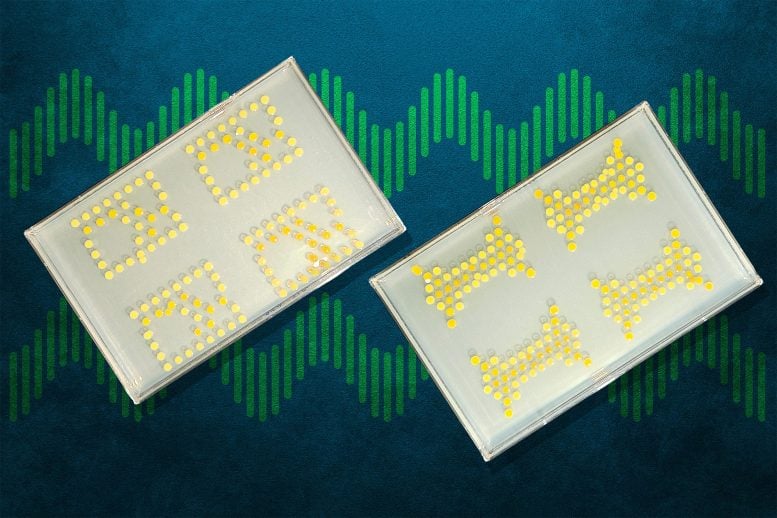
MIT researchers have engineered bacteria to behave like transistors, making it possible to build living “circuit boards” that can be printed onto growth material in a Petri dish.
In conventional electronics, transistors act as switches that control whether electrical current flows. In the biological system developed at MIT, engineered bacteria perform a similar role by regulating the movement of small signaling molecules that carry information to other parts of the circuit.
The team created two types of bacterial transistors and three additional bacterial strains that act as relays between them. Together, those five strains provide a flexible toolkit that can be arranged into many different circuit designs. In their new study, the researchers used the system to build circuits capable of combining two or three inputs, as well as directing an incoming signal to a selected destination within the circuit.
“We’ve built some initial computer architecture components that are commonly used, but any operation can be built with these five strains,” says Hamid Doosthosseini PhD ’25, an MIT postdoc and the lead author of the new study.
Living Circuits Could Be Added to Plants
The researchers ultimately hope to create biological circuits that could be placed on plant leaves or roots. Those circuits could process information about changing environmental conditions, including drought or attacks by pests, and then help trigger an appropriate response.
Christopher Voigt, head of MIT’s Department of Biological Engineering, is the senior author of the paper, which was recently published in Nature Chemical Biology. Former MIT postdoc Haorong Chen is also an author of the paper.
Turning Cells Into Biological Transistors
Synthetic biology circuits are usually built by engineering cells to produce proteins and transcription factors that interact in specific ways. A circuit might, for example, detect a target molecule and then activate the production of a particular output.
These systems can perform several kinds of logic operations, but they face important limitations. To prevent unwanted interactions within a circuit, researchers generally need different transcription factors for different functions. Because only a limited number of suitable transcription factors are available, there is a ceiling on how complicated a circuit can become inside one cell. Packing too many circuits into a single cell can also strain the machinery the cell uses to make proteins.

The MIT team approached the problem differently. Rather than placing an entire circuit inside one cell, they engineered individual cells to work as transistor-like components. Those cells can then be arranged in different combinations to build a wider range of circuits.
For the transistors, the researchers used a bacterium called Pantoea agglomerans, which commonly grows on surfaces, including plants. They engineered two forms of the bacterial transistor, both controlled by a molecule called OC-6. One is switched on by OC-6, while the other is switched off.
Each transistor can also detect another molecule, OC-12. Depending on whether OC-12 is present and whether the transistor is active, the cell produces a signaling molecule known as OHC-14.
Wiring Bacterial Colonies Together
The team also engineered three strains of Pantoea agglomerans to act as biological relays. These strains convert the OHC-14 signal into a new output that can then be passed to another transistor. In this way, the researchers can “wire” bacterial components together in a manner similar to the layout of an electronic circuit board.
One possible arrangement is a bidirectional switch. Two transistors can detect OC-12 and then route that information toward different relay strains depending on a separate switch input. The signal can then move into additional transistors that continue processing the information.
To build the circuits physically, the researchers printed bacterial colonies onto plates containing agar, a growth medium. Neighboring colonies were placed about 5 millimeters apart.
That spacing is important because it limits how far each chemical signal can travel. A signal reaches only the nearest colony, which can then pass information to the next component. This creates a controlled path that allows information to move through the circuit in one direction.
Bacterial Circuits Perform Logic Operations
The researchers showed that a single transistor could carry out several kinds of logic operations depending on where it was positioned in the circuit, including “multi-input,” “or,” and “imply” gates.
They also combined transistors into more advanced systems. These circuits were able to add two signals, process larger numbers of signals at the same time, and function as a demultiplexer. A demultiplexer takes one incoming signal and directs it toward one of several possible outputs depending on a control signal.
The largest circuit demonstrated in the study contained 24 connected bacterial colonies and was designed to add two inputs together.
“This work shows that we can get toward more complicated functions by linking up simpler functions in individual cells,” Voigt says. “Computationally, there’s nothing that your iPhone can do that these circuits couldn’t do.”
Slow Computing With a Biological Purpose
These living circuits are dramatically slower than electronic computers. Each calculation takes about eight hours to complete.
For the kinds of biological applications the team has in mind, however, that speed may be more than adequate.
“We’re not trying to replace computers, but rather put computational control into biology. If you have bacteria on the root of a plant, or the plant itself is doing the computing, running a simple calculation overnight is fast enough relative to a growth season,” Voigt says.
In agriculture, such circuits might eventually be placed on plant roots to detect different forms of stress. When a particular signal is detected, the circuit could trigger a biological response, such as producing a fungicide.
Reference: “Living circuit boards built by printing bacterial transistors” by Hamid Doosthosseini, Haorong Chen and Christopher A. Voigt, 17 August 2026, Nature Chemical Biology.
DOI: 10.1038/s41589-026-02300-3
The research was funded, in part, by the U.S. Defense Advanced Research Projects Agency and by the U.S. Intelligence Advanced Research Projects Activity.
Never miss a breakthrough: Join the SciTechDaily newsletter.
Follow us on Google and Google News.