
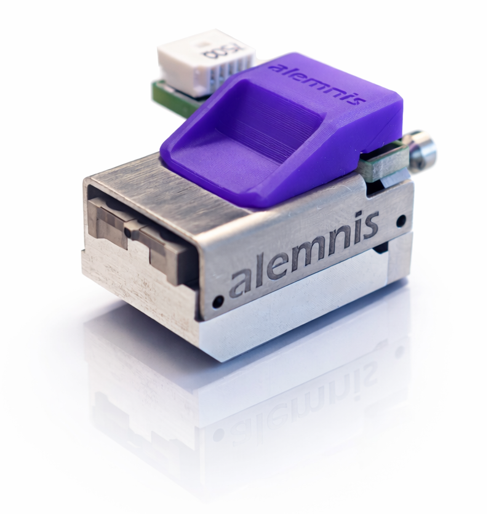
Alemnis AG has released the MLC-0.025, a new low-force load cell designed to extend high-precision mechanical testing into lower-force applications.
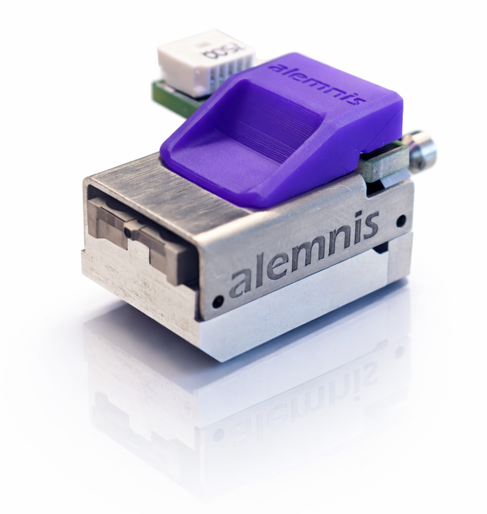
With a force range of 25 mN and a low noise level, the MLC-0.025 expands the testing capabilities of the Alemnis platform for applications where small forces and small material volumes need to be measured accurately. The new load cell is particularly suited to ultra-low-force nanoindentation and high-precision nanomechanical testing.
As research increasingly focuses on thin films, microstructures, soft materials, MEMS, and other small-scale material systems, accurately characterizing their mechanical response requires measurement capabilities adapted to correspondingly small forces and dimensions.
The MLC-0.025 was developed to address these requirements while providing greater sensitivity and flexibility for researchers working across a wide range of micro- and nanoscale applications.
Extending Mechanical Testing to Lower Forces
The MLC-0.025 provides researchers with a dedicated solution for experiments where precise measurement at low forces is essential.
Its 25 mN force range, combined with a low noise level, supports sensitive force measurements and helps researchers characterize small and delicate structures under low applied loads.
The load cell is well suited to applications including:
- Ultra-low-force nanoindentation
- Thin films and coatings
- MEMS and microstructures
- Soft and compliant materials
- Semiconductor structures
- Biomaterials
- Localized mechanical characterization
- Small-volume material testing
By extending the available force range while maintaining low-noise measurement performance, the MLC-0.025 enables researchers to investigate mechanical behavior at smaller scales with increased sensitivity.
Low-Noise Performance for Sensitive Measurements
At very low force levels, measurement noise can have a significant influence on the quality of experimental data. The low noise level of the MLC-0.025 is therefore particularly important for applications requiring sensitive detection of small changes in force.
This low-noise performance helps support reliable measurements when working with small material volumes, delicate structures, and low-force testing conditions.
Combined with its 25 mN force range, the MLC-0.025 provides a measurement solution designed for applications where both sensitivity and precise force control are important.
Exchangeable Tip Across Alemnis Load Cells
An important feature of the MLC-0.025 is its exchangeable tip design.
The tip is compatible with all Alemnis load cells up to 4 N, allowing users to use compatible tip configurations across different load-cell ranges.
This provides additional flexibility when an experimental program requires testing at different force levels. Researchers can move between very low-force measurements and higher-force experiments while maintaining a consistent and adaptable testing configuration.
The exchangeable tip design also helps simplify experimental setup and makes it easier to adapt the system to different materials, samples, and testing requirements.
Retrofit Capability for Existing Alemnis Systems
The MLC-0.025 can be retrofitted to the Alemnis standard system, allowing existing users to add low-force measurement capability to their current setup.
This gives laboratories a practical way to expand the range of experiments they can perform without replacing their complete testing platform.
By integrating the MLC-0.025 into an existing Alemnis system, researchers can extend their testing capabilities toward lower-force applications while continuing to use a familiar experimental setup.
Designed for Small Forces and Small Material Volumes
Mechanical characterization becomes increasingly challenging as the dimensions of materials and structures decrease.
Thin coatings, microfabricated devices, small structural features, and other localized material volumes may require much smaller applied forces to obtain meaningful mechanical information.
The MLC-0.025 extends Alemnis capabilities into this low-force regime, supporting researchers who need to characterize mechanical behavior at increasingly small length and force scales.
Its 25 mN force range and low noise level make it particularly suitable for applications where controlled loading and sensitive force measurement are important for investigating localized material response.
Greater Flexibility for Nanomechanical Research
With the MLC-0.025, Alemnis expands its load-cell portfolio with a solution developed specifically for demanding low-force applications.
The combination of a 25 mN force range, low noise level, an exchangeable tip compatible with all Alemnis load cells up to 4 N, and the ability to be retrofitted to the Alemnis standard system gives researchers greater flexibility in configuring experiments and extending the capabilities of existing Alemnis equipment.
From ultra-low-force nanoindentation to the characterization of thin films, microstructures, soft materials, and other small-volume material systems, the MLC-0.025 provides a new option for researchers working at the micro- and nanoscale.