
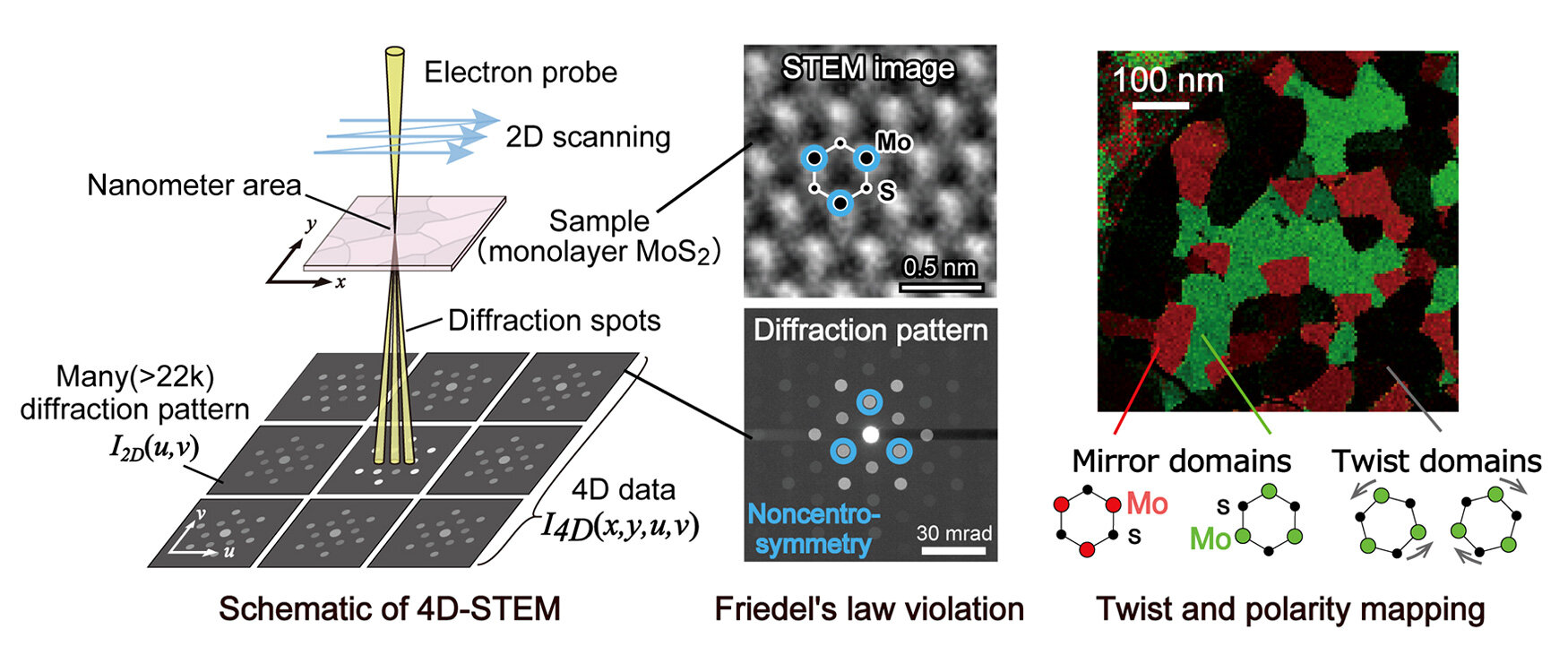
A research team led by NIMS has, for the first time, produced nanoscale images of two key features in an ultra-thin material: twist domains (areas where one atomic layer is slightly rotated relative to another) and polarities (differences in atomic orientation). The material, monolayer molybdenum disulfide (MoS₂), is regarded as a promising candidate for use in next-generation electronic devices.
This breakthrough was achieved by combining scanning transmission electron microscopy (STEM) with artificial intelligence (machine learning), allowing researchers to capture highly detailed nanoscale features over large areas. The research was published in Small Methods on August 6, 2025.
Monolayer molybdenum disulfide (MoS₂)—a two-dimensional material consisting of a single atomic layer with semiconductor properties—has attracted global attention as a promising candidate for use in next-generation electronic devices.
The performance of this material is influenced by its microstructural characteristics, including the presence of twist domains (areas where one atomic layer is slightly rotated relative to another) and polarities (differences in atomic orientation). It has been challenging to perform high-precision, large-area evaluation of MoS₂ microstructures using existing technologies.
New methods that can analyze these twist domains and polarities at the nanoscale are essential to speed up the development of breakthrough materials and practical devices.
The research team developed a technique capable of analyzing twist domains and polarities in monolayer MoS₂ at the nanoscale. They first used state-of-the-art electron microscopy (4D-STEM) to produce thousands of diffraction patterns and then applied machine learning to the analysis of the data.
Using this combined approach, the team collected over 20,000 diffraction patterns from MoS₂ samples grown using the same techniques employed in semiconductor manufacturing. The diffraction pattern data were then analyzed using unsupervised machine learning.
Through this process, the team was able to image twist domains and polarities with nanoscale resolution for the first time. This information will help researchers understand how different fabrication conditions affect the material’s microstructure and quantitatively identify regions that could influence its performance. Such insights can guide the optimization of growth processes and help uncover the causes of performance problems, thereby significantly contributing to the development of next-generation, high-performance electronic devices.
The new measurement technique can be used to study not only two-dimensional materials but also composites, potentially expediting the development of new materials and devices. The method can also be improved further by upgrading 4D-STEM performance, refining the machine learning algorithms used for data analysis and combining these advances.
With such improvements, the technique could give scientists in both industry and academia more powerful ways to evaluate materials. NIMS will continue working to advance research and development in computational metrology by combining cutting-edge measurement tools with approaches from information science.
More information:
Koji Kimoto et al, Unveiling Twist Domains in Monolayer MoS2 through 4D‐STEM and Unsupervised Machine Learning, Small Methods (2025). DOI: 10.1002/smtd.202501065
Citation:
High-precision analysis of 2D materials microstructures achieved using electron microscopy and machine learning (2025, November 13)
retrieved 13 November 2025
from https://phys.org/news/2025-11-high-precision-analysis-2d-materials.html
This document is subject to copyright. Apart from any fair dealing for the purpose of private study or research, no
part may be reproduced without the written permission. The content is provided for information purposes only.