
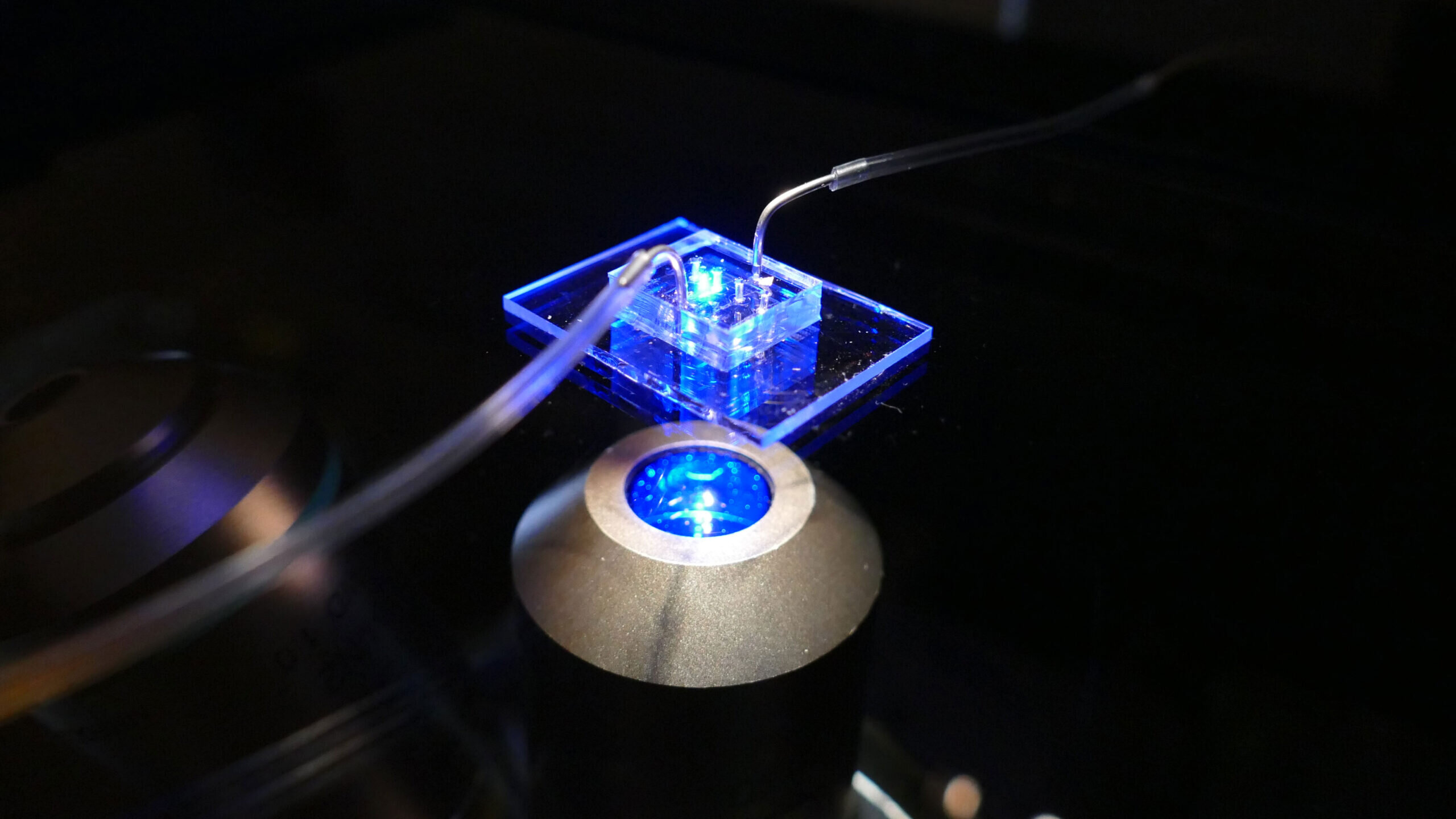
Cardiovascular disease continues to be the leading cause of death worldwide. But advances in heart-failure therapeutics have stalled, largely due to the difficulty of delivering treatments at the cellular level. Now, a UC Berkeley-led team of researchers may have solved this delivery bottleneck, potentially opening the door to novel, lifesaving treatments.
At the core of their new approach is a human cardiac microphysiological system (MPS)—also known as a heart-on-a-chip—that provides a miniaturized model of the human heart, complete with 3D micromuscles. Such devices consist of microfluidic channels, less than the width of a human hair, lined with living human cells. By controlling the fluid flow and other elements, researchers can mimic aspects of the heart’s physiology.
Using their heart-on-a-chip, researchers from UC Berkeley, the Gladstone Institutes and UCSF were able to discover a lipid nanoparticle that could penetrate the dense heart muscle and efficiently deliver its cargo of therapeutic messenger RNA (mRNA) into heart muscle cells, or cardiomyocytes.
Their findings are published in Nature Biomedical Engineering.
Lipid nanoparticles are tiny, spherical particles made of fats that encapsulate therapeutic agents. They are considered the most clinically advanced nonviral transport system for delivering mRNA in gene editing therapies and in vaccines, including the Pfizer-BioNTech and Moderna COVID-19 shots.
However, successfully delivering mRNA to cardiomyocytes hinges on something called endosomal escape, long seen as a challenge in this field. The endosome acts as a cell’s sorting station, and if the therapeutic agent gets stuck there, it will start to degrade. To be effective, the lipid nanoparticle must exit the endosome and enter the cell’s cytoplasm, where it can distribute its mRNA cargo for maximum therapeutic effect.
To tackle this problem, the researchers synthesized lipid nanoparticles with a novel acid-degradable polyethylene glycol coating, with the idea that it could easily diffuse through heart tissue and still leave the endosome. Using their heart-on-a-chip, they then tested different iterations to identify the most effective version for delivering the gene-editing therapy to cardiomyocytes. Later, they tested these same lipid nanoparticles on mouse hearts and recorded similar, positive results.
According to Kevin Healy, co-principal investigator of the study, the researchers’ organ-on-a-chip approach also could allow scientists to more accurately predict test results on live organisms and accelerate advances in mRNA cardiac therapies. The key, he said, is the model’s ability to replicate the complex 3D cellular environments of microtissues better than simple 2D models, which typically consist of a single layer of cells grown in a petri dish.
“Our framework enables faster, animal-sparing identification of effective lipid nanoparticles for safely delivering these therapies,” said Healy, professor of bioengineering and of materials science and engineering at UC Berkeley. “So, by using organ-on-a-chip models to predict heart-targeted delivery and safety, we can potentially accelerate programs for heart failure therapeutics, cardioprotective factors and gene correction, while reducing time and cost to translation.”
More information:
Gabriel Neiman et al, A microphysiological system for screening lipid nanoparticle−mRNA complexes predicts in vivo heart transfection efficacy, Nature Biomedical Engineering (2025). DOI: 10.1038/s41551-025-01523-4
Citation:
Lipid nanoparticles that can deliver mRNA directly into heart muscle cells discovered (2025, November 5)
retrieved 5 November 2025
from https://phys.org/news/2025-11-lipid-nanoparticles-mrna-heart-muscle.html
This document is subject to copyright. Apart from any fair dealing for the purpose of private study or research, no
part may be reproduced without the written permission. The content is provided for information purposes only.