
Close Menu
  • News
    • Medical
    • Nanomaterials
    • AI & Robotics
    • 2D Materials
    • Metamaterials
    • Nanoelectronics
    • ETF’s
    • Medicine
  • Environment
    • Earth.com
    • TreeHugger
    • Nanomuscle
  • Beauty
    • Makeupanalysis
What's Hot

Nanotechnology Plus Medicine Equal NanoMedicine

February 3, 2026

Improving PPE’s Antimicrobial Efficacy with ZnO Nanoparticles

December 5, 2025

PI Introduces Next-Generation 6-Axis Nanopositioning Alignment System

December 4, 2025
Facebook X (Twitter) Instagram
  • Contact Us
  • Privacy Policy
  • Terms & Conditions
Facebook X (Twitter) Instagram
Elnano – Global Innovative Nanotechnology SolutionsElnano – Global Innovative Nanotechnology Solutions
  • News
    • Medical
    • Nanomaterials
    • AI & Robotics
    • 2D Materials
    • Metamaterials
    • Nanoelectronics
    • ETF’s
    • Medicine
  • Environment
    • Earth.com
    • TreeHugger
    • Nanomuscle
  • Beauty
    • Makeupanalysis
Elnano – Global Innovative Nanotechnology SolutionsElnano – Global Innovative Nanotechnology Solutions
Home » Plasma strategy boosts antibacterial efficacy of silica-based materials
Nanotech

Plasma strategy boosts antibacterial efficacy of silica-based materials

November 5, 2025No Comments2 Mins Read
Share
Facebook Twitter LinkedIn Pinterest Email

by Sun Hongmei; Zhao Weiwei, Hefei Institutes of Physical Science, Chinese Academy of Sciences

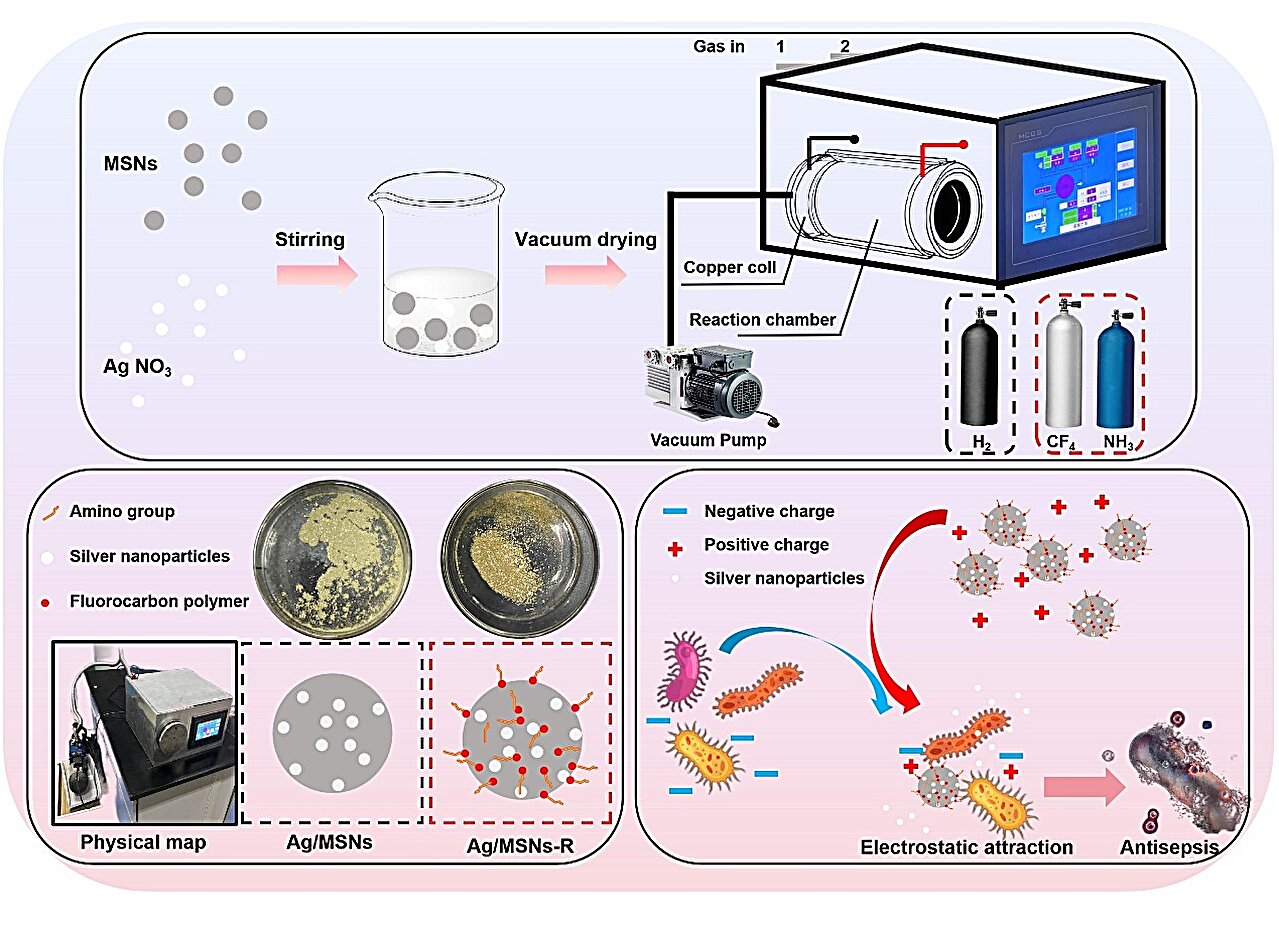
Schematic diagram of the preparation and antibacterial mechanism of Ag/SiO2-R. Credit: SUN Hongmei

Researchers Ni Guohua and Associate Researcher Sun Hongmei from the Institute of Plasma Physics, together with Associate Professor Wang Dong from Anhui Medical University, have developed a novel two-step plasma strategy to modify mesoporous silica-supported silver nanoparticles, enabling them to achieve strong antibacterial activity and accelerated wound healing.

Their findings were published in the Chemical Engineering Journal.

Mesoporous silica-supported silver nanoparticles (Ag/MSNs) show great potential for wound healing due to their strong antibacterial activity and low toxicity. However, their negatively charged surface repels bacteria, lowering antibacterial efficiency. Traditional ways to add positive amino groups often suffer from uneven distribution, poor stability, and complex procedures.

In this study, the team developed a two-step plasma strategy to create surface-functionalized silver/mesoporous silica composites (Ag/MSNs-R). In this method, silver nanoparticles were first deposited on MSNs through hydrogen plasma reduction. Then, a mixed plasma of CF₄ and NH₃ was applied to graft an amine-fluorocarbon polymer layer onto the surface.

As a result, silver nanoparticles with an average diameter of about 6.25 nm were uniformly distributed, and the modified materials acquired a positive surface charge, enhancing their interaction with bacterial membranes.

Laboratory tests showed that Ag/MSNs-R reduced bacterial viability by more than 98% against both Staphylococcus aureus (Gram-positive) and Escherichia coli (Gram-negative), achieving antibacterial effects several times stronger than unmodified Ag/MSNs.

Animal studies further confirmed that the modified materials effectively suppressed E. coli infections, alleviated inflammation, and promoted faster wound healing through the Arginase-1 signaling pathway.

See also  Nanoscale Ceramic Film Boosts High-Frequency Performance

This work not only provides a new approach for grafting functional groups onto silica, but also opens new possibilities for designing safer and more effective antibacterial materials for medical use.

More information:
Jingjing Zha et al, Plasma synthesis of amine-fluorocarbon polymer functionalized mesoporous silica-supported silver nanoparticles for enhanced antibacterial efficacy, Chemical Engineering Journal (2025). DOI: 10.1016/j.cej.2025.167038

Provided by
Hefei Institutes of Physical Science, Chinese Academy of Sciences

Citation:
Plasma strategy boosts antibacterial efficacy of silica-based materials (2025, November 5)
retrieved 5 November 2025
from https://phys.org/news/2025-11-plasma-strategy-boosts-antibacterial-efficacy.html

This document is subject to copyright. Apart from any fair dealing for the purpose of private study or research, no
part may be reproduced without the written permission. The content is provided for information purposes only.


Source link

antibacterial Boosts Efficacy materials Plasma silicabased strategy
Share. Facebook Twitter Pinterest LinkedIn Tumblr Email

Related Posts

Improving PPE’s Antimicrobial Efficacy with ZnO Nanoparticles

December 5, 2025

PI Introduces Next-Generation 6-Axis Nanopositioning Alignment System

December 4, 2025

H.E. Máté Pesti’s Visit to Cubic Sensor and Instrument Co.

December 2, 2025

Nanostars Amplify SERS Signal and Boost Sensing

December 1, 2025
Add A Comment

Comments are closed.

Top Posts

Revolutionary Nanoparticles Restore Brain Function in Mice

October 7, 2025

Ultrasensitive sensor maps magnetization textures in rhombohedral graphene

October 17, 2025

How AI’s “Perfect” Emails Can Backfire With Your Team

September 21, 2025

Subscribe to Updates

Get the latest sports news from SportsSite about soccer, football and tennis.

Explore the future with our Nanotech blog—covering innovations, research, applications, and breakthroughs shaping science, medicine, and modern technology.

We're social. Connect with us:

Facebook X (Twitter) Instagram YouTube
Top Insights

Nanotechnology Plus Medicine Equal NanoMedicine

February 3, 2026

Improving PPE’s Antimicrobial Efficacy with ZnO Nanoparticles

December 5, 2025

PI Introduces Next-Generation 6-Axis Nanopositioning Alignment System

December 4, 2025

Subscribe to Updates

Get the latest creative news from FooBar about art, design and business.

  • Contact Us
  • Privacy Policy
  • Terms & Conditions

© 2026 elnano.com - All rights reserved.

Type above and press Enter to search. Press Esc to cancel.