
LEDs, or light-emitting diodes, are essential components in near-eye displays like virtual reality and augmented reality headsets and smart glasses, along with electronics like cameras and medical equipment.
Conventional LEDs use direct current power, which requires two contacts, like the positive and negative contacts to connect a battery. As device form factors continue to shrink, fabricating nano-LEDs requires each of the hundreds of microscopic components to touch both contacts, which presents a complicated alignment problem for device manufacturers.
In Applied Physics Letters, researchers at Nanjing University used alternating current power to drive an LED device instead of DC power, significantly reducing the complexity of fabricating nanoscale LED devices.
“Using AC was absolutely essential for our design,” said author Tao Tao. “It allowed us to explore a new regime of LED behavior.”
In addition to simplifying the design by using AC power and only one contact, the researchers developed key improvements throughout the fabrication process and overall device performance.
“We aimed to prove a single-contact nano-LED driven by alternating current can work effectively, but we didn’t stop at a simple demonstration,” Tao said. “We not only built the device but also analyzed its electro-optical behavior and developed a model to explain the underlying mechanisms.”
By controlling the AC current frequency, the researchers tested how the device performs at the quantum level, where electrons turn into photons, and where electrical current is transformed into light.
“It’s just like tuning the dial on an AC power source, selecting the right frequency for the application,” Tao said. “For a near-eye display, for instance, you might choose a frequency high enough that any flicker is far above human vision range, but you also watch out for that saturation point where each cycle is too brief for photons to be generated.”
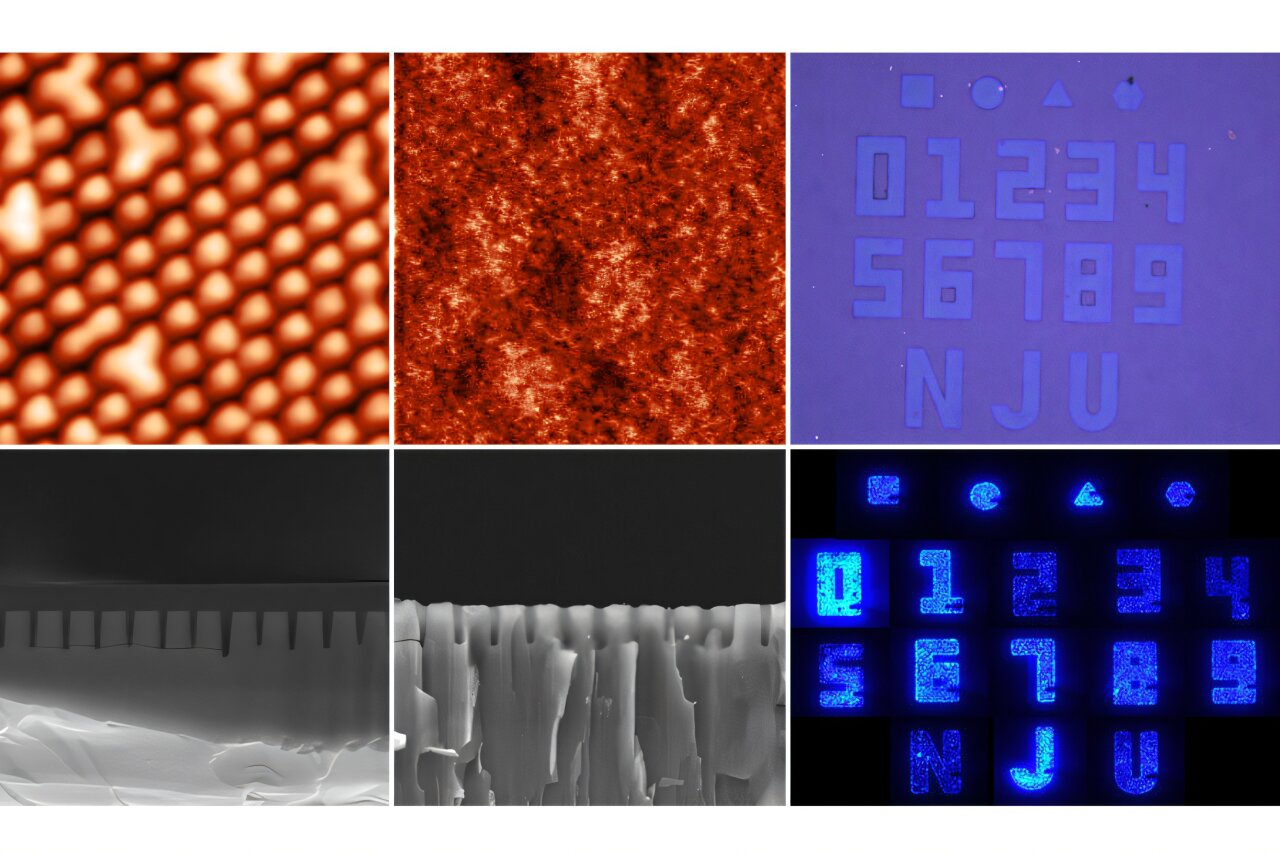
Their prototype was fabricated by layering semiconductor materials and using an etching process to create an array of 300-nanometer-thick nanorods on the surface. Smooth, uniform nanorods without rough edges or defects ensure that the device’s quantum efficiency, the translation of electrical power to light, is improved.
“This is where the nano size really is a game-changer—you can’t achieve the pixel densities required for next-gen AR glasses with traditional LED sizes,” Tao said.
While their analysis is especially relevant to near-eye displays, it also has applications for optical communications and biomedical devices.
“It’s both academic and applied research ahead,” Tao said. “The potential payoff is devices that are smaller, more efficient, and offer visual experiences that are a leap beyond what we have today.”
More information:
Investigation on fabrication and physical mechanisms of single-contact AC-driven nano-LED devices, Applied Physics Letters (2025). DOI: 10.1063/5.0292605
Citation:
AC instead of DC unlocks nano-LEDs for VR headsets and near-eye displays (2025, November 4)
retrieved 5 November 2025
from https://phys.org/news/2025-11-ac-dc-nano-vr-headsets.html
This document is subject to copyright. Apart from any fair dealing for the purpose of private study or research, no
part may be reproduced without the written permission. The content is provided for information purposes only.