
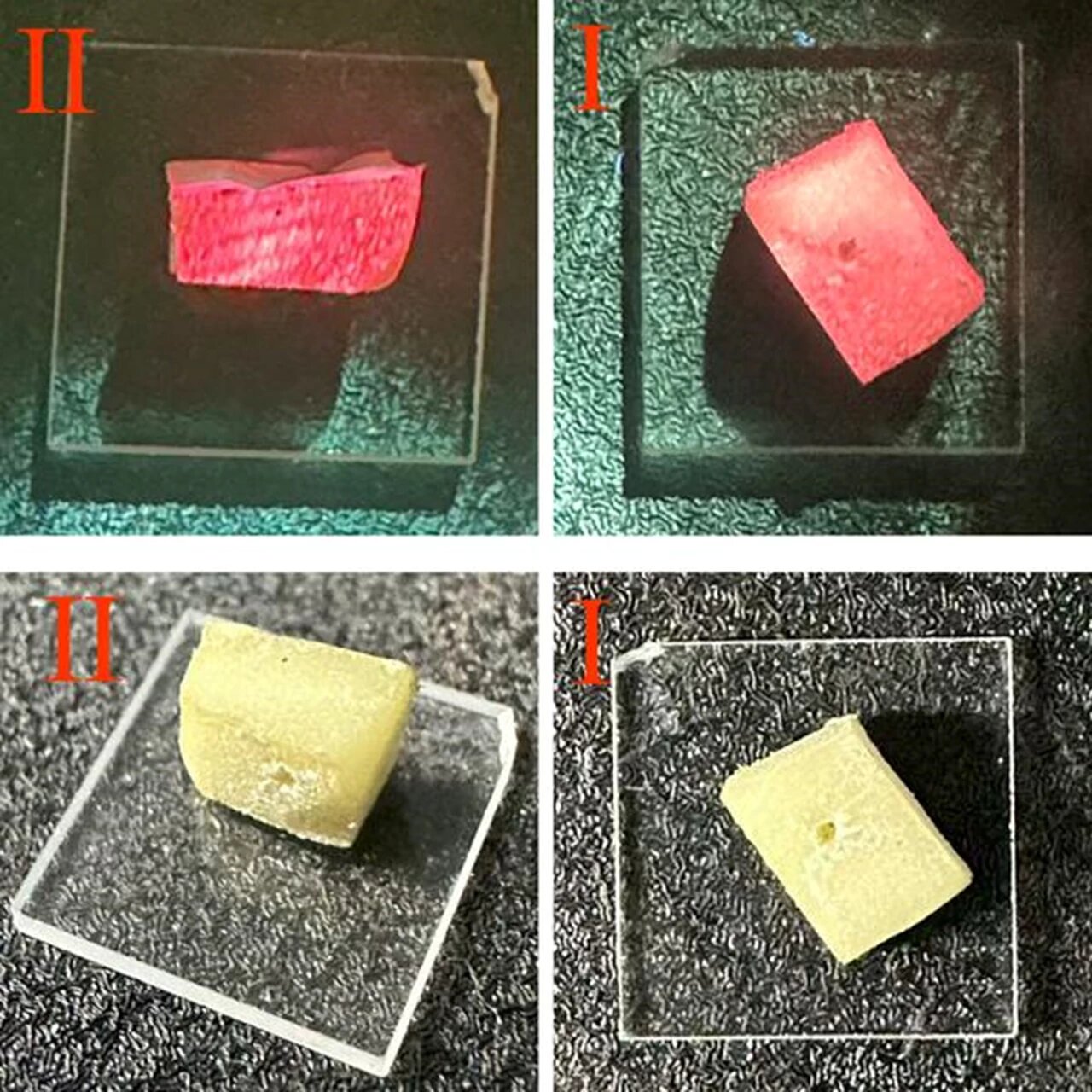
Physicists at Umeå University, in collaboration with researchers in China, have developed a laser made entirely from biomaterials—birch leaves and peanut kernels. The environmentally friendly laser could become an inexpensive and accessible tool for medical diagnostics and imaging.
The study has been published in the journal Nanophotonics and shows how a so-called random laser can be made entirely from biological materials.
“Our study shows that it is possible to create advanced optical technology in a simple way using only local, renewable materials,” says Jia Wang, Associate Professor at the Department of Physics, Umeå University, and one of the authors of the study.
A random laser is a type of laser in which light scatters many times inside a disordered material before emerging as a focused beam. It holds great promise for applications such as medical imaging and early disease detection, and has therefore attracted significant research attention. However, conventional random laser materials are often toxic, or expensive and complex to produce.
Carbon dots from birch leaves
Wang and her collaborators created their laser using two common natural materials: birch leaves and peanut kernels. They made nanometer-scale carbon dots from the birch leaves to serve as the gain medium and cut peanut kernels into small cubes whose rough and irregular surfaces help trap and scatter light.
Instead of relying on complex technology, the natural microstructure of the peanut kernel does the job on its own. The laser itself is still powered by an external light source, but the functional parts that scatter and amplify the light are made entirely from biomaterials.
“The synthesis of the carbon dots is simple and straightforward, essentially a one-step pressure-cooking process,” explains Wang. “Instead of relying on complex technology, the natural microstructure of the peanut kernel does the job on its own.”
Could be developed into an optical tag
The researchers tested how much energy was required to make the laser emit light, and the results showed that it performs just as well as artificially engineered lasers.
“The potential of this biomaterial-based random laser extends beyond bioimaging and diagnostics. Given its low cost, renewability, and safety, it could also be developed into an optical tag for authenticating high-value documents, luxury goods, and electronic devices,” says Wang.
Wang’s research group has long been working on harnessing local, renewable resources for new technologies. Two years ago, they published a study demonstrating how birch leaves collected on Umeå University’s campus can be used to produce organic semiconductors—materials found in thin TV and mobile phone displays.
About random lasers
Random lasers are promising for medical imaging and early disease diagnostics because they can produce intense yet diffuse light that penetrates tissue without causing damage. Unlike conventional lasers, which emit light in a narrow, directed beam, a random laser scatters light in many directions. This allows it to illuminate biological samples more evenly and provide detailed information about structures within the tissue.
A few earlier studies have reported biomaterial-based random lasers composed entirely of biological materials, such as abalone shells or coral skeletons combined with chlorophyll.
More information:
Zhihao Huang et al, Biomaterial-based random lasers achieved from peanut kernel doped with birch leaf–derived carbon dots, Nanophotonics (2025). DOI: 10.1515/nanoph-2025-0312
Citation:
Birch leaves and peanuts turned into advanced laser technology (2025, November 3)
retrieved 3 November 2025
from https://phys.org/news/2025-11-birch-peanuts-advanced-laser-technology.html
This document is subject to copyright. Apart from any fair dealing for the purpose of private study or research, no
part may be reproduced without the written permission. The content is provided for information purposes only.