
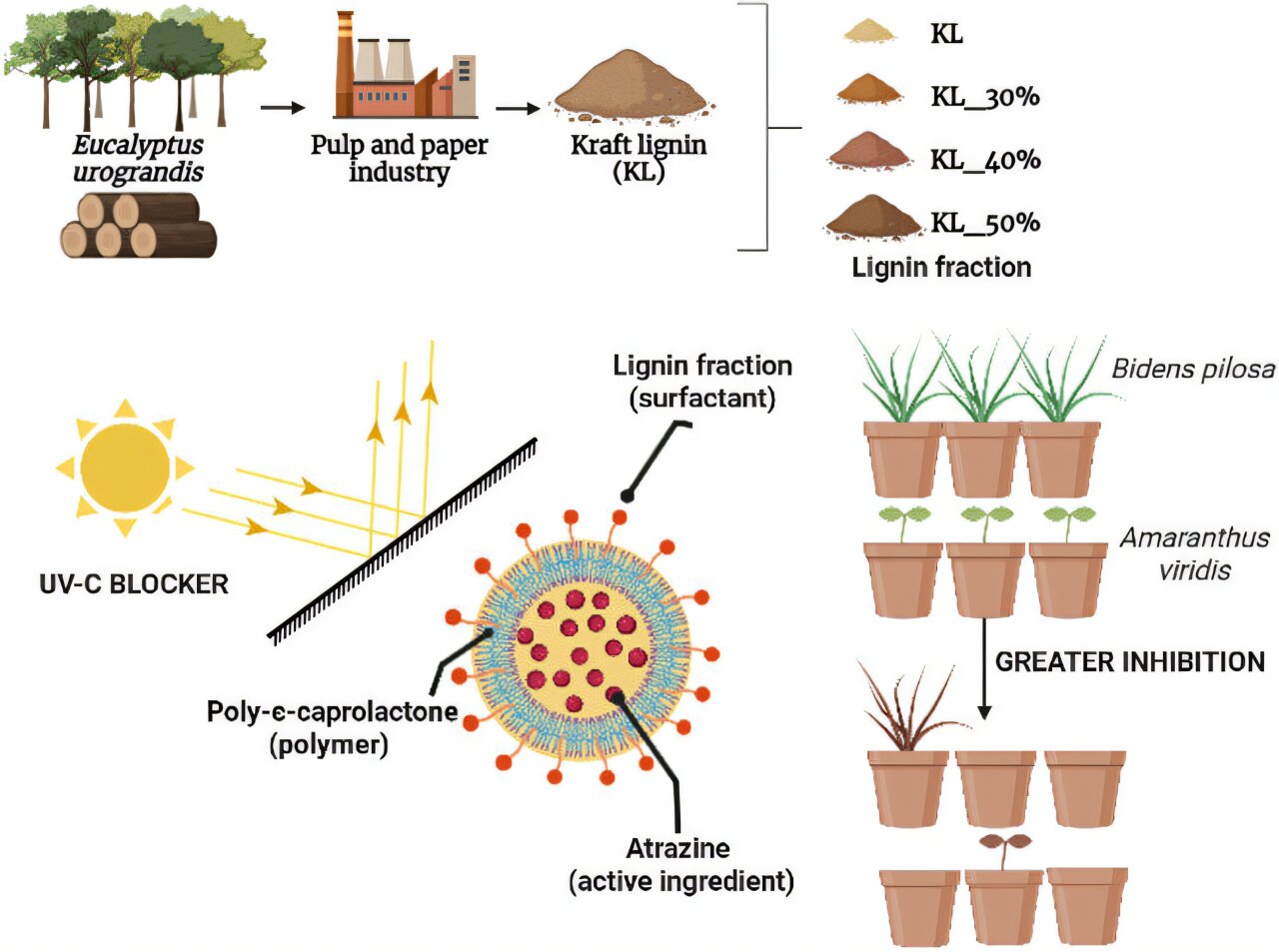
A recent study has shown that a fraction obtained from lignin, an organic polymer responsible for the rigidity of plant cell walls, was able to improve the performance of nanoparticles with herbicide.
The work is published in the journal ACS Sustainable Chemistry & Engineering and was recently featured on its cover.
The study was conducted by researchers from three research institutions in the state of São Paulo, Brazil: São Paulo State University (UNESP), the State University of Campinas (UNICAMP), and the Federal University of São Carlos (UFSCar).
“Lignin has antioxidant properties and is one of the main components of plant biomass, but it’s still underutilized and often treated as waste from the pulp and paper industry. That’s why our group sought more sustainable ways to add value to this abundant and renewable material,” says Leonardo Fraceto, a professor at the Institute of Science and Technology at UNESP, Sorocaba campus.
The substance was obtained from Eucalyptus urograndis, a hardwood tree, and was then subjected to a green process. This process used acetic acid as a solvent to obtain different fractions with distinct structural and chemical properties. Next, nanoparticles were produced using atrazine, an herbicide that combats weeds.
These nanoparticles underwent a series of physical, chemical, and thermal analyses to examine their structure and behavior.
“We found that the different lignin fractions have very distinct properties. Some are richer in phenolic groups. Others have a higher molar mass or promote greater thermal stability. These differences directly impact the formation and performance of the nanoparticles,” Fraceto explains.
Some fractions are more effective at protecting polymeric materials (composed of macromolecules, proteins, and cellulose, for example) from ultraviolet ray-induced degradation, while others act as stabilizers in substance release systems. These results demonstrate that lignin is not a single, uniform waste product, but rather a material that can be customized for different applications.
According to Fraceto, this finding is significant, because although using lignin as a surfactant is promising for the efficient distribution of active ingredients in agrochemical formulations, several challenges must be overcome. One major problem is the variability in its structure, which can affect its consistency and performance as a stabilizing agent.
In the case of atrazine nanoparticles, using the lignin fraction increased the stability and efficiency of herbicide release. Using specific lignin fractions was crucial to optimizing nanoparticle performance. The developed formulations effectively controlled black jack (Bidens pilosa L.) and green pigweed (Amaranthus viridis L.), demonstrating their potential for sustainable agricultural pest management.
“Not only were we able to use a simple, environmentally friendly process, but we also took advantage of an abundant byproduct in Brazil, opening up possibilities for the bioeconomy,” Fraceto explains. “This type of study connects materials science, sustainability, and technological innovation, bringing academia closer to solutions for current challenges, such as developing greener agricultural inputs.”
More information:
Jéssica de Souza Rodrigues et al, Lignin as a Dual-Function Stabilizer for Protecting PCL Nanoparticles from Photodegradation and Enhancing Atrazine Delivery, ACS Sustainable Chemistry & Engineering (2025). DOI: 10.1021/acssuschemeng.5c04472
Citation:
Lignin increases the stability and effectiveness of herbicide nanoparticles, study shows (2025, October 29)
retrieved 30 October 2025
from https://phys.org/news/2025-10-lignin-stability-effectiveness-herbicide-nanoparticles.html
This document is subject to copyright. Apart from any fair dealing for the purpose of private study or research, no
part may be reproduced without the written permission. The content is provided for information purposes only.