
Modern energy technologies are essential for meeting the growing global demand for electricity, driven by rapid industrialization and the global transition toward renewable energy. Among these technologies, rechargeable lithium-ion batteries (LIBs) play a crucial role, powering devices from portable electronics to electric vehicles.
To boost their performance and energy density, researchers increasingly rely on high-voltage cathode materials (>4.2 V vs. Li/Li+), which can deliver more energy per charge cycle. However, operating at such voltages poses challenges: lithium cobalt oxide (LiCoO₂, LCO) cathodes often suffer from structural degradation and the formation of undesired phases that hinder lithium-ion transport. Understanding these phase transformations at the cathode–electrolyte interface is therefore essential for developing longer-lasting, higher-performing LIBs.
To address this challenge, Professor Yoshifumi Oshima from the Japan Advanced Institute of Science and Technology (JAIST), together with Senior Lecturer Kohei Aso from JAIST, Dr. Takuya Masuda from the National Institute for Materials Science, Japan, and Professor Masaaki Hirayama from the Institute of Science Tokyo, developed a novel electron microscopy technique known as cepstral matching analysis (CMA).
As Prof. Oshima explains, “This method enables visualization of nanoscale structures with about 1 nm spatial resolution while causing minimal sample damage, a combination previously unattainable with conventional imaging.”
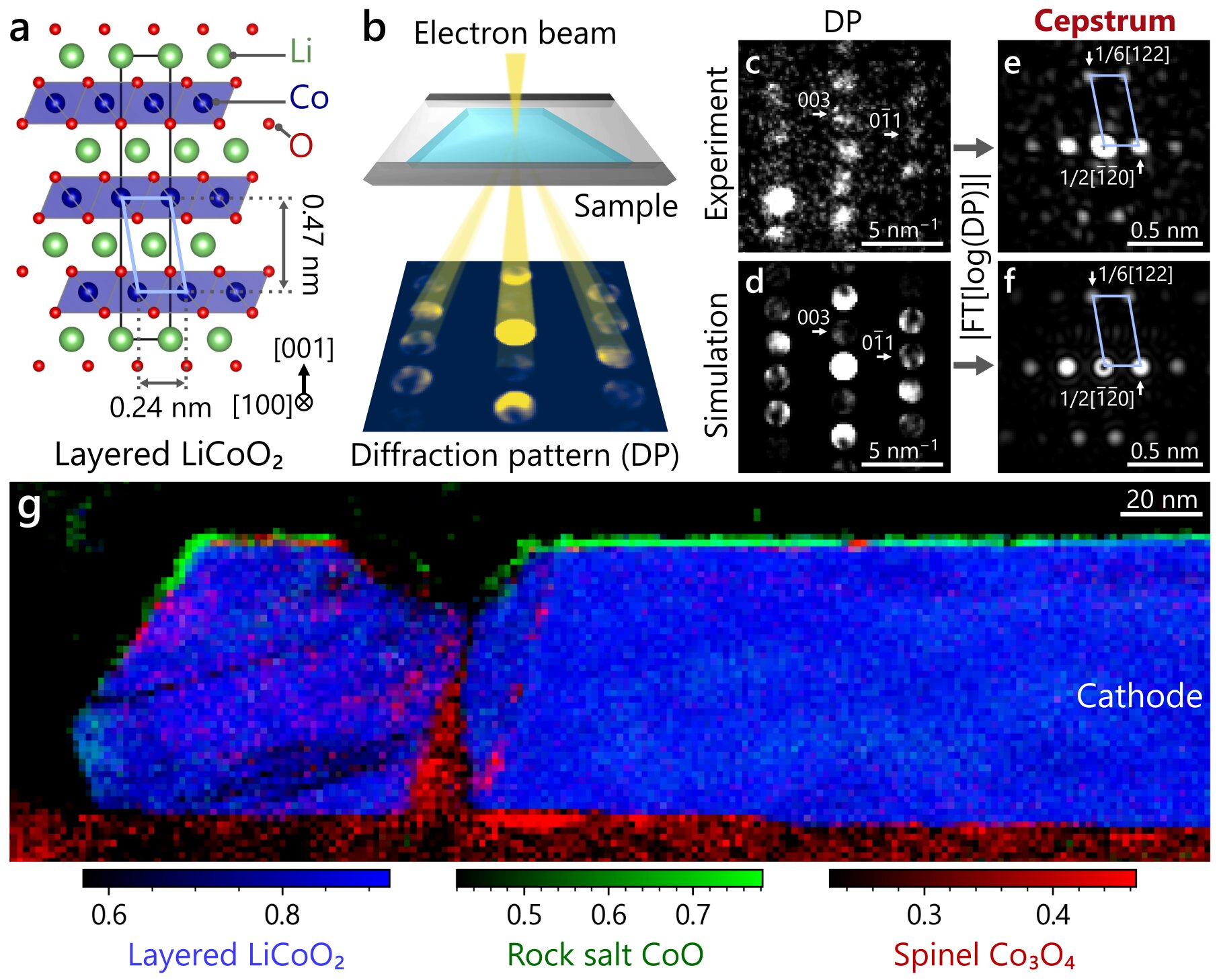
When applied to high-voltage-cycled LCO cathodes, CMA revealed that while the bulk largely retained its layered structure, spinel- and rocksalt-type phases emerged within the top about 3 nm of the electrolyte interface—structures known to contribute to degradation. This study was published in the journal Nano Letters on October 21, 2025.
The researchers combined scanning nanobeam electron diffraction (SNED) with CMA to capture structural information from the diffraction data under an ultralow electron dose (about 3 × 10³ e⁻ nm⁻²), nearly two orders of magnitude lower than that used in conventional methods. This approach reduced beam-induced damage while maintaining a high spatial resolution (about 1 nm).
Diffraction patterns collected across epitaxial LCO thin films—chosen for their uniform crystal orientation and minimal mechanical defects—were converted into cepstra and compared with simulated references for layered, spinel, and rocksalt phases. This process minimized artifacts caused by sample tilt, thickness variations, and bending, enabling accurate, low-damage mapping of nanoscale transformations.
CMA identified distinct LCO domains in the epitaxial films. The top 1–3 nm near the electrolyte interface exhibited phase transformations—roughly 1–2 nm of the cathode surface converted to rocksalt-type phases, with spinel-like contrasts appearing on certain facets. Although the bulk structure remained layered, these interfacial transformations hindered lithium-ion transport and contributed to capacity fade.
The SNED–CMA method demonstrated several key advantages. Its low electron dose preserved fragile battery materials. Cepstral transformation further corrected the effects of sample tilt and thickness, improving accuracy and reproducibility.
Beyond the immediate findings, Prof. Oshima highlights the method’s wider potential: “This technique can evaluate protective coatings and elemental doping strategies that suppress interfacial structural changes. It is also applicable to next-generation cathode materials, including nickel–manganese–cobalt layered oxides, lithium-rich layered oxides, and all-solid-state batteries, where nanoscale transformations critically impact performance.”
This study marks a significant step forward in low-damage, high-resolution imaging of interfacial phase transformations in energy materials. The insights gained can guide the design of lithium-ion batteries with longer lifespans and higher energy densities, supporting everyday applications such as longer-lasting smartphones and electric vehicles with extended ranges.
In addition, the approach holds promise for studying other devices that depend on ionic conduction and structural stability, including gas sensors, atomic switches, and fuel cells—bridging nanoscale materials science with next-generation energy technologies.
More information:
Kohei Aso et al, Low-Dose Nanoscale Visualization of Crystal Phases in Epitaxial Cathodes via Cepstral Matching of Scanning Nanobeam Electron Diffraction, Nano Letters (2025). DOI: 10.1021/acs.nanolett.5c03692
Citation:
Advanced electron microscopy reveals nanoscale crystal transformations causing lithium battery degradation (2025, October 28)
retrieved 28 October 2025
from https://phys.org/news/2025-10-advanced-electron-microscopy-reveals-nanoscale.html
This document is subject to copyright. Apart from any fair dealing for the purpose of private study or research, no
part may be reproduced without the written permission. The content is provided for information purposes only.