
The potential of using low-energy light to shape ferroelectric thin films for micro devices is advancing with an international team of researchers most recently reporting success with “photostriction.”
Light-induced nonthermal deformation of materials, or photostriction, has the advantage of directly converting photon energy into mechanical motion, offering exciting possibilities for wireless, light-powered sensors and optomechanical devices, says Flinders University researcher Dr. Pankaj Sharma.
Since its discovery in the 1960s, scientists have explored photostriction in a wide range of materials—from semiconductors and oxides to ferroelectrics and polymers. However, many of these systems face challenges.
“Conventional semiconductors show weak responses, lead-based materials raise environmental concerns, and some light-sensitive compounds are unstable,” says Flinders University senior lecturer in physics Dr. Pankaj Sharma, lead and corresponding author of a new article published in ACS Nano.
The paper is titled “Giant Photostriction and Optically Modulated Ferroelectricity in BiFeO3.”
“Ferroelectrics, the electrical analogs of magnets, show promise but are mostly limited to UV light, and epitaxial thin films grown on substrates are constrained by their supports,” he says.
Now, the research team has demonstrated major photostrictive effects under visible light in unconstrained thin films of BiFeO3—a multiferroic.
BiFeO3, or bismuth ferrite, is an inorganic compound with a perovskite structure that is a room-temperature multiferroic material, meaning it exhibits both ferroelectric and antiferromagnetic properties. Its ability to have its magnetic and electric properties controlled by external fields makes it a promising material for new electronic and spintronic devices, as well as for applications like photocatalysis and energy storage.
The new study shows that these nanostructured films, created through a low-cost, scalable spray-pyrolysis process, exhibit record-high light-driven strains using remarkably low optical power.
“Light can precisely control the internal structure and electronic responses of these films,” says Dr. Sharma, from the College of Science and Engineering at Flinders University. “This points to a future where micro-devices can be powered and actuated entirely by light.”
Dr. Haoze Zhang, postdoctoral fellow and first author of the study at Flinders University, adds, “These materials could form the foundation for light-controlled actuators, wireless sensors, and self-powered optomechanical systems.”
The key lies in unconstrained nanocrystalline BiFeO3 films, which feature a dense network of domain walls—atomically thin boundaries within the crystal.
“When illuminated, these walls efficiently separate photo-induced charge carriers, while the nanocrystals move more freely, generating strong electromechanical responses,” explains Dr. Zhang.
“The resulting photostriction is up to five times greater than bulk BiFeO3 crystals, rivaling advanced halide perovskites but without their stability or toxicity issues.”
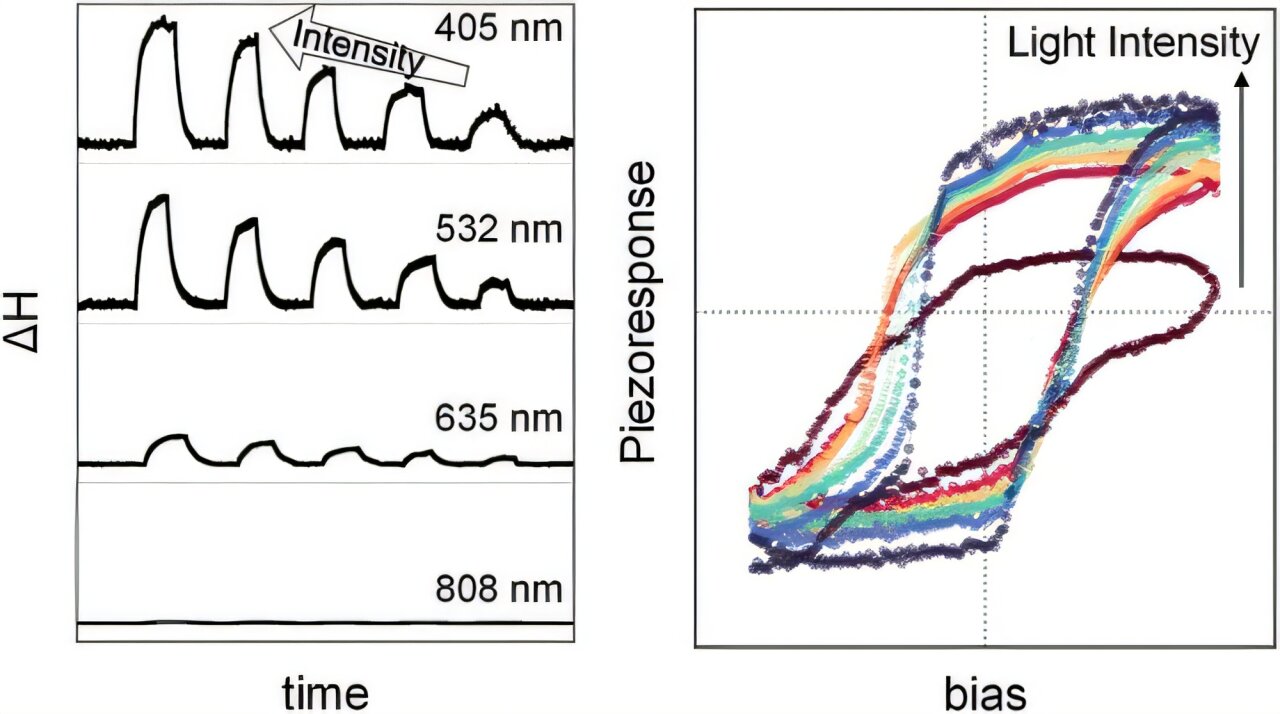
By tuning light wavelength and intensity, the team demonstrated fine control over piezoelectric and ferroelectric properties, establishing a versatile platform for energy-efficient, multifunctional nanoscale devices.
More information:
H. Zhang et al, Giant Photostriction and Optically Modulated Ferroelectricity in BiFeO3, ACS Nano (2025). DOI: 10.1021/acsnano.5c05203
Citation:
Light reshapes ferroelectric thin films for wireless sensors and micro-devices (2025, October 24)
retrieved 25 October 2025
from https://phys.org/news/2025-10-reshapes-ferroelectric-thin-wireless-sensors.html
This document is subject to copyright. Apart from any fair dealing for the purpose of private study or research, no
part may be reproduced without the written permission. The content is provided for information purposes only.